


As a QA engineer, I’ve spent countless hours running tests, logging defects, and communicating with developers. Over time, one truth became painfully clear: a failed test without evidence is almost useless. Screenshots, logs, HAR files, and execution videos are not just nice-to-haves—they are the backbone of trust, accountability, and efficiency in QA.
Early in my career, we relied on simple screenshots or handwritten notes to validate defects. It worked to some extent, but there were major limitations. Developers often struggled to reproduce issues, test results were questioned, and sign-offs dragged on. That’s when we realized that structured, rich test evidence could be a game-changer—not just for QA, but for the entire software delivery lifecycle.
The Challenge of Minimal Test Evidence
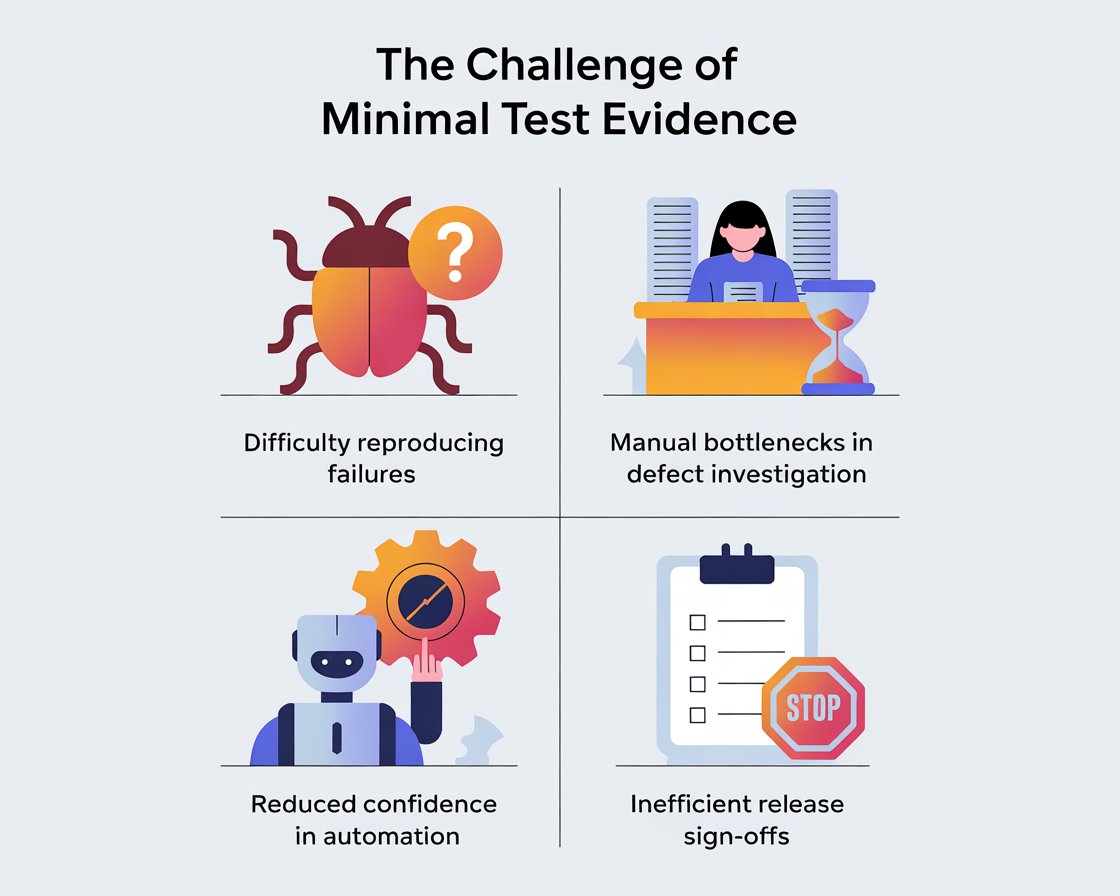
Before we invested in robust test evidence practices, our QA workflow faced several challenges:
1. Difficulty in Reproducing Failures
A simple screenshot often showed that something went wrong, but not why. Developers would spend hours trying to reproduce the issue, sometimes failing entirely because critical context was missing.
2. Manual Bottlenecks in Defect Investigation
Without proper evidence, QA had to explain failures in meetings or emails repeatedly. This slowed down defect resolution and frustrated both QA and development teams.
3. Reduced Confidence in Automation
Automated tests were valuable, but without rich evidence, stakeholders questioned their reliability. “Did the test really fail, or was it an environmental issue?” became a recurring concern.
4. Inefficient Release Sign-Offs
Manual sign-offs relied heavily on QA presenting evidence in meetings, compiling screenshots, and creating reports. This consumed hours of valuable time each release cycle.

Other Useful Guides: automation testing interview questions
Transforming QA with Test Evidence
We realized that improving test evidence was not just a technical improvement—it was a cultural shift. Test evidence became an integral part of how we communicated results, debugged issues, and built confidence in automation.
1. From Screenshots to Videos
Initially, screenshots were our primary source of evidence. While they showed the state of the UI at the moment of failure, they lacked context. By switching to test execution videos, we captured the entire flow leading to the failure.
- Developers could see every click, scroll, and data entry step.
- Flaky or intermittent failures were easier to analyze.
- The sequence of events was fully reproducible, reducing back-and-forth communication.
2. Capturing Network-Level Evidence with HAR Files
Some failures weren’t visible in the UI—they were caused by backend or network issues. By capturing HAR (HTTP Archive) files, we could record all network requests and responses during test execution.
- Developers gained visibility into API failures or delays.
- Environmental issues could be distinguished from actual defects.
- Complex workflows involving third-party services became easier to debug.
3. Centralized Evidence Management
We consolidated all test artifacts—screenshots, videos, HAR files, logs—into a centralized repository. This provided:
- Easy access for developers, QA, and stakeholders.
- Searchable and organized evidence for every test case.
- Historical records that helped identify patterns or recurring issues.
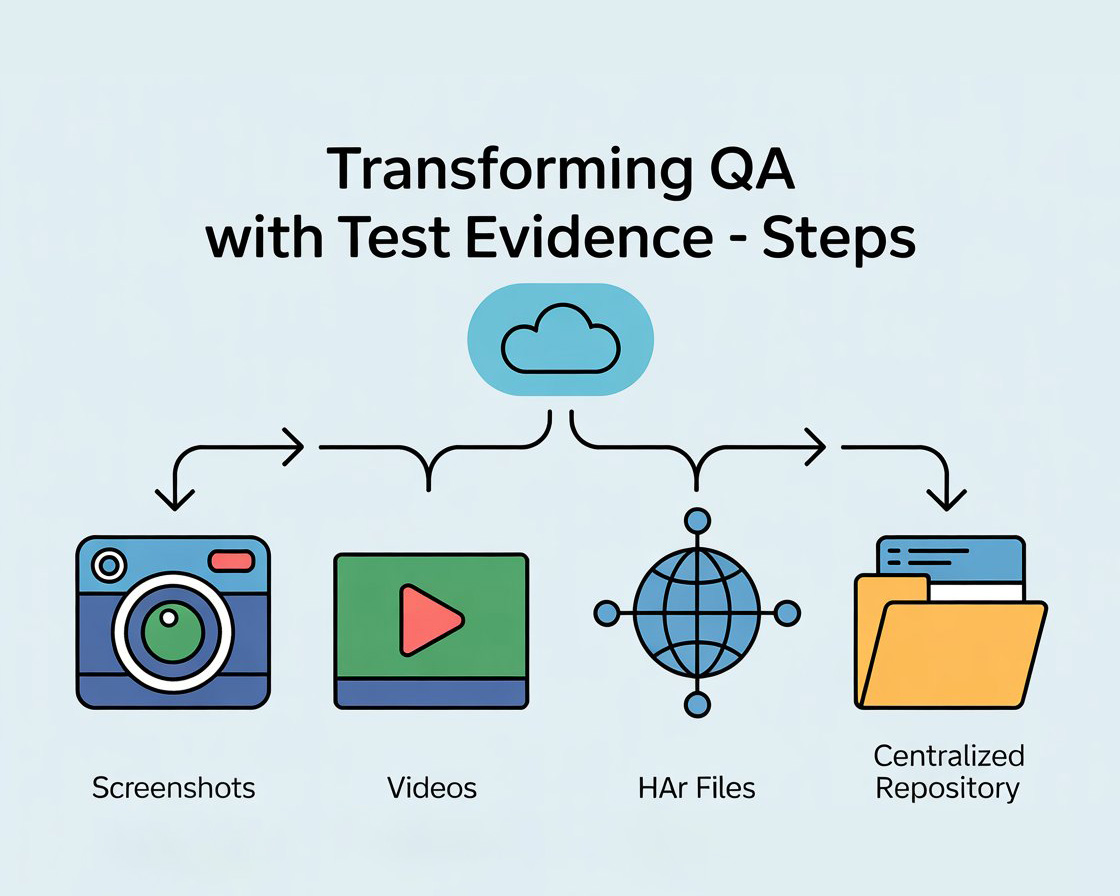
Centralization transformed evidence from scattered, hard-to-access files into a reliable source of truth.
Benefits of Rich Test Evidence
Investing in structured test evidence brought several tangible benefits:
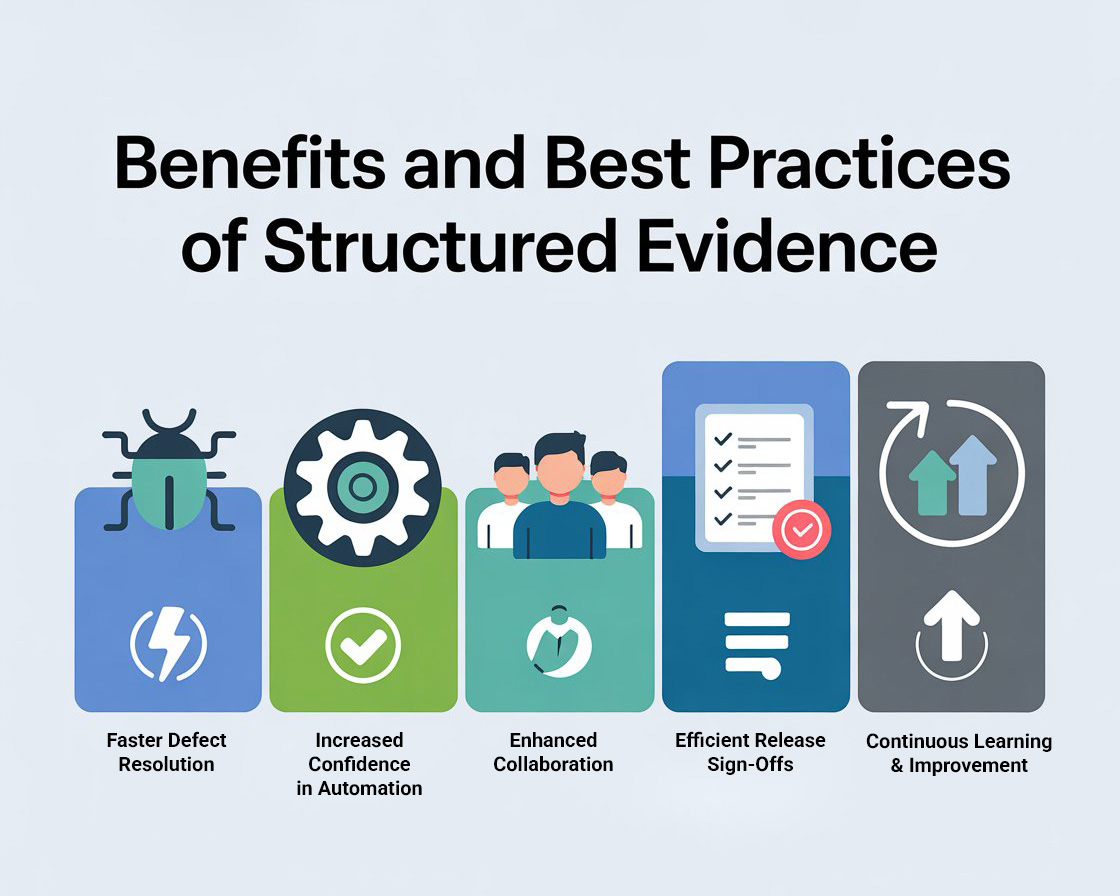
1. Faster Defect Resolution
With full videos, HAR files, and logs, developers could reproduce failures immediately. This drastically reduced the time spent investigating defects, accelerating the overall development cycle.
2. Increased Confidence in Automation
Automation became more trustworthy. Stakeholders could verify failures independently, without needing QA to interpret results manually. Green builds truly meant the software was stable.
3. Enhanced Collaboration
Clear, detailed evidence improved communication between QA and development teams. Misunderstandings were minimized, and teams could focus on solving problems rather than explaining them.
4. Efficient Release Sign-Offs
With centralized, comprehensive evidence, release sign-offs became faster and more confident. QA could present all required evidence automatically, eliminating hours of manual report compilation.
5. Continuous Learning and Improvement
Test evidence created a historical record of issues, helping teams identify recurring problems, flaky tests, or weak coverage areas. This enabled continuous improvement of both the application and the test suite.
Explore More: Manual testing interview questions
Best Practices for Test Evidence
From my experience, creating effective test evidence requires more than just recording videos. Here are some key practices:
1. Capture Context, Not Just State
Evidence should provide the full context of a test, including steps, data inputs, environment, and network interactions. This ensures that failures can be reproduced accurately.
2. Integrate Evidence with Automation
Automated tests should capture evidence as part of the execution. This eliminates manual effort and ensures every test run is fully documented.
3. Organize and Centralize
Store all artifacts in a central repository, organized by test case, environment, and execution timestamp. This simplifies retrieval and auditing.
4. Use Evidence for Learning
Analyze evidence to identify trends—flaky tests, frequent errors, or problematic workflows. Evidence isn’t just for debugging; it’s a tool for improving the entire QA process.
5. Secure Sensitive Data
Ensure that any captured evidence doesn’t expose sensitive user information, especially when dealing with production-like data or third-party integrations.


Real-World Impact
After implementing comprehensive test evidence strategies:
- The average defect resolution time decreased by over 50%.
- QA could validate complex workflows and third-party integrations more effectively.
- Stakeholders trusted automated test results, leading to faster release cycles.
- The QA team spent less time explaining failures and more time improving quality and coverage.
From my perspective, test evidence is more than a technical enhancement—it’s a strategic enabler for QA teams. It allows us to deliver reliable, actionable insights, ensures accountability, and strengthens collaboration across development, QA, and operations teams.
Conclusion
Test evidence is the real game-changer in modern QA. Screenshots, videos, HAR files, and centralized logs turn automated tests into powerful, reliable, and reproducible insights. They accelerate defect resolution, improve stakeholder confidence, and enable faster, more predictable releases.
From my experience, investing in robust test evidence isn’t optional—it’s essential. QA teams that leverage structured, comprehensive evidence not only find and fix defects faster but also gain influence as strategic partners in product development.
For any tester or SDET aiming to future-proof QA, the message is clear: don’t just run tests—capture the evidence, tell the story, and empower your team to act confidently on every result.
FAQs
Q1. What is test evidence in QA?
Test evidence is the set of artifacts captured during test execution—such as screenshots, videos, HAR files and logs—that show not just that a test failed, but how and why it failed. It turns raw pass/fail results into clear, actionable information for developers and stakeholders.
Q2. Why is test evidence important for QA teams?
Without solid evidence, failures are hard to reproduce, defects take longer to resolve and stakeholders may not trust automation results. Rich, structured evidence builds confidence, reduces back-and-forth, and makes QA a trusted source of truth in the release process.
Q3. What types of test evidence should we capture?
Strong test evidence usually includes execution videos, screenshots at key steps, HAR or network traces, and relevant logs. Together, these provide full context around the failure—from UI behaviour to backend responses—so teams can quickly pinpoint the root cause.
Q4. How does rich test evidence improve release sign-offs?
When every automated run automatically attaches videos, logs and network data to test results, QA can present clear proof for each critical flow. This speeds up sign-off meetings, reduces manual report preparation and gives stakeholders higher confidence in “green” builds.
Q5. What are best practices for managing test evidence?
Best practices include capturing full context (steps, data, environment), integrating evidence into automation runs, centralizing artifacts in a searchable repository, using them for trend analysis and ensuring sensitive data is masked or protected. Evidence should help both debugging and continuous improvement.
Q6. What real-world benefits can QA teams expect from better test evidence?
Teams that adopt robust evidence practices see faster defect resolution, stronger trust in automation, smoother collaboration with developers and more efficient, predictable releases. Over time, evidence also reveals recurring issues and flaky tests, helping improve both the app and the test suite.
We Also Provide Training In:
- Advanced Selenium Training
- Playwright Training
- Gen AI Training
- AWS Training
- REST API Training
- Full Stack Training
- Appium Training
- DevOps Training
- JMeter Performance Training
Author’s Bio:


Content Writer at Testleaf, specializing in SEO-driven content for test automation, software development, and cybersecurity. I turn complex technical topics into clear, engaging stories that educate, inspire, and drive digital transformation.
Ezhirkadhir Raja
Content Writer – Testleaf