
Generative AI is quietly becoming a “new teammate” in QA.
Not just for writing test cases faster—but for deciding what to test, what to ignore, how to interpret failures, and even what “good enough” looks like.
That’s why the ethical impact of generative AI in software testing isn’t a side conversation. It’s a product risk conversation.
If you work in testing, you already understand something many teams forget:
quality isn’t a feeling—quality is evidence.
Ethical AI is the same. It’s not a slogan. It’s not a policy PDF.
It’s a set of risks you can surface, measure, and reduce—using the same discipline we apply to reliability and security.
Below is a practical, evergreen view of the ethical impact of GenAI in software testing—and how to turn it into a trust advantage (for teams, customers, and regulators).
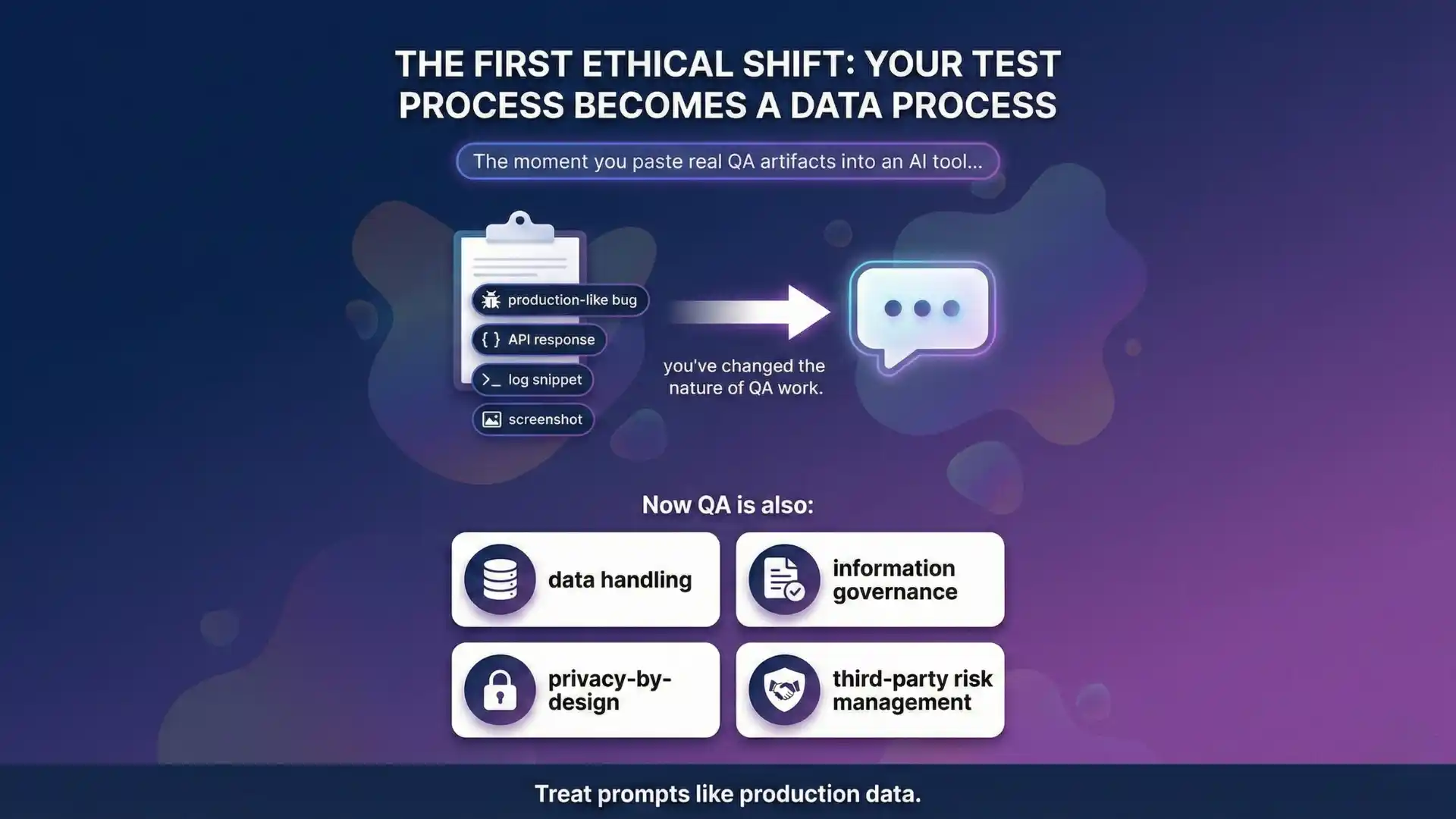
1) The first ethical shift: your test process becomes a data process
The moment you paste a production-like bug, an API response, a log snippet, or a screenshot into an AI tool, you’ve changed the nature of QA work.
Now QA is also:
- data handling
- information governance
- privacy-by-design
- third-party risk management

Why this matters: testing artifacts often contain secrets—tokens, emails, phone numbers, account IDs, addresses, financial fields, health data, internal URLs, even credentials in logs.
And the cost of getting this wrong is not theoretical. IBM’s Cost of a Data Breach Report 2024 puts the global average cost of a breach at USD 4.88 million.
Ethical impact: If GenAI increases the chance of data exposure—even “accidentally”—then speed gains can convert into risk debt.
What trust-building QA teams do:
- Treat prompts and outputs as data flows
- Apply data minimization: share only what’s required to solve the testing task
- Mask/obfuscate PII in logs and screenshots before sending anywhere
- Default to private deployments / enterprise controls when needed
Continue Reading: AI and ML engineer salary in india
2) “The AI wrote it” is not accountability
In testing, we know who owns quality: the team.
But GenAI can blur responsibility:
- Who is accountable for a wrong test that missed a defect?
- Who owns an AI-generated summary that influenced a release decision?
- Who signs off a compliance report drafted by a model?
NIST’s AI Risk Management Framework describes trustworthy AI characteristics like valid and reliable, safe, secure and resilient, accountable and transparent, explainable, privacy-enhanced, and fair (bias managed).
Notice what’s embedded in that list: accountability is not optional. It’s a core trust requirement.
Ethical impact: If you can’t explain why you accepted an AI output, you’ve weakened your evidence chain.
What trust-building QA teams do:
- Make AI outputs “assistive,” not authoritative
- Require human review for anything that affects:
- release readiness
- defect severity/priority
- compliance evidence
- security conclusions
- Maintain an audit trail: prompt → output → reviewer → decision
3) Hallucinations: ethics meets reliability
Testers care about false positives and false negatives.
Generative AI adds a third category: confident fiction.
The Stanford AI Index highlights a lack of standardization in how leading developers evaluate and report responsible AI behavior, which makes systematic comparison of risks harder.
That matters in QA because we often use GenAI for:
- “Summarize this failure”
- “Explain what went wrong”
- “Suggest the root cause”
- “Generate missing edge cases”
Ethical impact: A hallucinated root cause can waste days, mislead stakeholders, and (worse) justify shipping something unsafe.
What trust-building QA teams do:
- Treat GenAI outputs as hypotheses, not truths
- Force grounding: “Use only the provided logs; if insufficient, say so.”
- Cross-check with system evidence (traces, metrics, screenshots, HAR files)
- Maintain a “known incorrect” set of prompts to continuously test model behavior
4) Bias shows up in test coverage—quietly
Bias in testing isn’t always social bias. Sometimes it’s product bias:
- the model over-focuses on happy paths
- ignores accessibility cases
- under-generates edge cases for certain locales, devices, bandwidth constraints
- assumes default Western naming, addresses, currencies, and timezones
OECD AI Principles emphasize human-centred values and fairness, transparency, robustness/security/safety, and accountability—guidance that applies directly when AI helps decide test scope.
Ethical impact: If AI-generated coverage systematically excludes certain user groups or conditions, your product quality becomes unfair—without anyone intending it.
What trust-building QA teams do:
- Add bias checks to test design:
- representative datasets
- locale/region diversity
- device + network variability
- accessibility scenarios
- Make “who could this fail for?” a standard review question for AI-generated test suites
Recommended for You: automation testing interview questions
5) Security ethics: GenAI expands the attack surface inside QA
GenAI isn’t just a content generator—it’s a new interface to your systems.
OWASP’s Top 10 for LLM Applications includes risks like prompt injection and insecure output handling, which can lead to unauthorized actions and downstream exploits if outputs are trusted blindly.
QA teams are especially exposed because we handle:
- test environments with real integrations
- privileged test accounts
- scripts and pipelines
- logs and internal endpoints
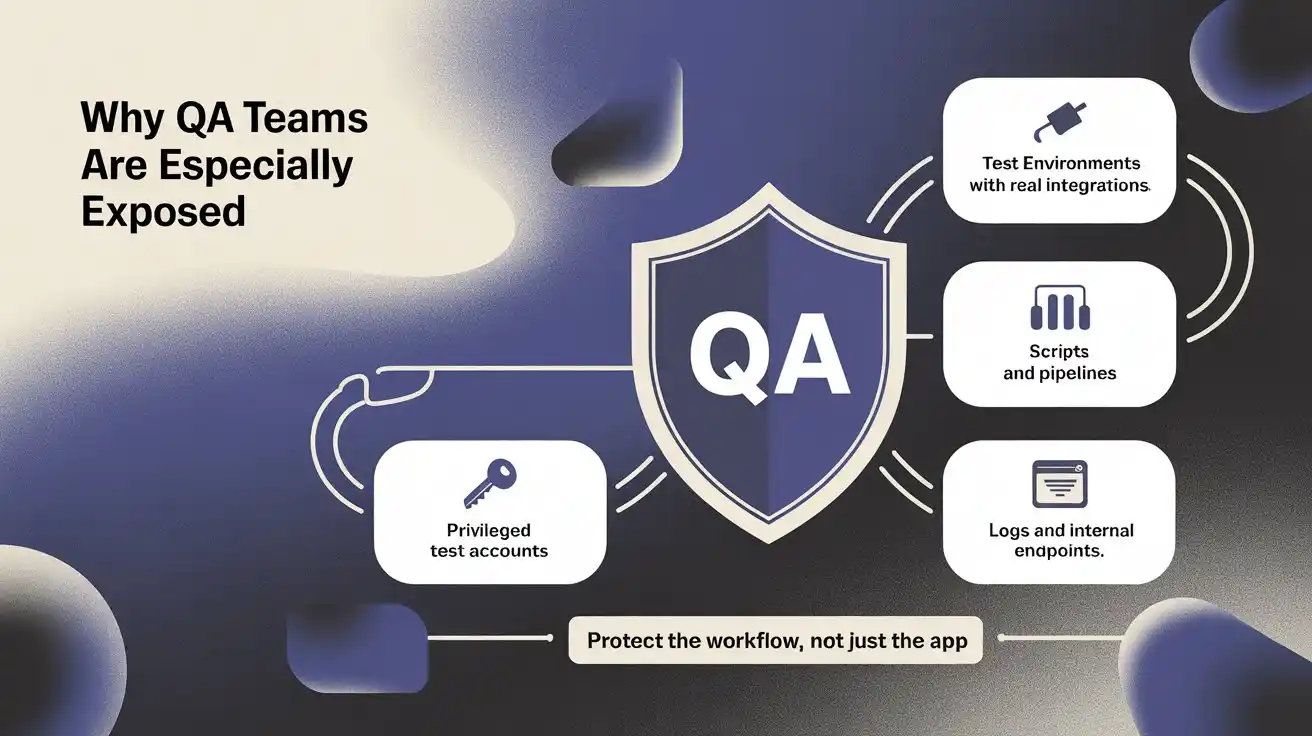

Ethical impact: If QA pipelines adopt GenAI without guardrails, we risk building “automation that can be manipulated.”
What trust-building QA teams do:
- Never execute AI-generated code blindly in CI/CD
- Sandboxed environments for generated scripts
- Strict secrets handling (no tokens in prompts)
- Secure SDLC alignment (GenAI becomes part of the SDLC)
A useful anchor here is NIST’s Secure Software Development Framework (SSDF): treat AI usage as a software supply chain component with defined practices, reviews, and controls.
6) Compliance pressure is increasing—and QA will feel it first
Even if you’re not building an “AI product,” you may be using AI inside your delivery process.
Regulations and standards are pushing toward transparency and governance (especially in high-impact domains). The EU’s AI Act policy page, for example, highlights transparency obligations and staged implementation timelines for different categories of AI systems.
Separately, ISO/IEC 42001 is emerging as a management-system standard for AI governance—risk assessment, lifecycle oversight, supplier control.
Ethical impact: Future audits won’t only ask “Is your product safe?”
They’ll ask “Can you prove your AI-assisted processes are controlled?”
What trust-building QA teams do:
- Document AI use cases inside testing:
- where it’s used
- what data is involved
- what decisions it influences
- what controls exist
- Maintain “evidence of oversight” as a first-class artifact
Additional Resources: manual testing interview questions
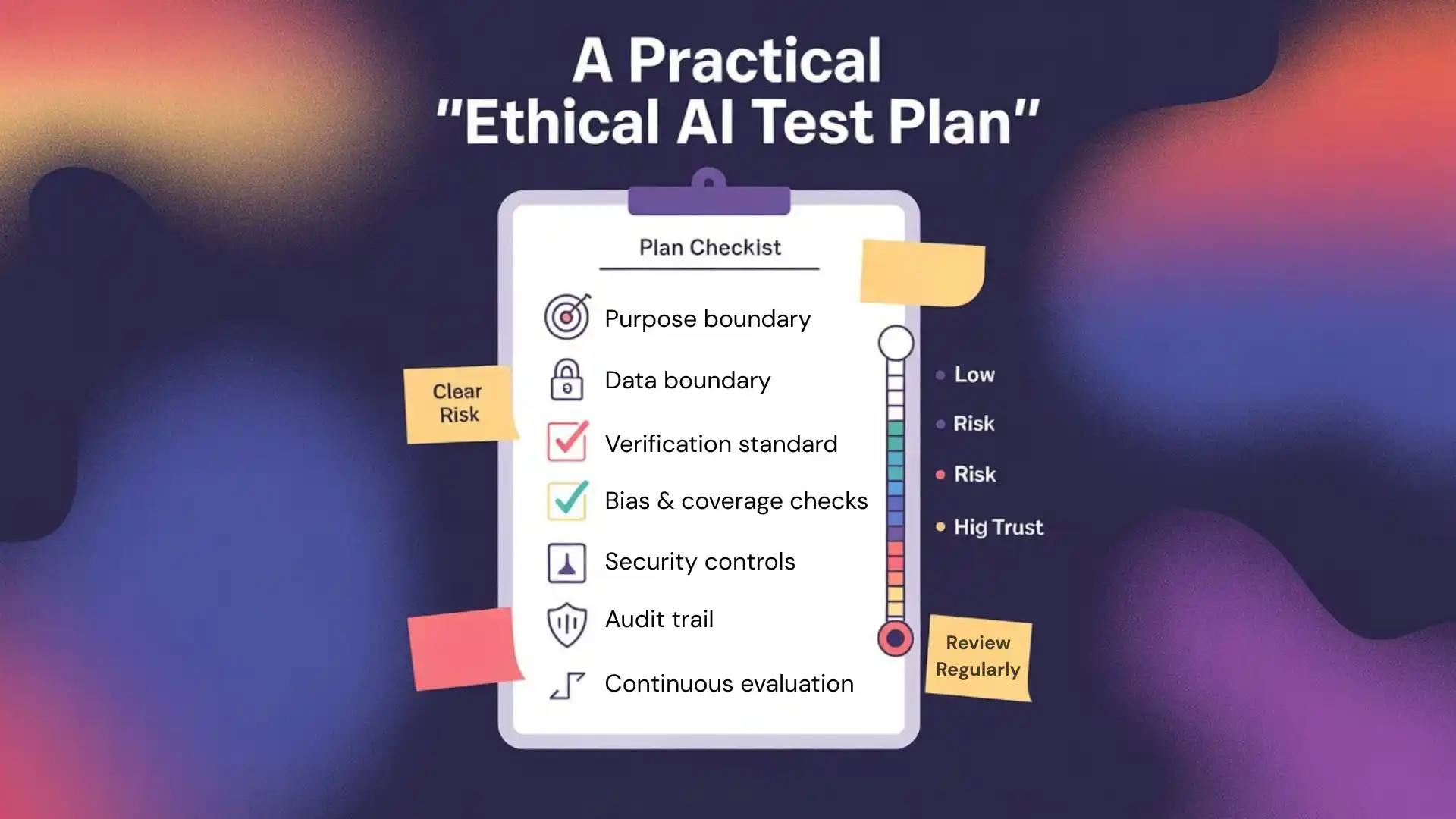
A practical “Ethical AI Test Plan” (the part most teams skip)
Here’s a simple, evergreen template we recommend adopting as a QA team whenever GenAI enters your workflow:
- Purpose boundary
- What tasks is AI allowed to do? (draft tests, summarize logs)
- What tasks is it NOT allowed to do? (approve releases, classify severity alone)
- Data boundary
- Allowed data types vs prohibited data types
- Masking rules
- Retention policy for prompts/outputs
- Verification standard
- What evidence is required to accept AI output?
- What are the “red flags” (overconfidence, missing citations, vague claims)?
- Bias & coverage checks
- Required scenario diversity (devices, locales, accessibility, edge cases)
- Security controls
- No secrets in prompts
- No direct execution of generated code in CI
- Prompt injection awareness for any AI-driven automation
- Audit trail
- Who reviewed? When? What changed because of AI?
- Store decisions like you store test results
- Continuous evaluation
- Track where AI helped vs harmed
- Create a regression suite for AI behavior (yes—like we do for software)
Where Testleaf stands (and why this builds trust)
At Testleaf, we look at ethical AI the way we look at quality engineering:
If it matters, we should be able to test it.
If we can’t test it, we shouldn’t trust it.
Ethics becomes practical when it turns into:
- measurable controls
- repeatable review habits
- evidence trails
- continuous risk reduction
GenAI will absolutely raise productivity in software testing.
But long-term trust will belong to teams who can answer these questions confidently:
- “What data did you expose, and how did you minimize it?”
- “Who is accountable for AI-assisted decisions?”
- “How do you prevent hallucinations from becoming release truth?”
- “How do you ensure coverage is fair and representative?”
- “What security risks did you test for?”
- “Can you prove oversight—not just claim it?”
If your QA team can answer those, you won’t just “use AI.”
You’ll lead responsibly—and that’s the kind of brand credibility that compounds over time.
FAQs
1) What is a software testing model?
A software testing model defines how testing is planned, executed, and aligned with development stages—so teams know what to test, when to test, and how to control defects.
2) What is the ethical impact of GenAI in software testing?
The ethical impact is about product risk: GenAI can influence what gets tested, what gets ignored, and how failures are interpreted—so teams must control data exposure, bias, hallucinations, and accountability.
3) Why does GenAI turn QA into a data-handling process?
Because prompts and outputs can include sensitive testing artifacts like logs, tokens, IDs, emails, screenshots, and internal URLs—so QA becomes information governance and privacy-by-design.
4) What data should QA teams avoid sharing with GenAI tools?
Avoid secrets and sensitive data such as tokens, credentials, personal data (PII), financial/health fields, internal endpoints, and production-like user identifiers unless properly masked and approved.
5) Can GenAI be responsible for release decisions?
No. GenAI should be assistive, not authoritative. Humans must review and own decisions that affect release readiness, severity, compliance evidence, or security conclusions.
6) What is a GenAI “hallucination” in QA?
A hallucination is confident but incorrect output (like a fake root cause). It can mislead teams, waste time, or justify shipping risk—so outputs must be treated as hypotheses and verified with evidence.
7) How do you reduce hallucinations in AI-assisted debugging?
Force grounding (“use only the provided logs”), cross-check with traces/metrics/screenshots, and maintain “known incorrect” prompts to continuously test model behavior.
8) How can GenAI introduce bias into testing?
It can skew coverage toward happy paths, miss accessibility, under-test certain locales/devices/network conditions, and assume defaults—so teams should review AI-generated coverage for diversity.
We Also Provide Training In:
- Advanced Selenium Training
- Playwright Training
- Gen AI Training
- AWS Training
- REST API Training
- Full Stack Training
- Appium Training
- DevOps Training
- JMeter Performance Training
Author’s Bio:


Content Writer at Testleaf, specializing in SEO-driven content for test automation, software development, and cybersecurity. I turn complex technical topics into clear, engaging stories that educate, inspire, and drive digital transformation.
Ezhirkadhir Raja
Content Writer – Testleaf