
AI is everywhere in software development today — from code generation to deployment pipelines.
But in testing, the conversation is often oversimplified.
Most blogs list “top AI tools” as if adopting them automatically improves quality.
In reality, many QA teams discover the opposite:
more tools, more noise, and sometimes… less trust.
So instead of another list, let’s answer a more important question:
Which AI tools actually improve functional testing — and under what conditions?
What are AI testing tools for functional testing?
AI testing tools for functional testing are platforms that use machine learning and automation to improve test creation, execution, stability, and validation, helping QA teams build faster and more reliable testing systems.
The Reality: AI Is Changing Testing — But Not Replacing Thinking
Modern applications are:
- Faster to build
- More dynamic
- Constantly evolving
According to multiple industry reports (including insights from Capgemini and World Quality Report trends), teams are struggling less with writing tests and more with:
- Maintaining stability
- Reducing flakiness
- Scaling automation across CI/CD
AI is stepping in to address these challenges.
But tools alone don’t solve them.


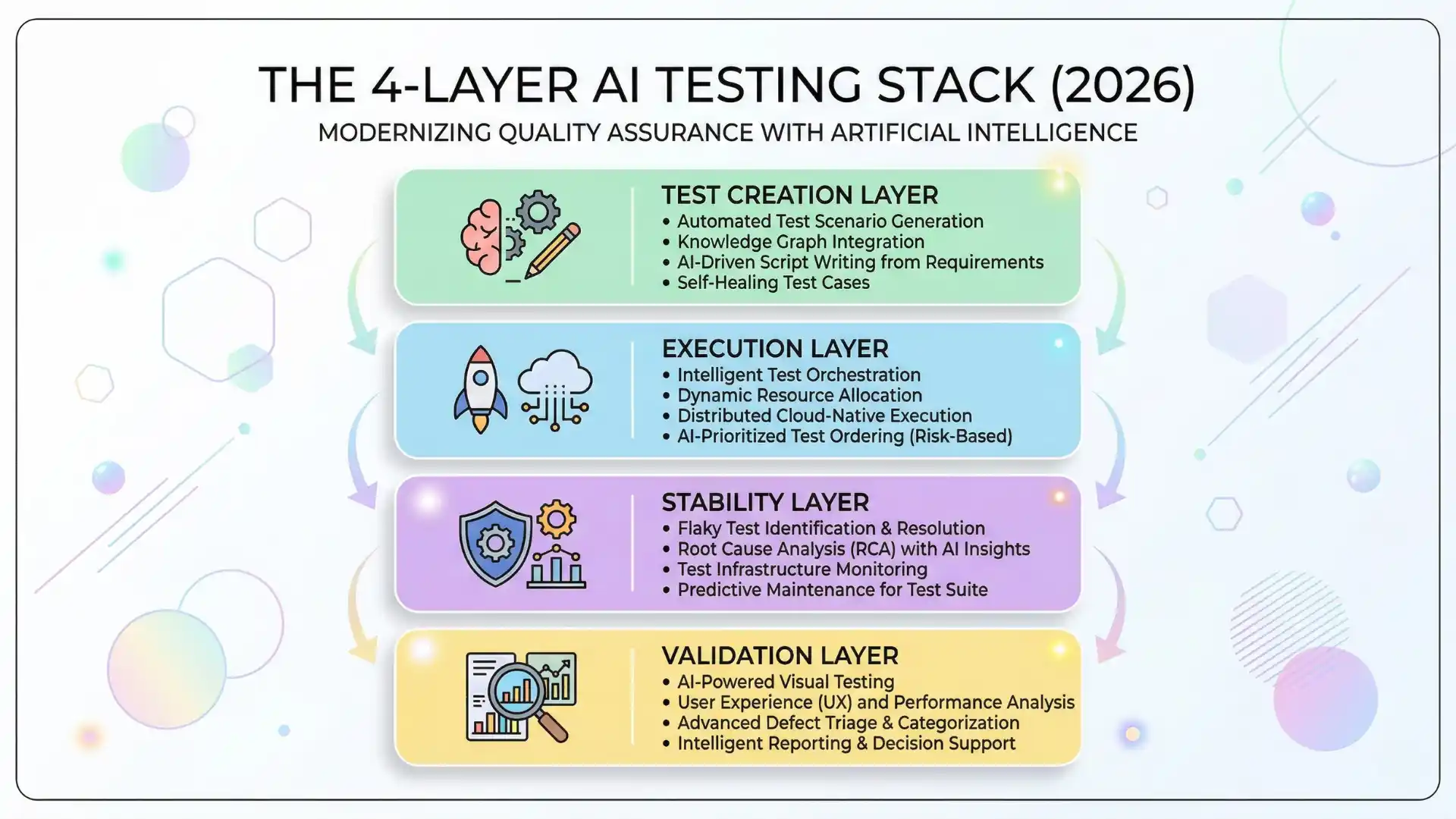
The 4-Layer AI Testing Stack (2026)
To understand where AI tools actually help, we need to look at testing as a system — not a toolset.
1. Test Creation Layer
AI helps generate and accelerate test creation.
- Tools: GitHub Copilot, mabl
- Value: Faster scripting, reduced manual effort
- Risk: Low-quality tests if prompts and design are weak
2. Execution Layer
This is where tests actually run — and where reliability matters most.
- Tools: Playwright, Selenium
👉 Why this layer matters most:
No amount of AI can fix unstable execution.
- Playwright reduces flakiness with auto-waits and modern architecture
- Selenium provides flexibility but depends heavily on implementation quality
3. Stability Layer
AI helps reduce maintenance and handle UI changes.
- Tools: Testim, Tricentis Tosca
- Value: Self-healing locators, reduced breakage
- Risk: Over-reliance can hide underlying test design issues
4. Validation Layer
Ensures that what works functionally also works correctly from a user perspective.
- Tools: Applitools
- Value: Detects visual and functional inconsistencies
- Critical for modern UI-heavy applications

Further Reading: Java Selenium interview questions
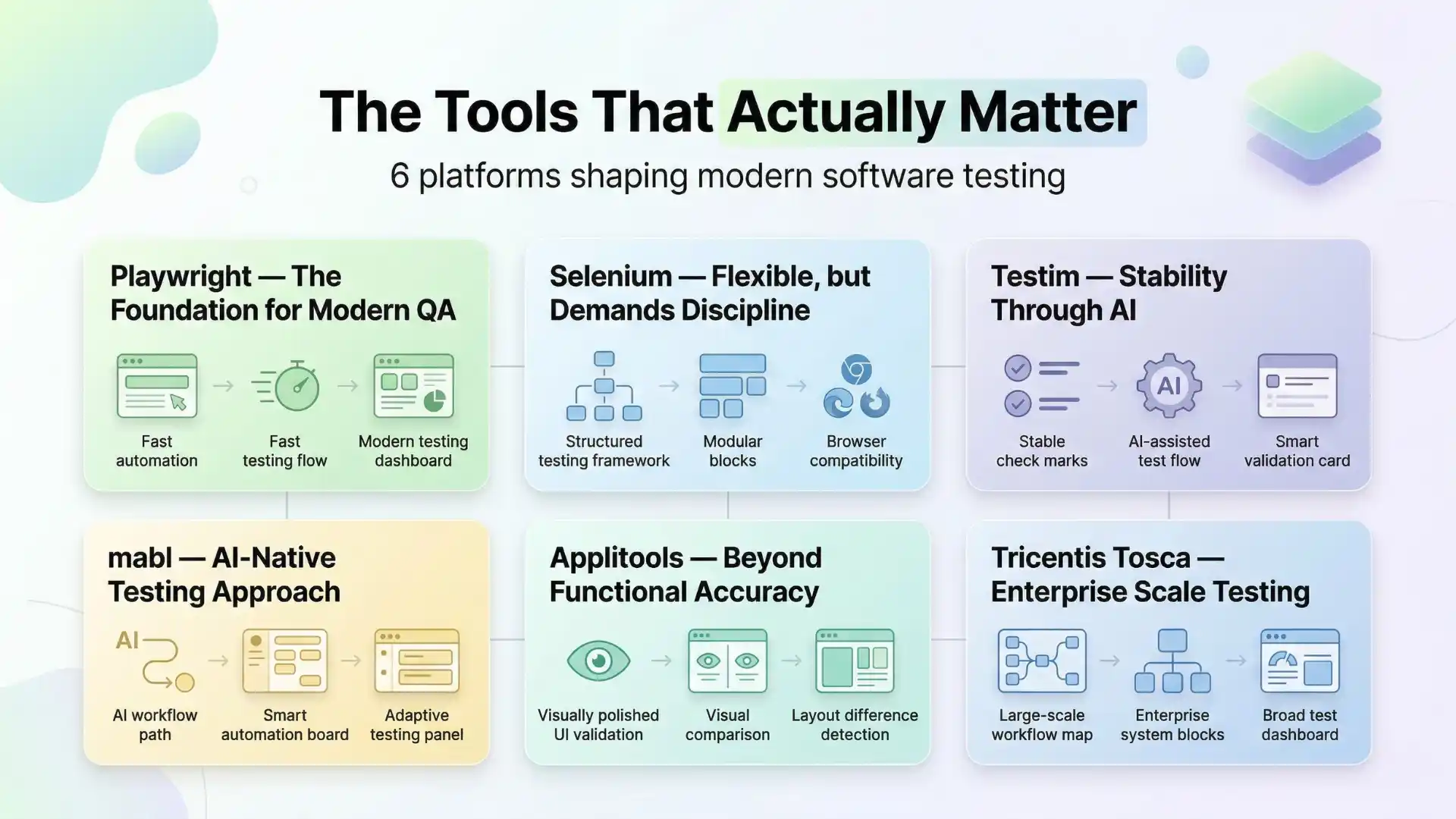
The Tools That Actually Matter (With Context)
Let’s break down the tools — not just by features, but by real-world impact.
1. Playwright — The Foundation for Modern QA
Playwright is leading the shift toward reliable, fast, and AI-assisted testing.
Why it stands out:
- Built for modern frontend architectures
- Native support for network control, parallel execution, and tracing
- Works seamlessly with AI tools for test generation and debugging
👉 In real-world teams, Playwright reduces:
- Flaky failures
- Debugging time
- CI instability
2. Selenium — Flexible, but Demands Discipline
Selenium remains deeply embedded in enterprise testing.
Strengths:
- Language flexibility
- Mature ecosystem
- Long-term stability
Challenges:
- Higher maintenance effort
- Stability depends on framework design
👉 With AI assistants like Copilot, Selenium becomes faster —
but it still requires strong engineering practices.
3. Testim — Stability Through AI
Testim focuses on solving a key QA pain point:
test maintenance.
- AI-based smart locators
- Self-healing capabilities
- Reduced manual updates
👉 Useful for teams dealing with frequent UI changes.
4. mabl — AI-Native Testing Approach
mabl is designed as an AI-first platform, not an add-on.
- Learns from user behavior
- Generates and adapts tests
- Covers web and API layers
👉 Best suited for teams exploring autonomous testing workflows.
5. Applitools — Beyond Functional Accuracy
Functional testing alone is not enough in modern UI-driven apps.
Applitools brings:
- Visual validation
- AI-based UI comparison
- Cross-browser consistency checks
👉 Critical for ensuring real user experience quality.
6. Tricentis Tosca — Enterprise Scale Testing
Tosca is designed for:
- Complex business workflows
- Large enterprise systems
- Model-based automation
👉 Strong in regulated and large-scale environments.
Other Useful Guides: playwright interview questions
What Most AI Testing Strategies Get Wrong
Across teams, the same pattern appears:
“We adopted AI tools — but testing didn’t improve as expected.”
Why?
Because:
- AI-generated tests lack context
- Self-healing hides deeper issues
- Tools are used without a strategy
The Real Differentiator: Skills Over Tools
The most successful QA teams are not the ones using the most tools.
They are the ones who:
- Understand test design deeply
- Build reliable automation frameworks
- Use AI to augment, not replace thinking
This is the real shift happening in modern QA.
Final Take
AI tools are powerful — but only in the right hands.
The goal is not to:
“Use more AI tools”
The goal is to:
Build AI-assisted testing workflows that are reliable, scalable, and maintainable
Because at the end of the day:
The best AI testing tool is the one that reduces maintenance without reducing trust.
FAQs
What are AI testing tools for functional testing?
AI testing tools for functional testing are platforms that use automation, machine learning, or AI-assisted capabilities to improve test creation, execution, stability, and validation. They help QA teams reduce manual effort and build more reliable testing workflows.
Which AI testing tools are best for functional testing in 2026?
Some of the most important AI testing tools for functional testing in 2026 include Playwright, Selenium, Testim, mabl, Applitools, and Tricentis Tosca. Each tool supports a different part of the testing workflow, from execution to stability and validation.
How does AI help in functional testing?
AI helps in functional testing by improving test generation, detecting flaky tests, supporting self-healing locators, optimizing execution, and enhancing validation. It helps QA teams make testing faster, smarter, and more scalable.
Is Playwright an AI testing tool?
Playwright is not purely an AI testing tool, but it is a modern automation framework that works very well with AI-assisted testing workflows. It is often used as the execution foundation for reliable and scalable functional testing.
What is the role of Playwright in AI-assisted functional testing?
Playwright plays a key role in AI-assisted functional testing by providing reliable execution, auto-waits, network control, tracing, and cross-browser support. It helps teams build stable test automation systems that can work well with AI-based test generation and analysis.
How is Selenium different from Playwright in modern functional testing?
Selenium offers flexibility, language support, and a mature ecosystem, while Playwright provides a more modern architecture with built-in auto-waits, tracing, and strong support for modern web applications. The right choice depends on testing goals, team maturity, and framework design.
What is the 4-layer AI testing stack?
The 4-layer AI testing stack includes the test creation layer, execution layer, stability layer, and validation layer. This model helps QA teams understand where different AI testing tools add value across the functional testing lifecycle.
Why do some AI testing strategies fail?
Some AI testing strategies fail because teams adopt tools without a clear testing strategy. Common issues include poor test design, over-reliance on self-healing features, low-quality AI-generated tests, and lack of reliable execution practices.
Can AI replace software testers in functional testing?
No, AI cannot replace software testers in functional testing. AI can support testers by improving speed, analysis, and automation, but human expertise is still essential for test design, strategy, business context, and quality decisions.
What should QA teams look for in AI testing tools?
QA teams should look for reliability, maintainability, stability, integration support, and real-world impact when choosing AI testing tools. The best tools reduce maintenance, improve trust in automation, and fit the team’s testing maturity.
We Also Provide Training In:
- Advanced Selenium Training
- Playwright Training
- Gen AI Training
- AWS Training
- REST API Training
- Full Stack Training
- Appium Training
- DevOps Training
- JMeter Performance Training
Author’s Bio:


Content Writer at Testleaf, specializing in SEO-driven content for test automation, software development, and cybersecurity. I turn complex technical topics into clear, engaging stories that educate, inspire, and drive digital transformation.
Ezhirkadhir Raja
Content Writer – Testleaf