
Most software tests are passing.
But that doesn’t mean your product is safe.
In today’s fast-moving development environment, test suites often create a false sense of confidence. They validate expected behavior, yet fail to predict real-world failures, performance bottlenecks, and hidden risks. As software becomes more complex and release cycles accelerate, traditional testing approaches are struggling to keep up. This is where machine learning is changing the game—shifting software testing from simple validation to intelligent, data-driven decision-making.
What is machine learning in software testing?
Machine learning in software testing is the use of data-driven algorithms to improve testing decisions such as defect prediction, flaky test detection, test case prioritization, and failure analysis. It helps QA teams move from manual validation to intelligent, predictive, and efficient testing.
How is machine learning used in software testing?
Machine learning is used in software testing to analyze historical test data, identify patterns, predict defects, detect flaky tests, prioritize test execution, and automate failure analysis. It enables teams to focus on high-risk areas and improve release confidence.
Key Takeaways
- Machine learning is transforming software testing from execution to intelligent decision-making
- Modern QA teams use ML for defect prediction, flaky test detection, and test optimization
- Testing is shifting from reactive validation to proactive risk management
- Teams that adopt ML early will gain speed, stability, and competitive advantage
Why Traditional Testing Will Not Hold Up in the AI Era
Traditional testing strategies were designed for a different era—one where software releases were predictable, development cycles were slower, and manual validation still had a meaningful role in ensuring quality. In that environment, testers could rely on structured test cases, stable data, and sequential workflows to validate applications effectively.
However, that reality has changed dramatically. Today’s software ecosystem is defined by rapid deployments, continuous integration pipelines, microservices architectures, and increasingly, AI-generated code. These shifts introduce a level of complexity and unpredictability that traditional testing methods struggle to handle. Tests that once passed consistently may now fail intermittently due to dynamic data, asynchronous behavior, or external dependencies.
As a result, relying solely on conventional automation frameworks and static test strategies is no longer sufficient. Teams that fail to evolve their testing approach risk slower releases, increased production defects, and a growing lack of confidence in their test suites. The challenge is no longer just executing tests—it is understanding where to test, what to test, and how to adapt in real time.
The Shift: From Test Execution to Test Intelligence
The role of software testing is undergoing a fundamental transformation. For years, testing has been centered around execution—running predefined test cases, verifying expected outcomes, and reporting defects. While this approach ensured functional correctness, it often lacked the ability to adapt to changing conditions or provide deeper insights into system behavior.
Today, modern QA teams are moving toward what can be described as test intelligence. Instead of focusing only on execution, testing systems are becoming capable of analyzing historical data, identifying patterns, and making informed decisions. This shift allows teams to prioritize high-risk areas, detect anomalies early, and reduce unnecessary test runs.
For example, rather than executing an entire regression suite for every build, intelligent systems can determine which tests are most relevant based on recent code changes. Similarly, instead of reacting to flaky failures after they occur, teams can proactively identify instability patterns and address them before they impact productivity.
This transition from execution to intelligence is not just a technical improvement—it represents a strategic shift in how quality is managed in modern software development.
What Is Machine Learning in Software Testing?
Machine learning in software testing refers to the application of data-driven algorithms that learn from past testing activities to improve future outcomes. Unlike traditional rule-based automation, where every condition must be explicitly defined, machine learning models identify patterns and relationships within data to make predictions and decisions.
In a testing context, this means analyzing large volumes of information such as test results, execution logs, defect history, and user behavior. By learning from this data, ML systems can uncover insights that are difficult for humans to detect manually. For instance, they can identify recurring failure patterns, detect anomalies in execution times, or highlight areas of the application that are more prone to defects.
The key advantage of machine learning is its ability to continuously improve. As more data becomes available, the models refine their predictions, making testing processes increasingly accurate and efficient over time. This transforms testing from a static process into a dynamic, evolving system that adapts to the needs of the application.


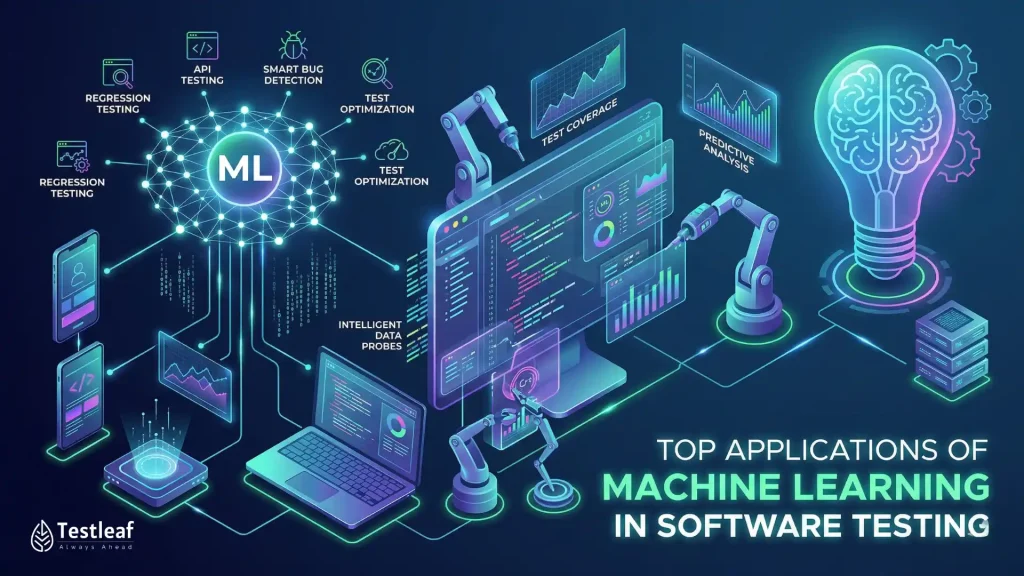
Top Applications of Machine Learning in Software Testing
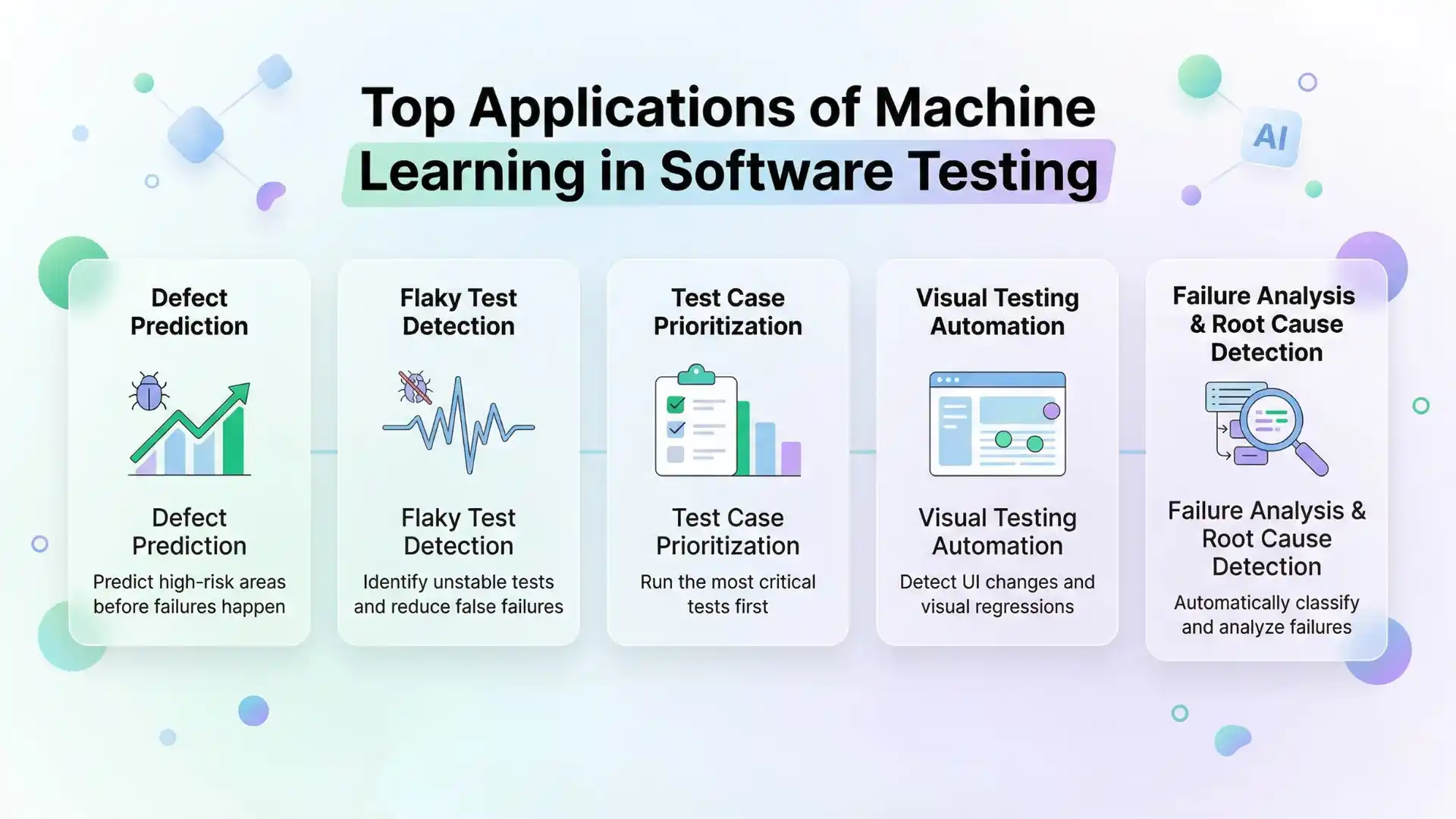
1. Defect Prediction
Defect prediction is one of the most impactful applications of machine learning in software testing. By analyzing historical defect data, code changes, and testing patterns, ML models can identify components that are more likely to fail in future releases. This allows QA teams to focus their efforts on high-risk areas rather than distributing resources evenly across the entire application.
For example, if a particular module has a history of frequent changes and past defects, the system can flag it as a priority for deeper testing. This targeted approach not only improves defect detection rates but also optimizes resource allocation, ensuring that critical issues are identified early in the development cycle.
2. Flaky Test Detection
Flaky tests are one of the biggest challenges in modern automation. These tests fail intermittently without any actual defect in the application, often due to timing issues, unstable environments, or external dependencies. Over time, flaky tests reduce trust in the test suite and increase the effort required for debugging.
Machine learning helps address this problem by analyzing test execution patterns across multiple runs. It can identify tests that exhibit inconsistent behavior and classify them as flaky. By detecting these patterns early, teams can isolate unstable tests, fix underlying issues, and restore confidence in their automation framework.
3. Test Case Prioritization
In large-scale applications, running the entire test suite for every build is often impractical due to time constraints. Machine learning enables intelligent test case prioritization by determining which tests are most likely to uncover defects based on recent code changes and historical data.
This approach ensures that critical tests are executed first, providing faster feedback to developers. It also reduces the overall execution time of test suites, making continuous integration pipelines more efficient. As a result, teams can maintain high quality without compromising on speed.
4. Visual Testing Automation
User interface issues are often difficult to detect using traditional functional testing methods. Elements may appear correctly in one environment but break in another due to layout shifts, styling inconsistencies, or responsiveness issues.
Machine learning enhances visual testing by comparing UI elements at a deeper level, detecting even subtle differences in layout, color, and structure. Unlike pixel-by-pixel comparisons, ML-based systems can distinguish between meaningful changes and noise, reducing false positives and improving accuracy.
5. Failure Analysis and Root Cause Detection
Debugging test failures is a time-consuming process that often involves manual investigation. Machine learning simplifies this by automatically analyzing failure logs and categorizing issues based on their root causes.
For instance, it can differentiate between failures caused by application defects, environment issues, or test script errors. This classification allows teams to respond more effectively, reducing triage time and improving overall productivity.

Key Benefits of Machine Learning in Software Testing
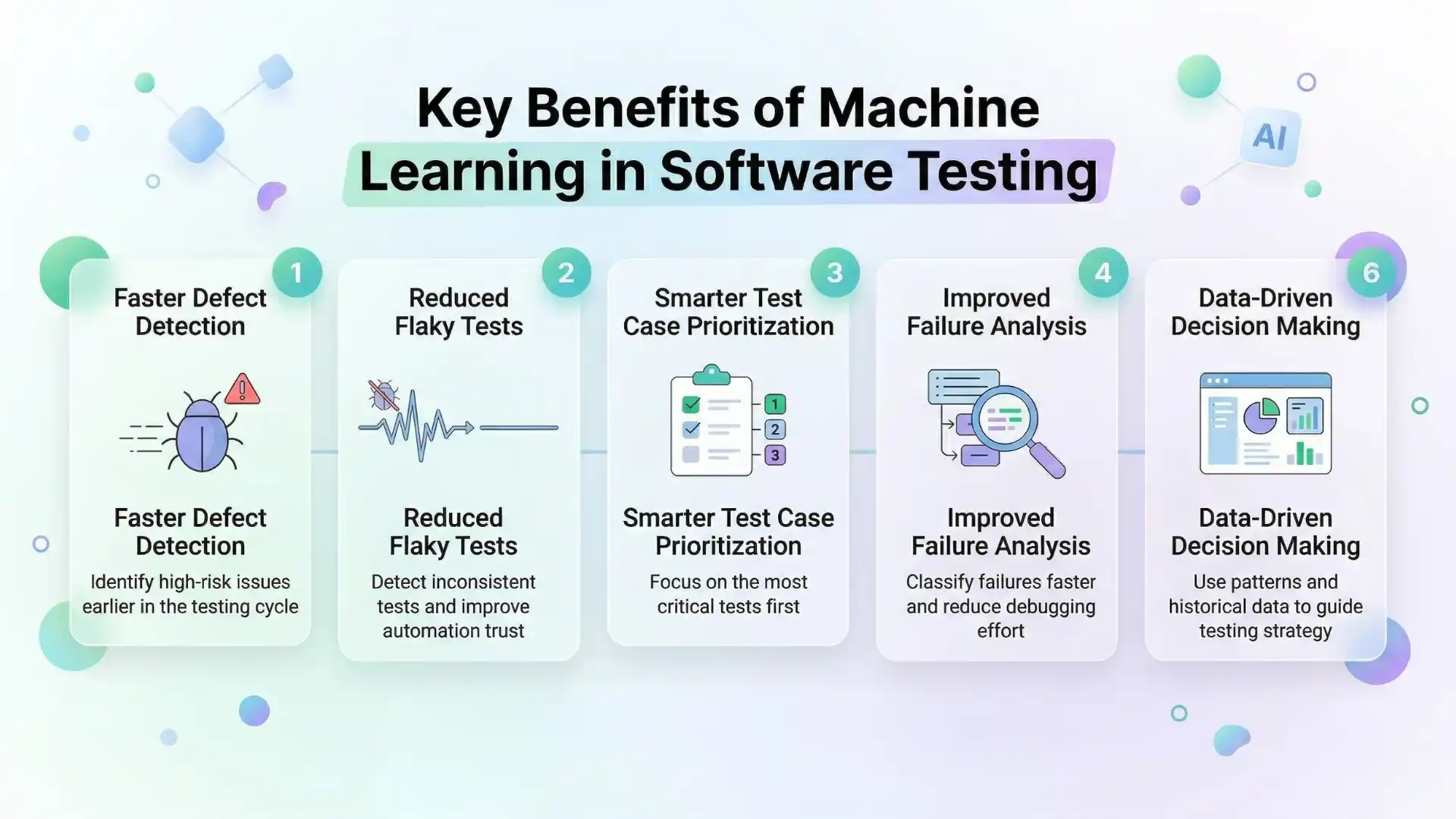
Machine learning brings a shift from traditional automation to intelligent testing systems. Instead of executing tests blindly, it enables QA teams to make smarter decisions based on data and patterns.
Key benefits include:
- Faster Defect Detection
Machine learning models analyze past defects and identify high-risk areas early, helping teams catch issues before they reach production. - Reduced Flaky Tests
By detecting inconsistent test patterns, ML helps eliminate unstable tests and improves trust in automation suites. - Smarter Test Case Prioritization
ML ensures that the most critical tests run first, reducing execution time and speeding up CI/CD pipelines. - Improved Failure Analysis
Automatically classifies failures into categories such as product issues, environment problems, or test script errors. - Efficient Regression Testing
Focuses testing efforts on areas impacted by recent changes, reducing unnecessary test runs. - Data-Driven Decision Making
Helps QA teams move from assumptions to insights, improving overall testing strategy.
Tutorial: How Machine Learning Works in Software Testing
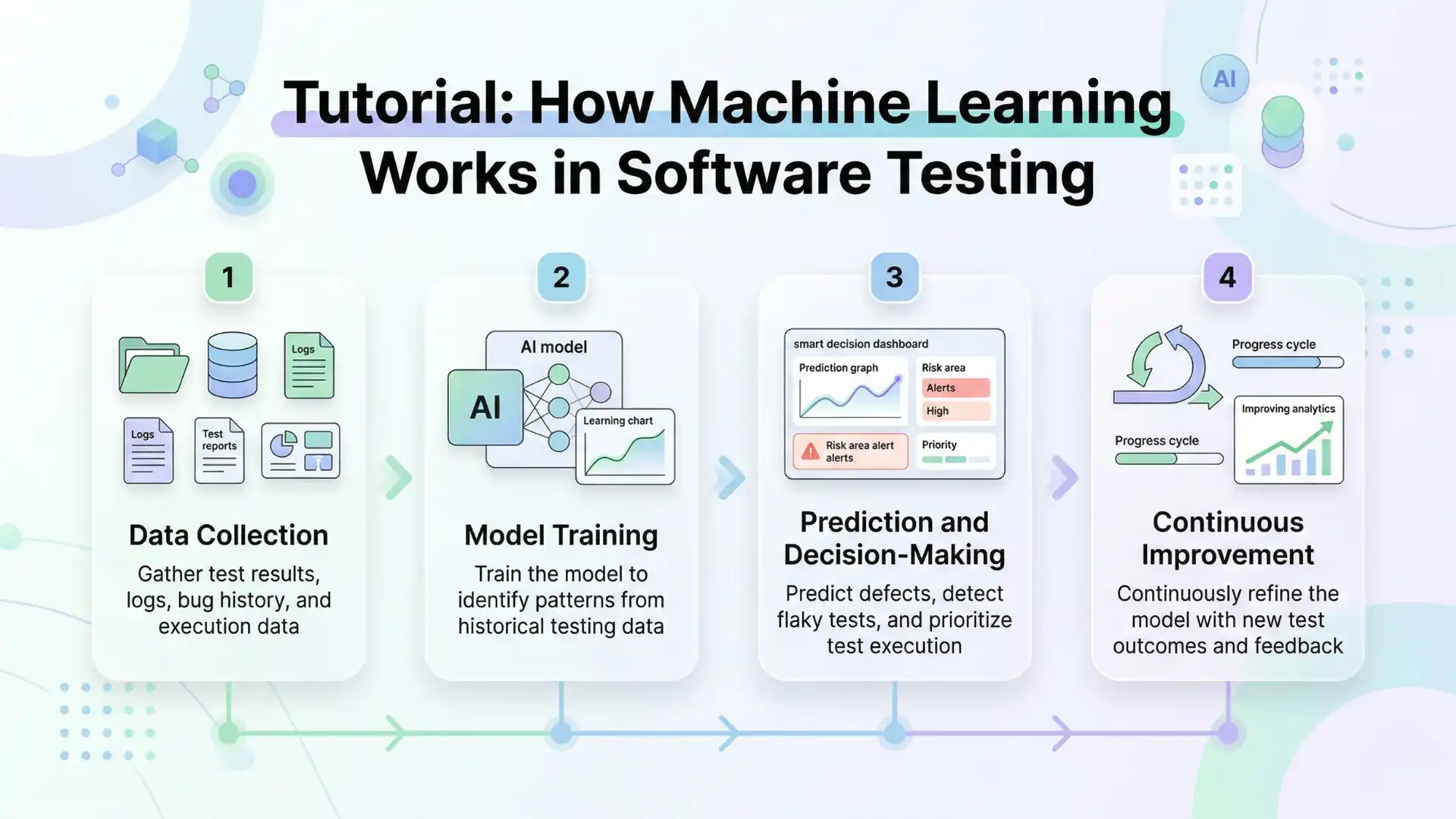
Understanding how machine learning integrates into testing workflows does not require deep expertise in data science. At a high level, the process follows a structured pipeline that can be applied to various testing scenarios.
Step 1: Data Collection
The foundation of any ML system is data. In software testing, this includes test execution results, logs, defect reports, and performance metrics. The quality and quantity of this data directly impact the effectiveness of the model.
Step 2: Model Training
Once the data is collected, machine learning algorithms are trained to identify patterns and relationships. For example, a model might learn which combinations of inputs lead to failures or which test cases are most likely to detect defects.
Step 3: Prediction and Decision-Making
After training, the model can make predictions based on new data. This could involve identifying high-risk areas, detecting anomalies, or recommending test execution strategies.
Step 4: Continuous Improvement
Machine learning systems improve over time as they are exposed to more data. By continuously updating the model, teams can ensure that their testing processes remain accurate and relevant.
Supervised vs Unsupervised Learning in QA
Machine learning techniques used in software testing can be broadly categorized into supervised and unsupervised learning, each serving different purposes.
Supervised learning relies on labeled data, where the desired outcome is already known. In testing, this might involve training a model to classify defects based on historical bug data. This approach is particularly useful for tasks such as defect prediction and failure classification.
Unsupervised learning, on the other hand, works with unlabeled data and focuses on identifying hidden patterns. In QA, this can be applied to anomaly detection, where the system identifies unusual behavior in test executions without predefined labels.
Both approaches play a crucial role in building intelligent testing systems, and their effectiveness depends on the specific use case and available data.
Traditional Testing vs Machine Learning in Testing
| Aspect | Traditional Testing | Machine Learning in Testing |
|---|---|---|
| Approach | Rule-based execution | Data-driven decision making |
| Testing Style | Reactive (after failures) | Predictive (before failures) |
| Test Execution | Fixed test suites | Dynamic and prioritized execution |
| Defect Detection | Based on predefined scenarios | Based on learned patterns and risk |
| Flaky Test Handling | Manual investigation | Automated detection and classification |
| Failure Analysis | Time-consuming manual debugging | Automated root cause classification |
| Efficiency | Slower for large systems | Optimized and scalable |
| Adaptability | Limited to predefined rules | Continuously improves with data |
The Real Challenge: Why Most Teams Fail with ML
Despite its potential, many teams struggle to implement machine learning effectively in their testing processes. One of the primary reasons is the lack of high-quality data. Without reliable and consistent data, ML models cannot produce meaningful insights.
Another challenge is the misconception that machine learning can replace good testing practices. In reality, ML is not a substitute for well-designed test cases, stable environments, or proper test data management. It is an enhancement, not a replacement.
Additionally, over-reliance on automated decisions without human oversight can lead to incorrect conclusions. Successful adoption of machine learning requires a balanced approach that combines data-driven insights with domain expertise.
The Future of Software Testing
The future of software testing is not about increasing the number of test cases or adopting more tools. Instead, it is about building intelligent systems that can adapt to changing conditions and provide meaningful insights.
As AI and machine learning continue to evolve, testing will become more predictive, automated, and integrated into the development lifecycle. QA engineers will shift from executing tests to designing systems that ensure quality at scale.
This evolution will redefine the role of testers, requiring new skills and a deeper understanding of data-driven decision-making. Teams that embrace this change will be better positioned to deliver high-quality software in an increasingly complex environment.
Final Thought
Machine learning will not replace testers, but it will fundamentally change how testing is performed. The value of a QA engineer will no longer be measured by the number of test cases executed, but by their ability to build intelligent, adaptive testing systems.
The question is no longer whether machine learning will impact software testing. It already has.
The real question is whether your testing strategy is evolving fast enough to keep up.
In many teams, this shift is already visible through the growing use of AI in software testing to improve speed, reduce noise, and strengthen release confidence. As delivery cycles get faster, AI in software testing is becoming a practical advantage for teams that want smarter and more reliable quality engineering.
FAQs
What is machine learning in software testing?
Machine learning in software testing is the use of data-driven algorithms to improve testing decisions such as defect prediction, flaky test detection, test case prioritization, and failure analysis. It helps QA teams make testing more predictive, efficient, and reliable.
How is machine learning used in software testing?
Machine learning is used in software testing to analyze historical test results, identify failure patterns, predict high-risk areas, detect flaky tests, prioritize important test cases, and improve regression testing efficiency.
What are the applications of machine learning in software testing?
The main applications of machine learning in software testing include defect prediction, flaky test detection, test case prioritization, visual testing automation, failure analysis, and root cause detection.
What are the benefits of machine learning in software testing?
The key benefits of machine learning in software testing include faster defect detection, reduced flaky tests, smarter test prioritization, improved failure analysis, efficient regression testing, and data-driven decision-making.
Can machine learning improve regression testing?
Yes, machine learning can improve regression testing by identifying high-risk areas, selecting the most relevant test cases, reducing unnecessary test runs, and helping teams get faster feedback during releases.
How does machine learning help detect flaky tests?
Machine learning helps detect flaky tests by analyzing repeated execution patterns, inconsistent failures, timing issues, and environment-related instability. This helps QA teams identify unreliable tests and improve automation trust.
Can machine learning replace software testers?
No, machine learning cannot replace software testers. It supports testers by improving analysis, prediction, and prioritization, while human expertise is still needed for strategy, validation, and quality decisions.
What is the difference between traditional testing and machine learning in testing?
Traditional testing is rule-based and reactive, while machine learning in testing is data-driven and predictive. Traditional testing follows predefined steps, whereas machine learning uses patterns from past data to guide smarter test decisions.
What is the future of AI in software testing?
The future of AI in software testing is more predictive, adaptive, and intelligent. QA teams will increasingly use AI and machine learning to optimize test execution, detect risk earlier, reduce manual effort, and improve release confidence.
We Also Provide Training In:
- Advanced Selenium Training
- Playwright Training
- Gen AI Training
- AWS Training
- REST API Training
- Full Stack Training
- Appium Training
- DevOps Training
- JMeter Performance Training
Author’s Bio:


Content Writer at Testleaf, specializing in SEO-driven content for test automation, software development, and cybersecurity. I turn complex technical topics into clear, engaging stories that educate, inspire, and drive digital transformation.
Ezhirkadhir Raja
Content Writer – Testleaf