


Automation testing is often introduced as a simple trade: less manual effort, faster execution, better efficiency.
That explanation is not wrong. It is just incomplete.
In 2026, automation testing is no longer a side capability used only by mature engineering teams. It sits much closer to the heart of release confidence, CI/CD speed, test coverage, and product quality. At the same time, the testing world is being reshaped by AI-assisted workflows. Capgemini’s World Quality Report 2025–26 says 43% of organizations are experimenting with GenAI in quality engineering, but only 15% have scaled it enterprise-wide, which suggests the real challenge is not excitement—it is execution maturity. Meanwhile, Stack Overflow’s 2025 Developer Survey says 84% of respondents are already using or planning to use AI tools in their development process, and 51% of professional developers use them daily.
That matters because automation testing today is no longer just about running scripts faster than humans. It is about building reliable feedback loops at scale.
So when people ask, “What are the pros and cons of automation testing?” the real answer is more nuanced. The advantages are real. But many of the so-called disadvantages are not signs that automation is weak. They are signs that automation demands discipline, architecture, and strategic thinking.
That is exactly why strong QA teams benefit from it.
What are the advantages and disadvantages of automation testing?
Automation testing improves speed, consistency, and test coverage by running repeatable checks automatically. However, it requires upfront setup, skilled engineers, and ongoing maintenance. When implemented strategically, these trade-offs become strengths that improve testing maturity and CI/CD reliability.
Key Takeaways
-
Automation testing speeds up regression and CI/CD feedback.
-
Consistent automated checks reduce human error.
-
Strong frameworks enable reusable testing assets.
-
Many “disadvantages” are actually maturity signals.
-
Automation works best for stable, high-value workflows.
What automation testing really means in 2026
Automation testing is the practice of using tools, frameworks, and scripts to validate software behavior with minimal manual repetition. In older discussions, that usually meant UI regression scripts. In modern engineering teams, it now includes browser automation, API checks, data-driven validation, contract testing, pipeline-triggered smoke tests, and increasingly AI-assisted support for generating ideas, drafting tests, or accelerating repetitive engineering work. Stack Overflow’s 2024 survey found that developers expect AI tools to become more integrated in testing code more than almost any other workflow area, with 80% saying testing will see deeper AI integration over the next year.
That shift is important. Automation testing is not a separate technical hobby anymore. It is part of how modern software teams manage speed without surrendering quality.
Other Helpful Articles: playwright interview questions
Why automation testing matters more now than before
Software systems are more distributed, more frequently updated, and more connected to third-party services than they were a few years ago. Release cycles have become tighter, and the expectation of continuous delivery has become normal in many teams. At the same time, AI tools are reducing friction around repetitive engineering tasks. GitHub’s research on Copilot found that 87% of developers reported preserving mental effort during repetitive tasks, a finding that helps explain why automation and AI together are becoming more attractive to engineering organizations.
But speed alone is not the reason automation matters.
Automation matters because it helps teams answer one critical question again and again: Can we trust this release?
That trust is hard to earn manually when the product is large, the test surface is growing, and every deployment creates pressure for fast feedback.
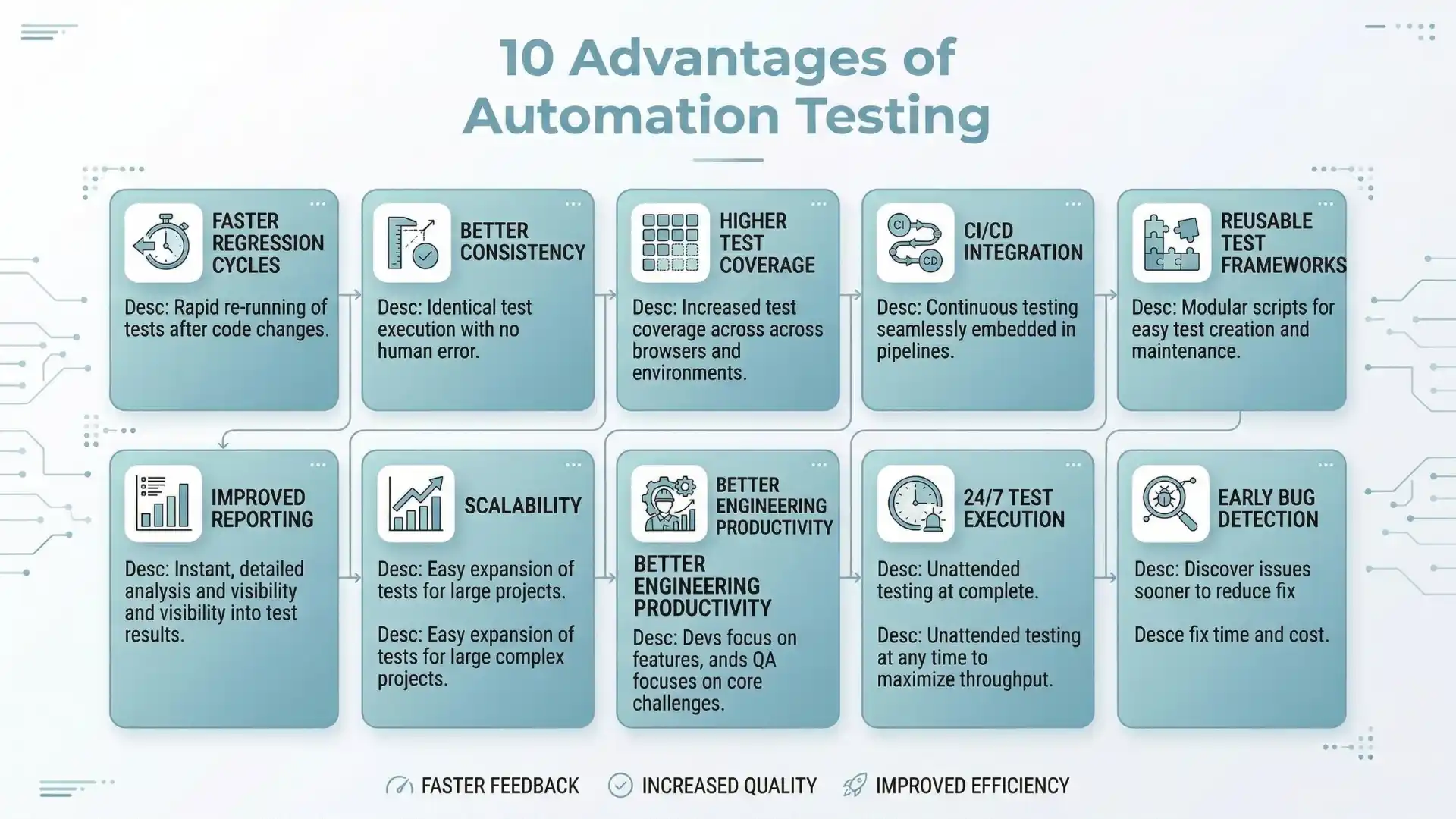
The 10 real advantages of automation testing
1. Faster regression cycles
The most visible advantage of automation testing is speed. Automated regression checks can execute far faster than repeated manual validation, especially when they are integrated into pipelines and triggered across environments automatically. This becomes even more valuable when release frequency increases.
But the deeper advantage is not just fast execution. It is fast feedback. Teams can discover whether a critical flow is broken before the problem reaches customers.
2. Better consistency in repetitive checks
Humans are excellent at investigation, judgment, and exploratory thinking. They are not ideal for endlessly repeating the same deterministic validation. Automation thrives there. The same test can execute with the same steps, the same assertions, and the same expected conditions every time.
That consistency improves confidence in regression-heavy areas like login, checkout, billing, search, and permissions-based workflows.
3. Higher coverage at practical scale
As applications grow, manually retesting every key path becomes unrealistic. Automation helps teams cover more combinations, browsers, environments, and datasets than a purely manual strategy can sustain.
This does not mean “automate everything.” It means automation makes broad, repeatable coverage possible where manual-only approaches become too slow or too expensive.
4. Stronger support for CI/CD
Automation testing becomes far more valuable when it is part of the release pipeline. Smoke suites, API validations, and regression checkpoints can run before code moves further downstream. That reduces the cost of discovering defects late.
In practice, this means quality stops being a final-stage activity and becomes part of delivery itself.
5. Better reuse of testing assets
A well-designed automation suite is not just a set of scripts. It becomes a reusable system of page objects, helper methods, fixtures, test data strategies, assertions, and reporting patterns.
That reuse compounds over time. Good automation frameworks make future testing easier, not harder.
6. Improved traceability and reporting
Automated tests can produce structured results: pass-fail data, screenshots, logs, traces, videos, and history across builds. This makes failures easier to track and trends easier to spot.
The real advantage here is operational visibility. Teams no longer rely on memory or fragmented manual notes to understand release risk.
7. More room for human judgment
One of the biggest myths about automation testing is that it reduces the value of testers. Good automation does the opposite. It frees testers from repetitive work so they can spend more time on risk analysis, edge cases, exploratory testing, and product thinking.
That is not replacement. That is leverage.
8. Better long-term ROI for stable workflows
Automation is especially effective for stable, repeated, business-critical flows. Once a framework is in place and the targeted workflows are mature, the long-term return becomes significant because the same validations can be reused across release cycles.
The key phrase is stable workflows. Automation pays back best when the business value is high and the change frequency is manageable.
9. Easier scaling across environments and browsers
Modern teams often need to validate software across multiple browsers, devices, and stages of deployment. Automation makes this practical. Running the same checks across combinations is tedious and error-prone manually, but much more scalable with tools designed for parallel execution.
10. Better alignment with modern engineering practice
Automation testing fits naturally into the current direction of software engineering: continuous integration, measurable quality gates, version-controlled test assets, and AI-supported productivity. With 84% of Stack Overflow respondents already using or planning to use AI tools in development workflows, it is clear that software teams are moving toward more tool-assisted execution, not less.

Automation testing is part of that broader maturity.
Continue Reading: manual testing interview questions
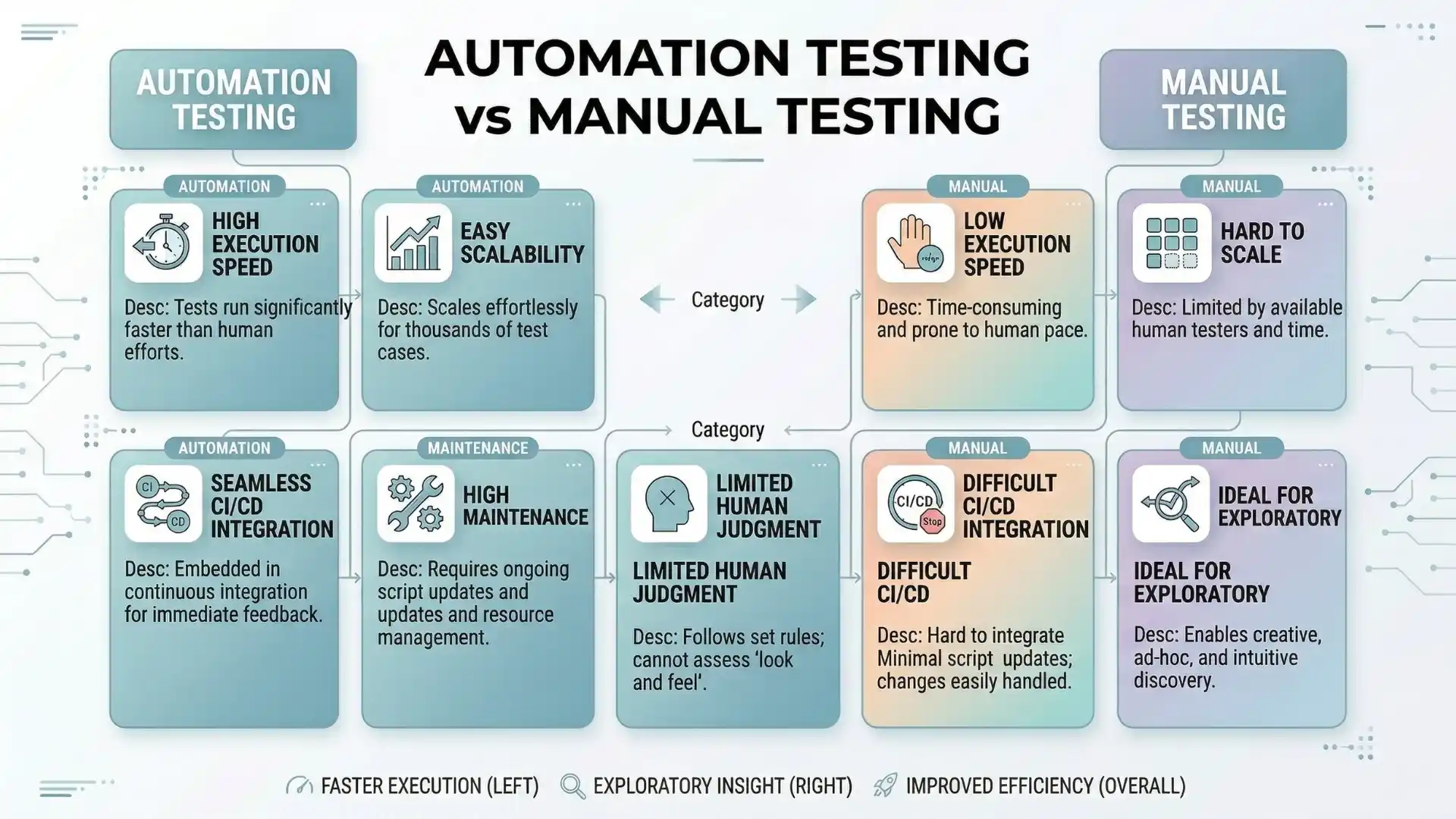
Automation Testing vs Manual Testing
| Feature | Automation Testing | Manual Testing |
|---|---|---|
| Execution Speed | Very fast | Slower |
| Repetition | Highly efficient | Error-prone |
| Human Judgment | Limited | Strong |
| Exploratory Testing | Limited | Excellent |
| CI/CD Integration | Strong | Not possible |
| Best Use Case | Regression & pipelines | Exploration & UX validation |
The 10 so-called disadvantages of automation testing—and why smart teams turn them into strengths
This is where most generic articles stop too early. They list problems like setup cost, maintenance, and skill requirements as if they are proof automation testing is flawed.
They are not.
They are trade-offs. And in strong teams, those trade-offs often become advantages.
1. Initial setup takes time—but creates long-term speed
Yes, automation requires upfront investment: tool selection, framework design, environment readiness, and test architecture. But that setup is what makes repeatable scale possible later.
Short-term effort is the entry fee for long-term acceleration.
2. It requires skilled engineers—which raises testing maturity
Automation testing exposes whether a team really understands selectors, waits, assertions, test design, data strategy, and debugging. That can feel like a barrier.
In reality, it raises the technical standard of quality engineering.
3. Maintenance pressure encourages better architecture
UI changes, API changes, and unstable environments can break brittle tests. That is often cited as a disadvantage.
But maintenance pressure teaches a valuable lesson: poorly designed automation does not survive. Teams that respond well become better at abstraction, framework design, locator strategy, and test isolation.
4. Flaky tests reveal hidden instability
Flaky tests are frustrating. But they are also diagnostic. A flaky test can reveal race conditions, brittle selectors, poor environment control, synchronization issues, or unstable dependencies.
In other words, flakiness is not always just a testing problem. It is often a signal about system quality.
5. Not everything should be automated—which improves prioritization
This is often framed as a limitation. Automation cannot fully replace exploratory testing, usability evaluation, visual judgment, or one-time validation.
That is true. And it is useful.
Because once teams accept that not every check deserves automation, they begin prioritizing high-value scenarios instead of chasing automation vanity.
6. Tooling complexity pushes teams toward scalable practice
Frameworks, browsers, grid infrastructure, reporting tools, CI integration, and test data pipelines can make automation ecosystems feel complex.
But complexity also forces teams to think in systems. That systems thinking is what allows quality work to scale beyond heroic manual effort.
7. Automation can create false confidence—which teaches stronger assertion design
A passing test is not the same as a meaningful test. Weak assertions, shallow coverage, or poorly chosen scenarios can make teams believe quality is stronger than it actually is.
This is not a reason to avoid automation. It is a reason to write better tests.
8. Large suites become slow—which forces smarter suite design
As suites grow, execution time can expand and pipelines can become noisy. That sounds like a disadvantage.
But it pushes teams to categorize suites properly: smoke, regression, critical path, component-level checks, and API validations. Mature teams do not respond by abandoning automation. They respond by designing execution strategy.
9. CI failures increase pressure—but improve feedback culture
When automated tests run in CI/CD, failures become visible sooner and more publicly. That can feel uncomfortable, especially in teams used to catching problems later.
But early visibility is a strength. It creates a culture where quality is discussed before release, not after incident.
10. Automation cannot replace human insight—which protects product quality
This is perhaps the most important point. Automation testing is powerful, but it cannot fully understand human perception, confusing UX, unclear workflows, or emotional friction in a product experience.
That is not a weakness. That is a boundary. And clear boundaries lead to better testing strategy.
When automation testing is worth it
Automation delivers the most value when the scenario is repeated frequently, matters to the business, and has a stable expected outcome.
That usually includes regression suites, smoke checks, API validations, data-driven scenarios, repeated customer journeys, and cross-browser checks. It is especially valuable when the team needs fast confidence on every change.
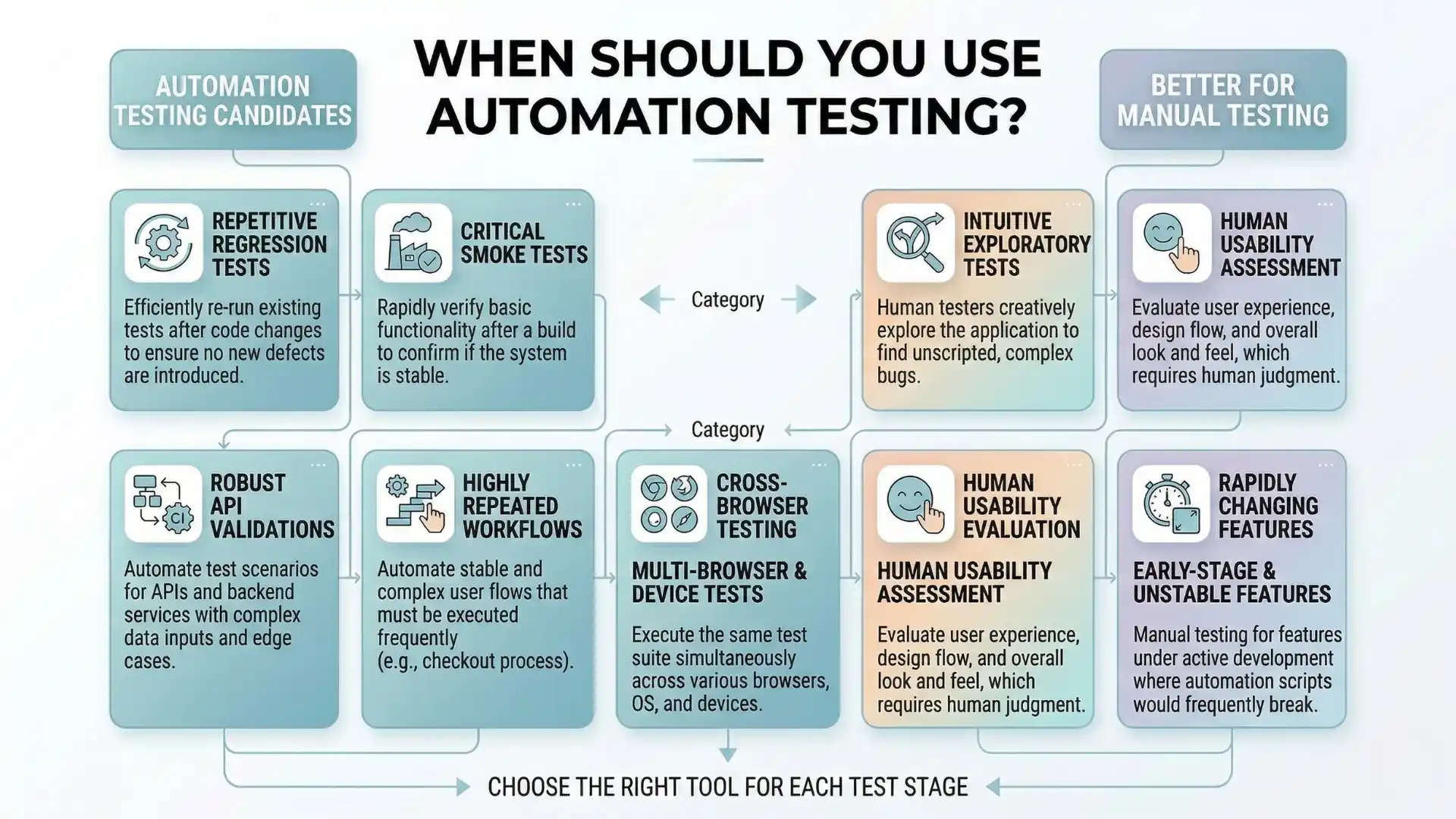
When automation should not be your first move
Automation is not always the smartest first move. It is often a poor fit for rapidly changing prototypes, one-off validations, subjective usability checks, and early exploratory learning.
Good QA strategy is not measured by how much you automate. It is measured by whether you automate the right things.
Automation testing vs manual testing is the wrong debate
The strongest teams do not frame this as a competition.
Manual testing brings intuition, exploration, product judgment, and contextual reasoning. Automation brings speed, repeatability, scale, and fast feedback. The future of quality is not manual or automation. It is manual and automation, used deliberately.
That point becomes even more important as AI becomes more embedded in engineering workflows. Stack Overflow’s 2025 survey shows AI adoption is growing rapidly, but that does not remove the need for human judgment. It increases the need for it, because tool-assisted work still needs review, interpretation, and context.
Why Automation Testing Matters in Modern Software Development
Modern software systems evolve rapidly with continuous integration and deployment. Automation testing helps teams maintain quality while shipping features faster. As engineering teams adopt AI-assisted development and cloud-based pipelines, automation becomes essential for scalable and reliable software delivery.
Final thoughts
Automation testing has real advantages. Faster regression, broader coverage, better CI/CD alignment, and stronger reuse all matter.
But the deeper truth is this: the so-called disadvantages of automation testing often reveal the very disciplines that strong engineering teams need anyway. Setup effort teaches long-term thinking. Maintenance teaches architecture. Flaky tests expose hidden instability. Skill requirements push teams toward maturity. Boundaries around what not to automate protect real quality.
That is why automation testing is not just a cost-saving technique. It is a quality strategy.
And in 2026, the teams that benefit most from it will not be the ones that automate the most. They will be the ones that automate with the most clarity, discipline, and purpose.
For testers and QA teams who want to stay relevant in the years ahead, learning the mindset behind strong frameworks, reliable design, and sustainable execution will matter more than ever. That is exactly why Selenium Automation Testing continues to remain one of the most valuable foundations in modern software quality.
FAQs
What are the advantages of automation testing?
Automation testing improves regression speed, consistency, test coverage, and integration with CI/CD pipelines.
What are the disadvantages of automation testing?
Automation testing requires initial setup time, skilled engineers, test maintenance, and stable environments.
Is automation testing better than manual testing?
Automation testing is better for repetitive checks and regression testing, while manual testing is essential for exploratory testing and usability evaluation.
When should automation testing be used?
Automation testing works best for repeated workflows such as login validation, checkout flows, regression suites, and API checks.
Why is automation testing important in CI/CD?
Automation testing enables fast feedback in CI/CD pipelines, allowing teams to detect defects early before software releases.
We Also Provide Training In:
- Advanced Selenium Training
- Playwright Training
- Gen AI Training
- AWS Training
- REST API Training
- Full Stack Training
- Appium Training
- DevOps Training
- JMeter Performance Training
Author’s Bio:


Content Writer at Testleaf, specializing in SEO-driven content for test automation, software development, and cybersecurity. I turn complex technical topics into clear, engaging stories that educate, inspire, and drive digital transformation.
Ezhirkadhir Raja
Content Writer – Testleaf