
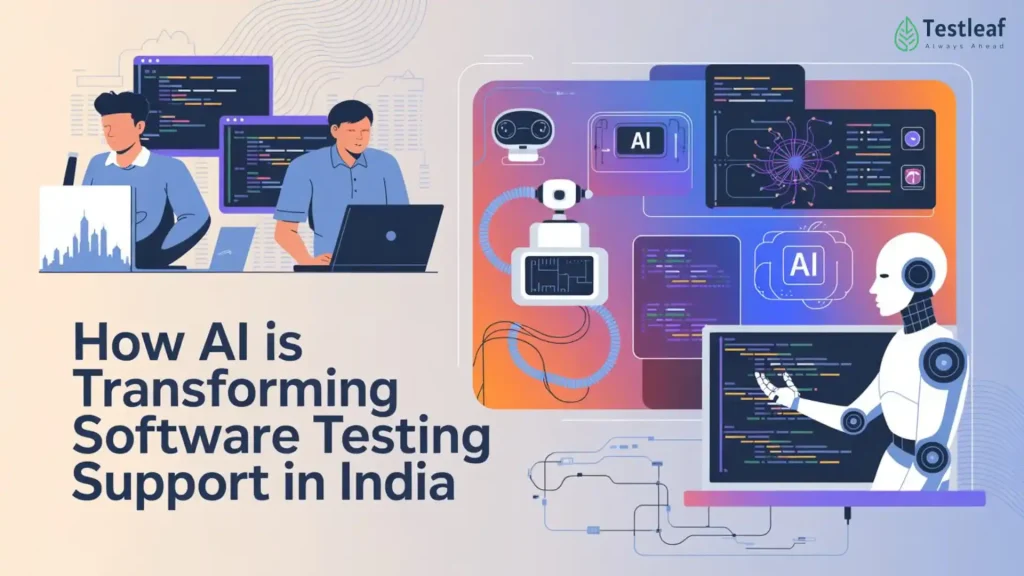
AI is not replacing software testers in India. It is reshaping how testing support is delivered, scaled, and improved.
For years, software testing support was treated as a back-office function. Teams wrote test cases, executed regressions, logged defects, chased environment issues, and struggled to keep pace with faster releases. That model is now under pressure.
India’s technology ecosystem is moving into a new phase where speed, scale, and decision quality matter as much as execution. Generative AI is accelerating that shift. An EY India survey reported that GenAI could improve productivity in India’s IT industry by 43% to 45% over five years, with 89% of companies already testing GenAI initiatives and 33% using them in production.
That matters for software testing because testing support is no longer only about “doing more tests.” It is about helping teams make better quality decisions, faster.
AI is transforming software testing support in India by reducing manual effort in test design, defect triage, regression selection, documentation, and QA communication. Its biggest value is not replacing testers, but helping teams deliver faster and make better quality decisions.
What is changing in software testing support in India?
AI is transforming software testing support in India by speeding up test design, improving defect analysis, helping teams prioritize regression better, and making QA support work more scalable without replacing human judgment.
Key takeaways
-
AI improves testing support, not just test automation.
-
It helps with test design, bug triage, regression focus, and documentation.
-
Indian QA teams benefit because they work at high scale under tight delivery pressure.
-
Human judgment is still essential for business risk and exploratory testing.
-
The best approach is to use AI for draft work first, then review critically.
What “software testing support” really means
When people discuss AI in testing, they often jump straight to automation. That is too narrow.
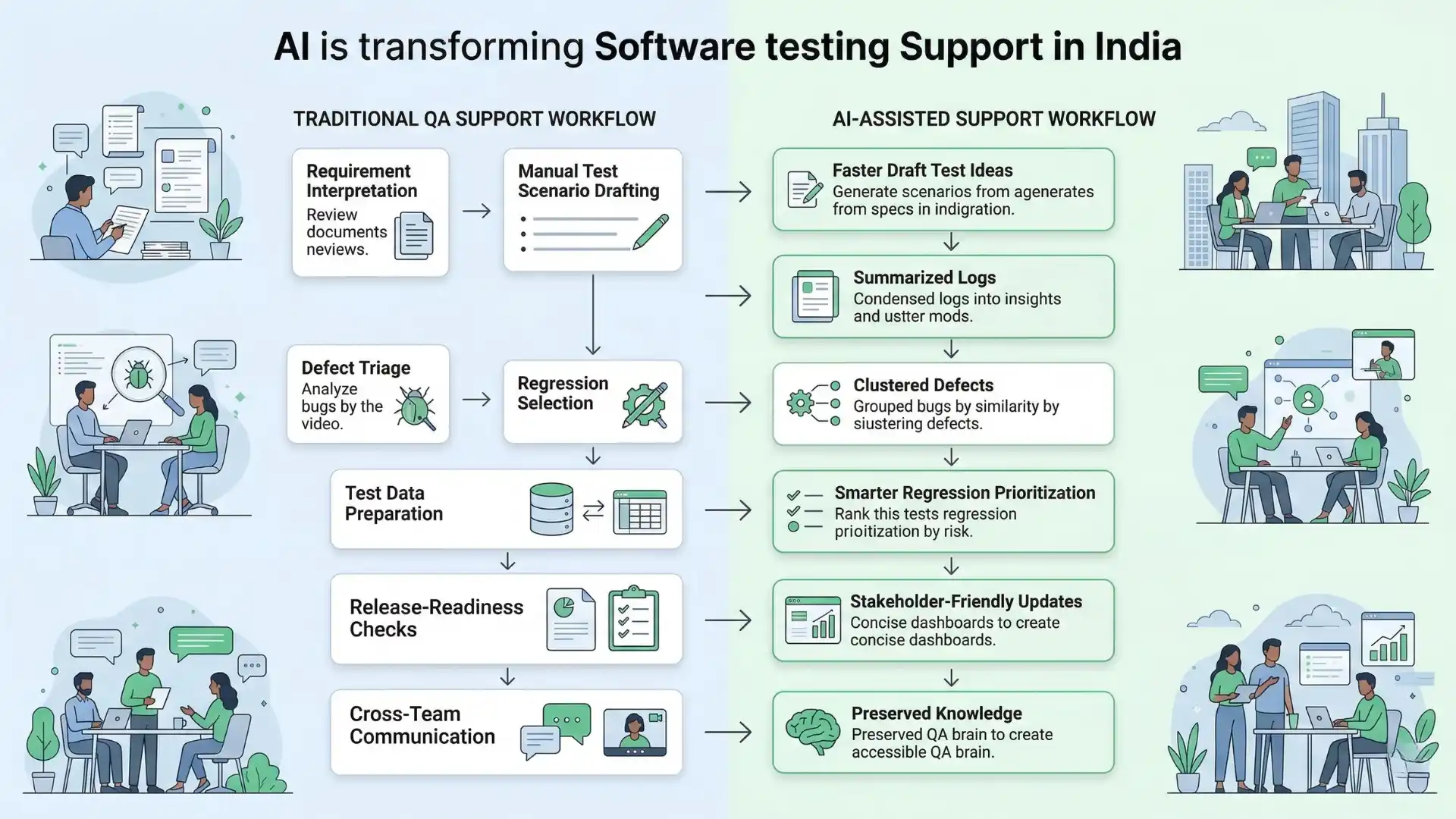
Software testing support includes the work that surrounds and strengthens testing itself: requirement interpretation, test scenario drafting, defect triage, log analysis, regression selection, test data preparation, documentation, release-readiness checks, and cross-team communication. In many Indian organizations, this support layer is where time is lost, quality slows down, and pressure builds.
The real value of AI is not that it magically replaces this work. The value is that it reduces friction inside it.
The biggest shift: from effort-heavy support to intelligence-assisted support
The strongest QA teams in India are not using AI simply to generate scripts. They are using it to improve the quality of support across the testing lifecycle.
A requirement document that once took hours to convert into test scenarios can now be turned into a structured first draft in minutes. A bug report that once moved slowly between tester, developer, and product owner can now be summarized with clearer reproduction logic, probable impact, and missing edge cases. A regression cycle that once expanded endlessly can now be narrowed with better signals and prioritization.
This is where AI becomes valuable: not as a replacement for judgment, but as a multiplier for clarity.
Capgemini’s World Quality Report 2025–26 captures this tension well. It found that 43% of organizations are experimenting with GenAI in QA, but only 15% have scaled it enterprise-wide. The gap is important. Awareness is high. Real operational maturity is still developing.
That is exactly why Indian QA leaders should think beyond hype. The question is no longer whether AI can support testing. The real question is how to adopt it in a way that improves quality without weakening trust.

Where AI is already changing software testing support
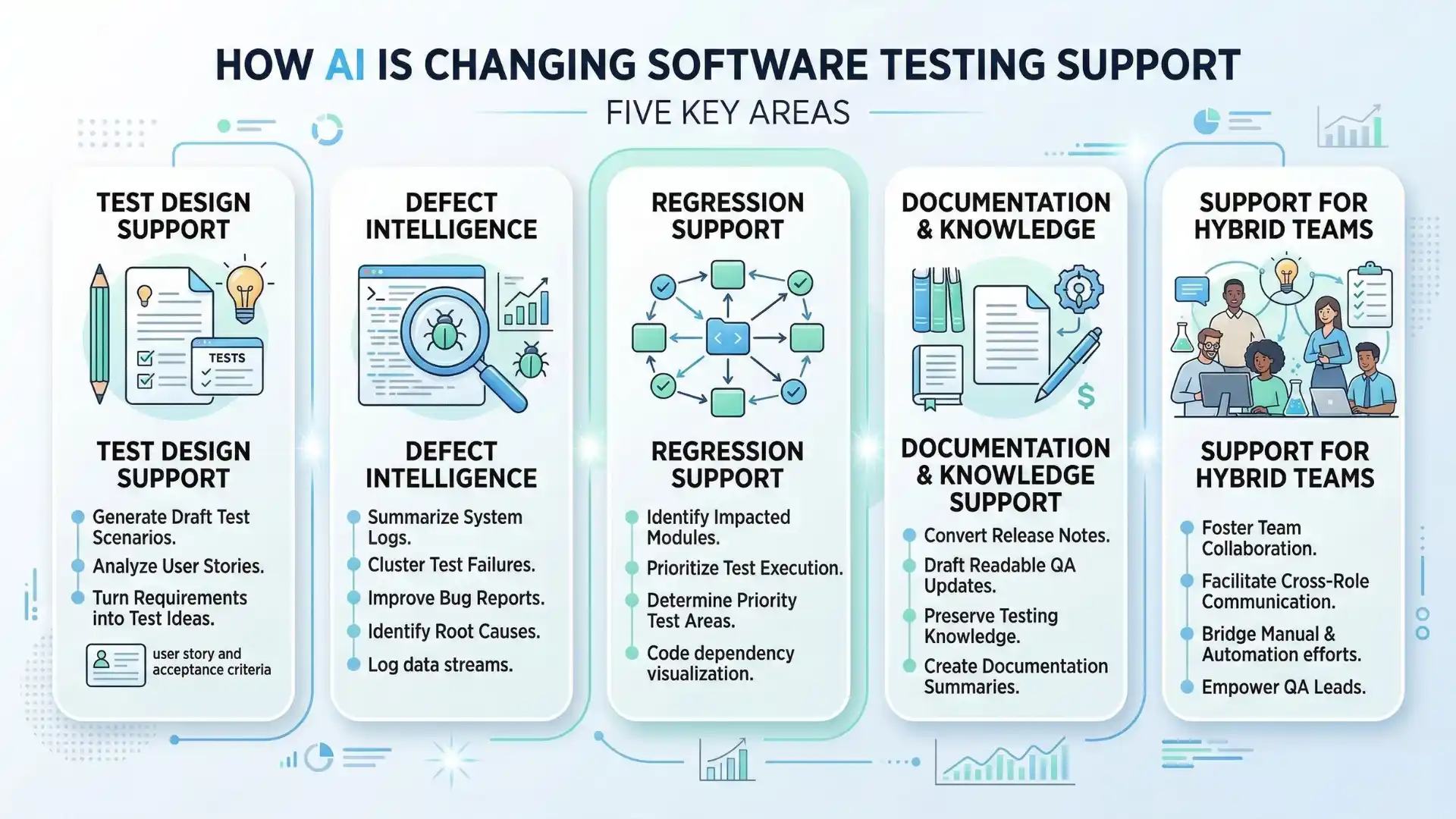
The first major area is test design support. AI can convert user stories, acceptance criteria, and change notes into draft test ideas faster than most teams can manually document them. This is especially useful when teams are working under sprint deadlines and need a stronger first pass rather than a perfect final answer.
The second area is defect intelligence. AI can help testers summarize logs, cluster recurring failures, rewrite vague bug descriptions, and highlight probable causes. This does not eliminate the need for technical skill. But it reduces the time spent translating raw evidence into actionable information.
The third area is regression support. One of the biggest testing challenges in modern delivery is deciding what truly needs to be retested. AI can help identify impacted modules, suggest priority areas, and support a risk-based approach instead of defaulting to large regression cycles.
The fourth area is documentation and knowledge support. Many testing delays happen not because a team lacks tools, but because context is scattered. AI can help summarize release notes, convert testing observations into stakeholder-friendly updates, and preserve institutional knowledge that often disappears when teams scale or shift.
The fifth area is support for hybrid teams. India has a large mix of manual testers, automation engineers, QA leads, consultants, and service-delivery teams. AI can serve as a bridge across these roles by making knowledge more accessible and routine support work more consistent.
Why this matters especially in India
India is not just a large technology market. It is one of the most operationally diverse testing environments in the world.
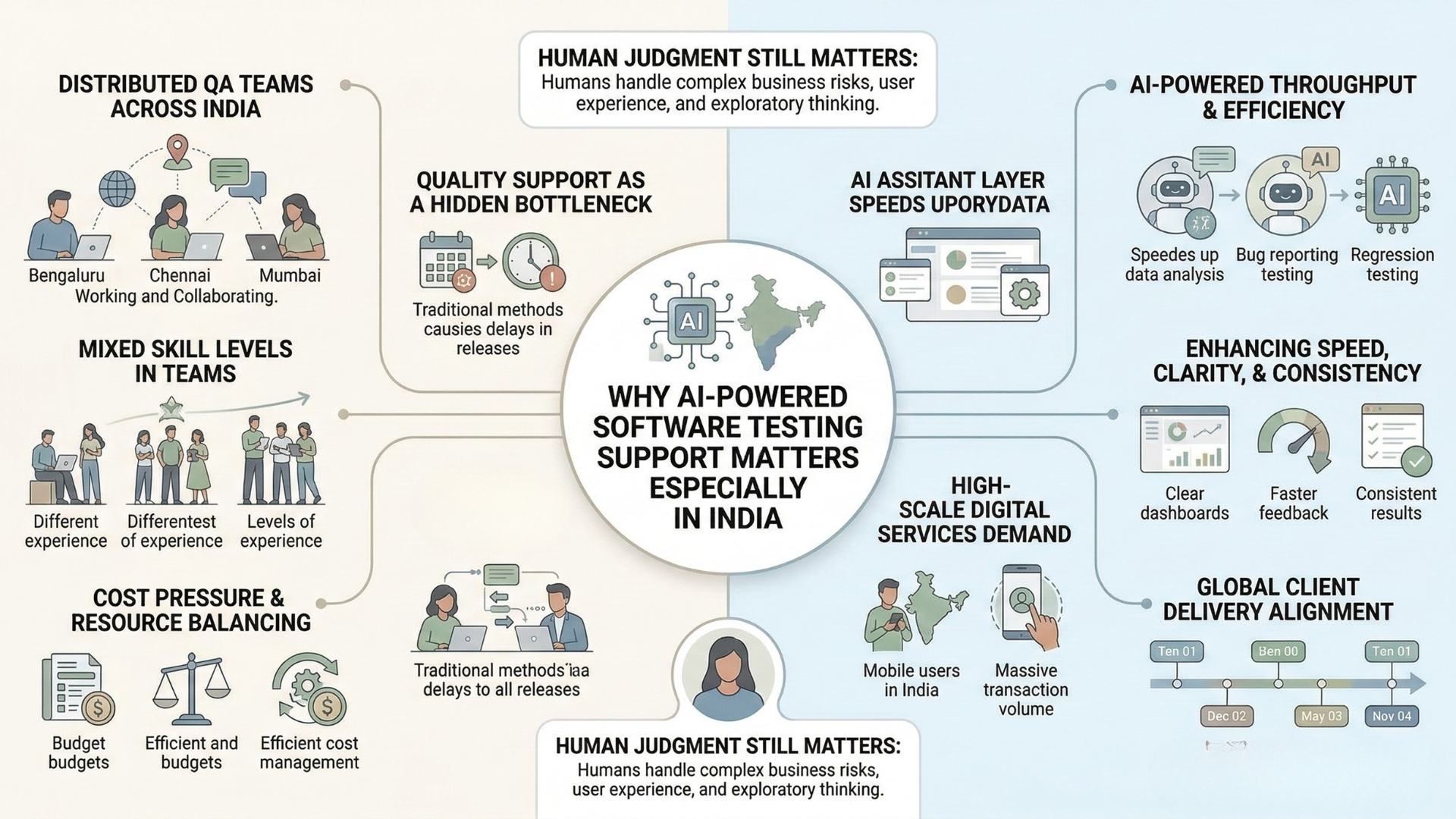
Teams here support global clients, fast-moving product companies, enterprise transformation programs, and digital services at massive scale. Many organizations work across distributed teams, mixed skill levels, aggressive timelines, and constant cost pressure. In that environment, software testing support often becomes the hidden bottleneck.
AI changes that equation because it helps teams improve throughput without relying only on linear headcount growth. That is one reason the India context matters so much. The conversation is not only about tools. It is about how Indian teams can scale quality support more intelligently.
But AI still has clear limits
This is where responsible leadership matters.
AI can suggest. It can summarize. It can draft. It can prioritize. But it does not truly understand business risk the way an experienced tester, product owner, or QA architect does.
It does not reliably interpret ambiguous stakeholder intent. It does not replace exploratory thinking. It does not automatically detect whether a test gap could become a serious production issue. And it should never be trusted blindly in quality-critical environments.
That balance is visible across the industry. PractiTest’s 2026 State of Testing Report highlights 76.8% adoption of AI in testing, but broad adoption does not automatically mean deep maturity.
In other words, AI is becoming common. Wise usage is still the differentiator.
What forward-looking QA leaders in India should do now
The best next step is not “adopt AI everywhere.” It is to start where testing support is repetitive, time-consuming, and low in strategic value.
Use AI first to accelerate draft work, not final decisions. Let it assist with test idea generation, bug summary creation, release-note interpretation, and documentation support. Keep human review where business context, product nuance, and release risk matter most.
At the same time, invest in a new tester capability: the ability to work with AI critically. In the coming years, the strongest testers in India will not be those who only execute faster. They will be those who can validate AI output, challenge weak suggestions, refine prompts with context, and combine domain knowledge with machine speed.
That is the real transformation.


The future of software testing support in India
AI is changing software testing support in India because it is changing the economics of attention.
Teams no longer need to spend all their energy on repetitive support work that drains time but adds little strategic value. They can redirect more effort toward risk analysis, exploratory depth, product understanding, and release confidence.
That is why this shift matters. Not because AI makes testers obsolete. Not because every QA problem now has an AI answer. But because the support system around testing is becoming faster, smarter, and more scalable.
The future belongs to teams that understand this clearly:
AI should not replace testing judgment. It should strengthen it.
And in India, where quality teams are expected to deliver global-scale outcomes under constant pressure, that shift may become one of the most important competitive advantages of the next few years.
As AI continues to reshape quality engineering, now is the right time for testers to move from awareness to action. Learning how to apply AI in software testing can help professionals improve test design, speed up defect analysis, strengthen automation workflows, and stay relevant in a fast-changing delivery environment. If you want to build practical, job-ready skills in this space, our AI course is designed to help you understand real-world use cases and confidently bring AI into your testing career.
FAQs
What is software testing support?
Software testing support includes test design help, defect triage, regression planning, documentation, release-readiness checks, and QA communication that strengthen the testing process.
How is AI used in software testing support?
AI is used to draft test scenarios, summarize defects, analyze logs, prioritize regression, support documentation, and improve QA communication.
Is AI replacing software testers in India?
No. AI is not replacing software testers in India. It is helping them work faster and make better decisions by reducing repetitive support work.
Why is AI important for QA teams in India?
AI is important because Indian QA teams often work across distributed environments, mixed skill levels, and fast release cycles where support efficiency matters.
What are the limits of AI in software testing?
AI can draft, summarize, and suggest, but it cannot reliably replace human judgment, exploratory thinking, or business-risk analysis.
We Also Provide Training In:
- Advanced Selenium Training
- Playwright Training
- Gen AI Training
- AWS Training
- REST API Training
- Full Stack Training
- Appium Training
- DevOps Training
- JMeter Performance Training
Author’s Bio:


Content Writer at Testleaf, specializing in SEO-driven content for test automation, software development, and cybersecurity. I turn complex technical topics into clear, engaging stories that educate, inspire, and drive digital transformation.
Ezhirkadhir Raja
Content Writer – Testleaf