
Real-World Risks, Research Insights & What It Means for Software Testing
Artificial Intelligence is no longer an emerging technology.
It is infrastructure.
From generative copilots and predictive analytics to autonomous systems and AI-driven testing tools, AI is now embedded into enterprise workflows. According to McKinsey’s global AI report, more than half of organizations have adopted AI in at least one core business function. The World Economic Forum projects that nearly 44% of workforce skills will shift by 2027 due to AI and automation.
But rapid adoption does not mean maturity.
As we move deeper into 2026, AI systems are exposing technical fragility, ethical tensions, governance gaps, and workforce disruption at scale.
This article breaks down the Top 20 challenges of Artificial Intelligence in 2026, categorized strategically to help technology leaders, engineers, and QA professionals understand not just what the problems are — but why they matter long-term.
What are the biggest challenges of Artificial Intelligence in 2026?
The biggest AI challenges in 2026 include hallucination, bias, lack of explainability, model drift, data quality issues, regulatory compliance, and testing complexity in AI systems.
Key Takeaways
-
AI is shifting from innovation to infrastructure
-
Technical challenges include hallucination, drift, and data quality
-
Ethical risks involve bias, privacy, and accountability
-
Testing AI requires new validation strategies
-
AI will transform—not replace—QA roles
Who Should Read This?
-
QA engineers working on AI-driven systems
-
Developers building AI applications
-
Tech leaders managing AI adoption
-
Professionals exploring AI in software testing
Recommended for You: api testing interview questions
1. Core Technical Challenges of Artificial Intelligence
1. AI Hallucination in Generative Systems
Large language models still produce confident but incorrect responses. Even with retrieval-augmented architectures and reinforcement learning, hallucination remains a reliability concern for enterprises.
2. Bias and Fairness in AI Models
AI systems reflect the biases present in training data. In sectors like hiring, lending, and healthcare, this creates real-world consequences.
3. Lack of Explainability (XAI Gap)
Deep learning systems often operate as black boxes. Regulators and enterprises increasingly demand explainable AI to ensure transparency.
4. Non-Deterministic Outputs
Unlike traditional software, AI systems may produce different outputs for the same input. This unpredictability complicates validation and quality assurance.
5. Model Drift in Production
AI models degrade over time as real-world data evolves. Without monitoring systems, performance can silently decline.
6. Data Quality Constraints
High-quality AI depends on clean, structured, and representative datasets — still a major bottleneck in many industries.
7. Adversarial Attacks & Prompt Injection
AI systems can be manipulated through crafted inputs. Security researchers continue to demonstrate vulnerabilities in generative systems.
8. Testing Complexity of AI Systems
Probabilistic models require new validation approaches. Traditional test case strategies often fail when applied to AI-based applications.
Popular Articles: manual testing interview questions
2. Ethical & Trust Challenges
9. Data Privacy & Regulatory Compliance
With regulations like GDPR and India’s Digital Personal Data Protection Act, AI deployments must operate within strict legal frameworks.
10. Deepfake & Synthetic Media Misuse
AI-generated content is advancing faster than detection systems, raising misinformation concerns.
11. Intellectual Property Conflicts
Legal debates continue over training AI systems on copyrighted data.
12. Accountability Gaps
When AI systems make harmful decisions, responsibility becomes unclear — developers, deployers, or organizations?
13. Algorithmic Transparency
Users increasingly demand visibility into how automated decisions are made.


3. Workforce & Economic Challenges
14. The AI Skill Gap
While AI adoption accelerates, AI literacy among professionals lags behind. The gap between AI capability and workforce readiness continues to widen.
15. Job Displacement Anxiety
Automation creates uncertainty. Although AI often augments rather than replaces roles, fear remains widespread.
16. Over-Reliance on Automation
Blind trust in AI-driven decisions without human oversight increases systemic risk.
17. Infrastructure Inequality
Advanced AI requires high compute power. Smaller organizations struggle to access the same resources as large enterprises.
4. Strategic & Governance Challenges
18. Regulatory Fragmentation Across Countries
Different AI laws across regions complicate global implementation strategies.
19. Vendor Lock-In
Heavy reliance on a single AI provider introduces long-term strategic risks.
20. Energy Consumption & Sustainability
Training large AI models consumes significant electricity. Sustainability concerns are now part of executive-level discussions.
More Insights: product based companies in chennai
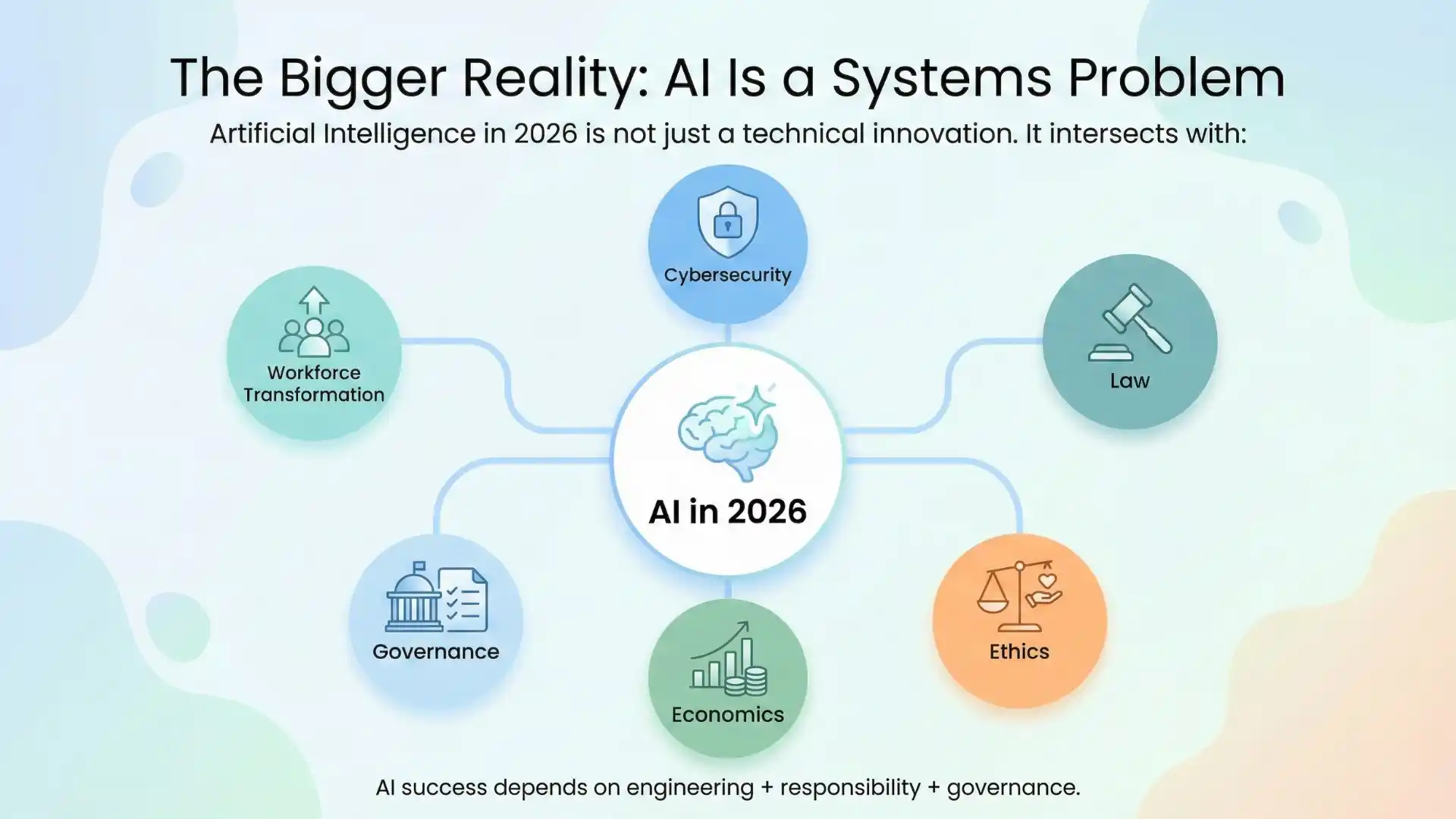
The Bigger Reality: AI Is a Systems Problem
Artificial Intelligence in 2026 is not just a technical innovation.
It intersects with:
- Cybersecurity
- Law
- Ethics
- Economics
- Governance
- Workforce transformation

Gartner predicts that a majority of AI projects will face compliance or risk-related delays if governance structures are not built alongside deployment.
The future of AI is not determined by how fast models grow.
It is determined by how responsibly they are engineered, validated, and monitored.
What These AI Challenges Mean for Software Testing
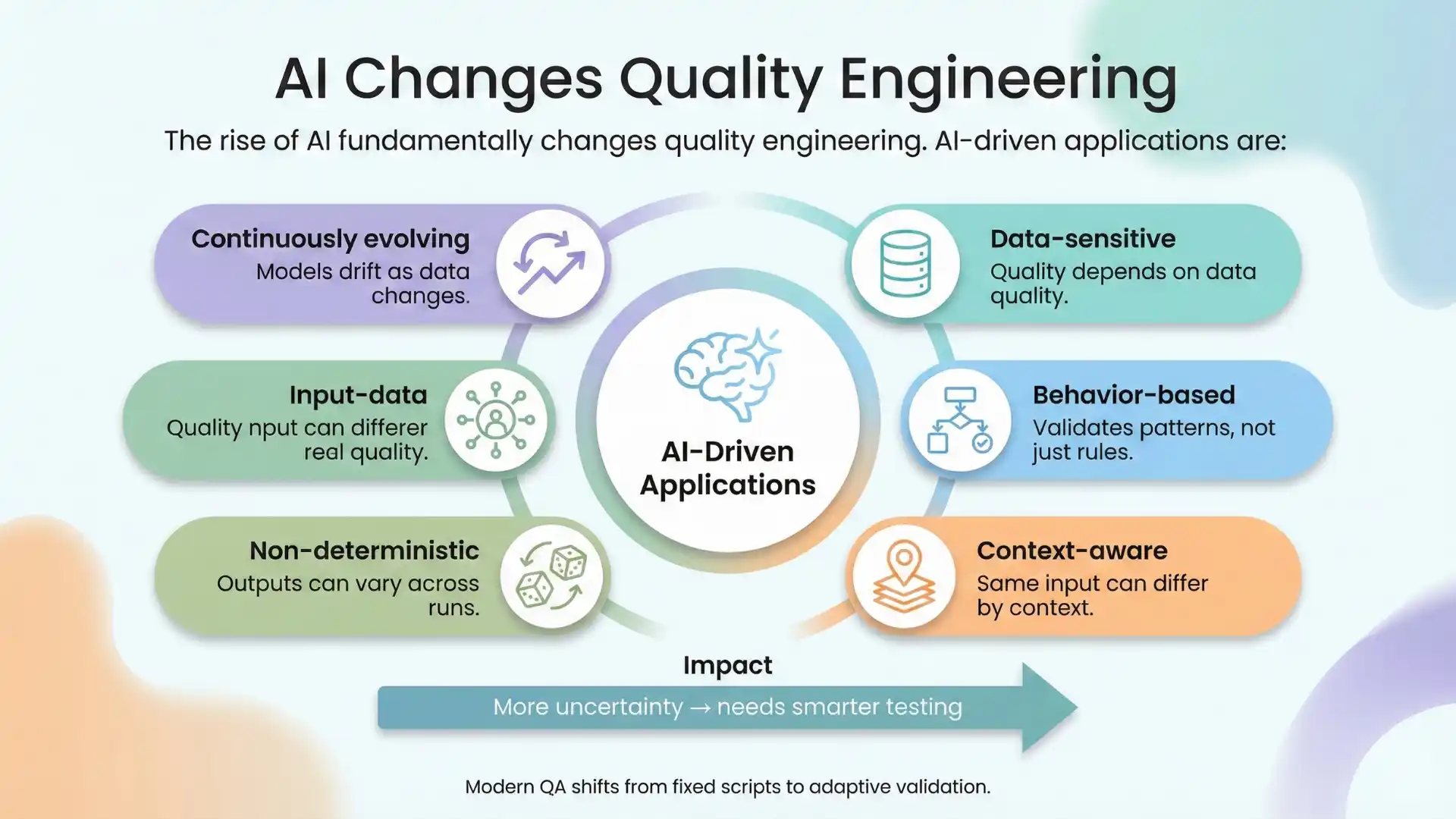
The rise of AI fundamentally changes quality engineering.
AI-driven applications are:
- Data-sensitive
- Behavior-based
- Context-aware
- Non-deterministic
- Continuously evolving
Traditional software testing focused on predictable logic flows.
AI systems require:
- Risk-based validation
- Bias detection strategies
- Model performance monitoring
- Intelligent test data generation
- Continuous drift evaluation
- Security-focused adversarial testing
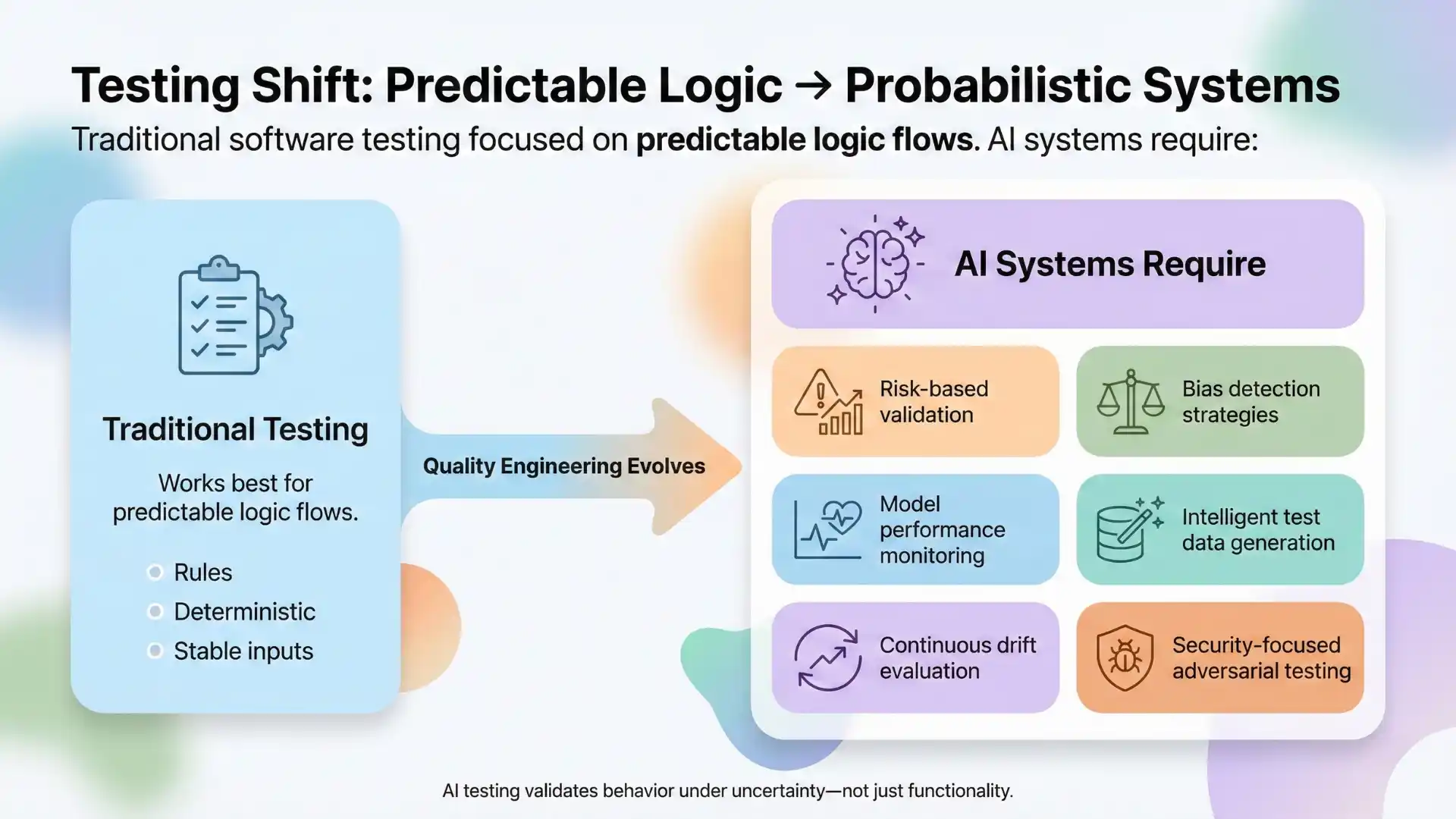
Testing AI is not just about checking functionality.
It is about validating behavior under uncertainty.
And that requires a shift in mindset.
Traditional Software vs AI Systems
| Aspect | Traditional Software | AI Systems |
|---|---|---|
| Behavior | Deterministic | Probabilistic |
| Testing | Rule-based | Risk-based |
| Output | Predictable | Variable |
| Maintenance | Code updates | Model retraining |
| Validation | Functional | Behavioral & statistical |
Final Thought: The Opportunity Behind the Challenge
Artificial Intelligence will continue to evolve.
Its complexity will increase.
Its influence will expand.
Its risks will become more sophisticated.
But every technological disruption creates opportunity.
If you face these AI challenges in software testing — from model instability and hallucination to bias detection and automation complexity — the solution is not to avoid AI.
The solution is to master it.
Learning AI in software testing equips professionals to:
- Validate intelligent systems effectively
- Build AI-aware automation frameworks
- Detect drift and anomalies early
- Reduce false positives in AI-driven applications
- Design resilient quality pipelines
The AI era in software testing is not about automation replacing testers.
It is about intelligent testers leading the transformation.
Those who invest in learning AI in software testing today will not just overcome these challenges — they will shine in the AI era of software testing.
The future belongs to professionals who understand AI, test AI, and evolve with AI.
FAQs
1. What is the biggest challenge in AI today?
Ensuring reliability and trust while scaling AI systems across real-world applications.
2. Why is AI hallucination a problem?
AI models generate responses based on probability, which can lead to incorrect or misleading outputs.
3. How does AI impact software testing?
AI introduces non-deterministic behavior, requiring new testing strategies like risk-based validation and model monitoring.
4. What is model drift in AI?
Model drift occurs when AI performance degrades over time due to changes in real-world data.
5. How can companies reduce AI bias?
By using diverse datasets, fairness testing, explainability tools, and continuous monitoring.
We Also Provide Training In:
- Advanced Selenium Training
- Playwright Training
- Gen AI Training
- AWS Training
- REST API Training
- Full Stack Training
- Appium Training
- DevOps Training
- JMeter Performance Training
Author’s Bio:


Content Writer at Testleaf, specializing in SEO-driven content for test automation, software development, and cybersecurity. I turn complex technical topics into clear, engaging stories that educate, inspire, and drive digital transformation.
Ezhirkadhir Raja
Content Writer – Testleaf