

Most Playwright frameworks do not become hard to maintain because Playwright is weak.
They become hard to maintain because teams slowly normalize duplication.
One login block gets copied into five test files.
One mock API response gets repeated across multiple specs.
One “temporary” helper becomes permanent.
One user creation flow is pasted again and again because “it works for now.”
Playwright frameworks become hard to maintain when teams copy setup logic, login flows, mock APIs, and test data across multiple specs. The solution is not just writing less code. It is separating responsibilities using fixtures for setup, Page Objects for page behavior, helpers for domain actions, and lean test files for business intent.
At first, nothing looks wrong.
The tests pass.
The sprint moves forward.
The team feels productive.
But after a few months, the hidden cost starts showing.
A small login change breaks multiple tests.
One mock gets updated, but another copy still uses the old response.
A new team member copies an outdated pattern because that is what they found first.
Debugging one failed test takes longer than writing a new one.
This is the silent reason Playwright frameworks become hard to maintain.
Not the tool.
Not the syntax.
Not the browser engine.
The real problem is poor test responsibility.
This article explains why Playwright framework maintenance problems usually come from duplicated setup and unclear test responsibility. It shows how fixtures help QA teams create predictable test contexts, reduce repeated code, improve CI stability, and build automation frameworks that remain easier to understand, change, and scale over time.
DRY Is Not About Writing Less Code
In test automation, DRY is often misunderstood.
Many teams think DRY means moving repeated code into helper functions. But that alone does not create a maintainable framework.
A test can have fewer lines of code and still be hard to understand.
A helper can reduce duplication but increase confusion.
A framework can look clean on the surface while hiding a complicated chain of setup logic underneath.
Good DRY design is not about making tests look short. It is about making tests easier to read, easier to debug, and easier to change.
That is where Playwright fixtures become important.
Playwright’s official documentation explains that fixtures establish the environment for each test and give the test everything it needs and nothing else. It also highlights that fixtures are isolated between tests, which makes them useful for clean and predictable test design.
That one idea is powerful.
The test should not prepare the entire world every time.
The framework should prepare the right world, and the test should focus on the story.
Recommended for You: playwright interview questions
The Real Cost of Repeated Setup
Duplication in automation rarely feels dangerous in the beginning.
A tester copies login code because another test needs the same user.
Another tester copies route mocking because it is faster than creating a reusable setup.
Someone else copies a navigation flow because the page journey looks similar.
Each decision feels practical.
But over time, the suite starts carrying too many versions of the same idea.
There are multiple ways to log in.
Multiple ways to create users.
Multiple ways to mock APIs.
Multiple ways to reach the same page.
Multiple helpers doing almost the same thing.
This creates a bigger problem than code duplication.
It creates decision duplication.
Every time someone writes a new test, they must ask:
“Which helper should I use?”
“Which login method is correct?”
“Which mock is updated?”
“Which setup is safe for CI?”
“Why does this test pass locally but fail in pipeline?”
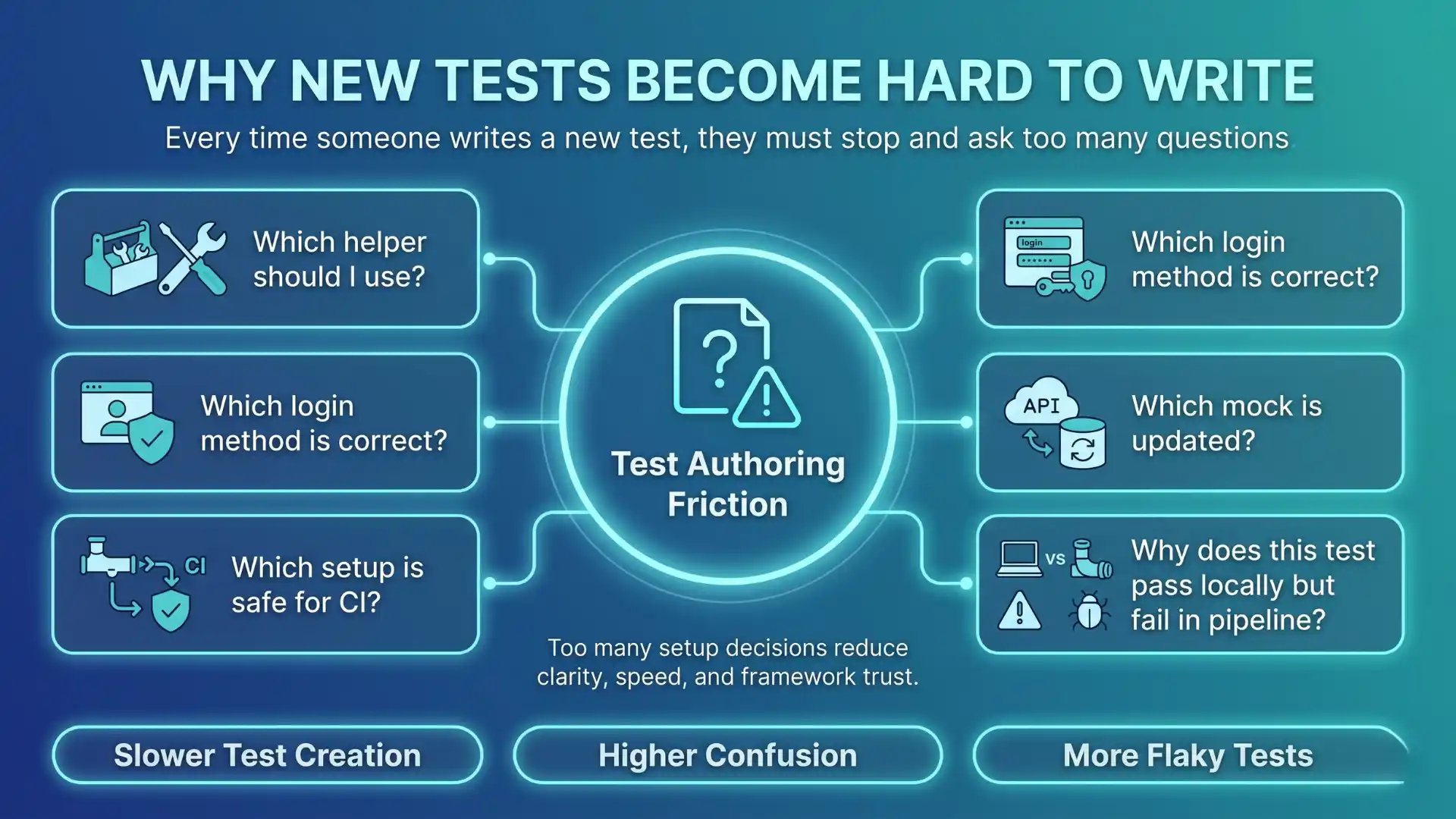

That is when automation stops being an accelerator and becomes a maintenance burden.
Fixtures Create One Clear Place for Shared Setup
A Playwright fixture is not just a reusable code block.
It is a controlled way to prepare test context.
Playwright already gives built-in fixtures such as page, browser, and context. Teams can extend this model with their own fixtures for common needs such as:
adminPage
loggedInUser
managerSession
mockOrdersApi
sampleCustomer
emptyCartState
seededProduct
ordersPage
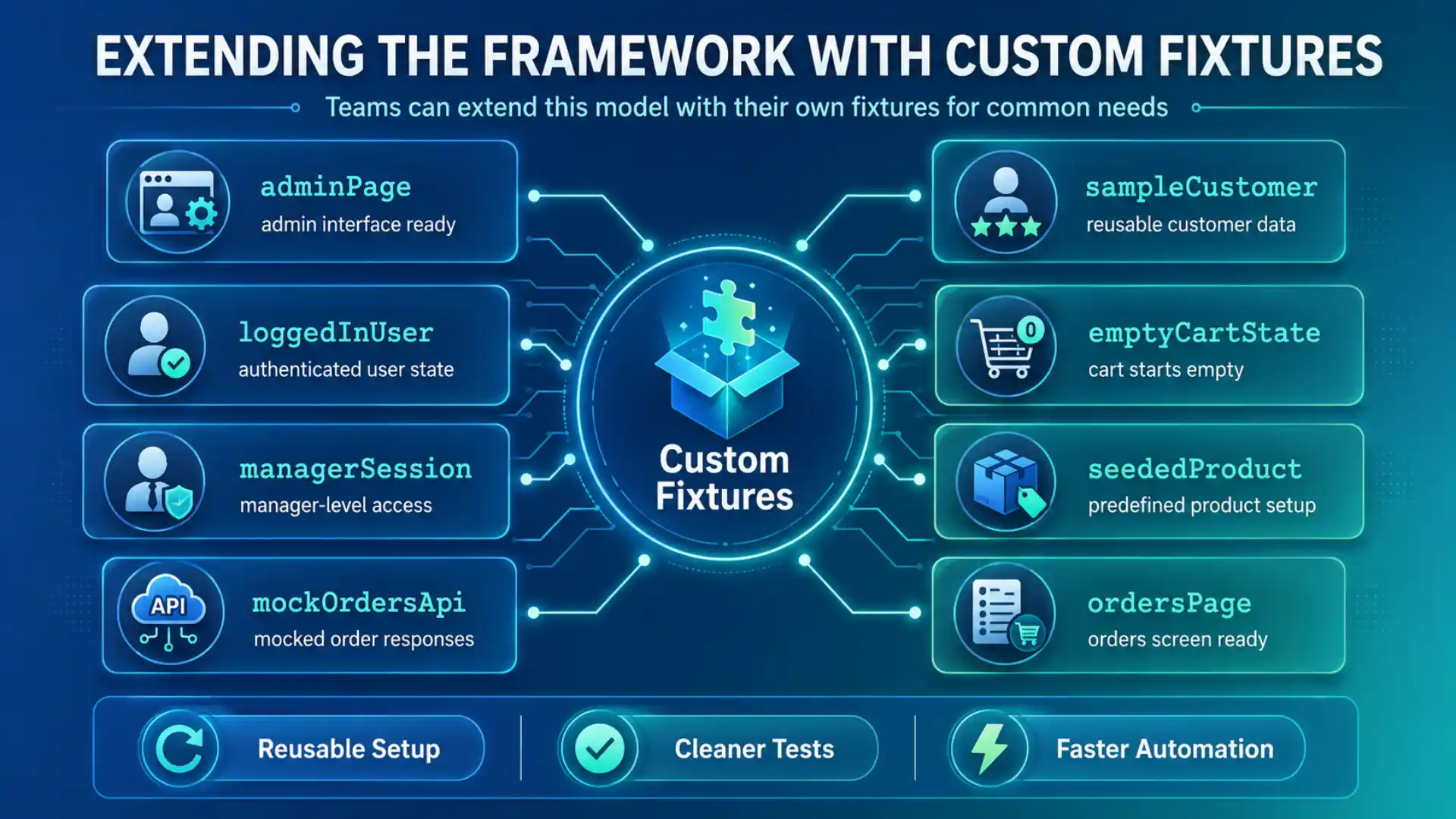
These names are not just technical labels. They define responsibility.
If every admin test starts through adminPage, the team has one clear place to manage admin setup.
If every order test uses mockOrdersApi, the mock behavior becomes easier to maintain.
If repeated test data comes from fixtures, the suite becomes more predictable.
This is where fixtures are stronger than random helper functions.
A helper function usually performs an action.
A fixture prepares a condition.
The fixture prepares.
The helper performs.
The test verifies.
That separation keeps the framework readable.
What Clean Fixture-Driven Tests Look Like
A duplicated test often looks like this:
test('admin can approve order', async ({ page }) => {
  await loginAsAdmin(page);
  await mockOrdersApi(page);
  await page.goto('/orders');
  await page.click('text=Approve');
  await expect(page.locator('.status')).toHaveText('Approved');
});
This test works, but it mixes too many responsibilities.
It handles login.
It handles mocking.
It handles navigation.
It handles action.
It handles assertion.
A cleaner fixture-driven version can look like this:
test('admin can approve order', async ({ adminPage, orders }) => {
  await orders.open();
  await orders.approveFirstOrder();
  await orders.expectStatus('Approved');
});
The second test is not just shorter.
It is clearer.
It does not hide the business flow. It removes the plumbing.
That is the difference between reducing code and improving design.
Check Out These Articles: Highest paying companies in india
Page Objects Alone Are Not Enough
Many Playwright teams already use Page Object Models. That is a good start.
Playwright’s documentation says large test suites can be structured to improve ease of authoring and maintenance, and Page Object Models are one way to structure such suites.
But Page Objects alone do not solve every framework problem.
A team may have clean page classes and still repeat login setup in every spec file.
They may have reusable locators but copied mock responses.
They may have page methods but scattered test data creation.
That is why mature Playwright design needs more than POM.
A clean framework usually combines:
Fixtures for setup
Page Objects for page behavior
Helpers for domain actions
Utilities for repeated assertions
Lean test files for business intent
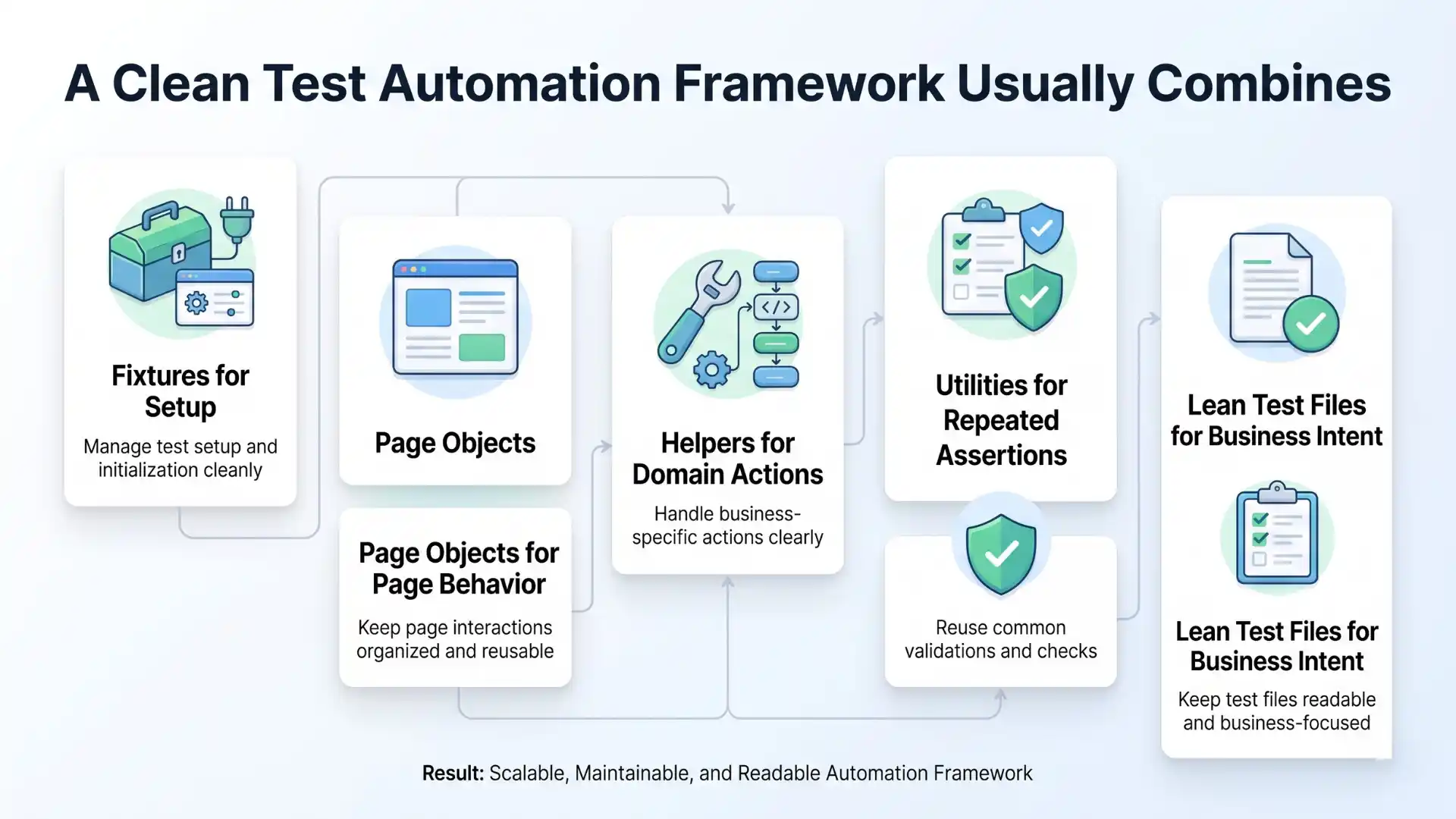
When these responsibilities are separated well, the framework becomes easier to scale.
The Trap of Over-Abstraction
There is also a danger on the other side.
Some teams hear “DRY” and start hiding everything.
The test becomes very short, but nobody knows what it really does.
A helper calls another helper.
That helper calls another utility.
The fixture name is too generic.
Debugging requires opening five different files.
The test looks clean, but the logic is invisible.
That is not maturity.
That is just confusion with fewer lines of code.
Good fixture-driven architecture should be clear, discoverable, and small in scope.
A good fixture name should explain its purpose immediately.
adminSession is clear.
mockOrdersApi is clear.
emptyCartState is clear.
setupEverything is not clear.
Naming is architecture.
When names are clear, the framework becomes easier for the team to trust.
Continue Reading: Automation testing interview question
When Not to Use Fixtures
Fixtures are powerful, but they should not be used everywhere.
Do not create a fixture when the setup is used only once.
Do not create a fixture just to make the framework look advanced.
Do not hide important business intent inside setup.
Do not create vague fixtures that future team members cannot understand.
A fixture should earn its place in the framework.
It should reduce repeated setup, improve consistency, and make the test easier to read.
If it does not do that, it is not helping.
Why This Matters for Modern QA Teams
Automation teams are no longer judged only by how many scripts they write.
They are judged by how reliably those scripts support fast delivery.
The World Quality Report has tracked quality engineering and testing trends for 16 years across technology, practices, industries, and geographies. Its 2024–25 edition continues to position quality engineering as a major part of modern software delivery.
This matters because the future of QA will not be decided only by tool knowledge.
Knowing Playwright is important.
But knowing how to design maintainable Playwright frameworks is more important.
A tester who only knows syntax can write automation.
A tester who understands architecture can build automation that survives product changes, team growth, CI pressure, and future AI-assisted workflows.
That is the difference between writing tests and building a test system.
The Testleaf Perspective
At Testleaf, we often see one common pattern across automation teams.
Two teams may use the same tool, but their outcomes can be completely different.
One team writes tests quickly, but duplicates setup everywhere.
Another team invests in fixtures, helpers, Page Objects, test data design, and clean responsibility.
After six months, the difference becomes clear.
The first team asks:
“Why are these tests failing again?”
The second team asks:
“Where should this responsibility live so the next person can change it safely?”
That question is the real sign of automation maturity.
Not how many tests were written.
Not how many folders the framework has.
Not how advanced the code looks.
Maturity means the framework is understandable, reusable, and safe to change.
Conclusion
Playwright fixtures are not just a way to reduce repeated code.
They are a way to design cleaner test responsibility.
They help teams move from copied setup to shared design.
From scattered helpers to clear ownership.
From fragile automation to maintainable test architecture.
The goal is not to build the smartest-looking framework.
The goal is to build a framework the team can understand, trust, and improve.
Because in the long run, the best Playwright framework is not the one with the fewest lines of code.
It is the one where every test clearly shows what matters, every setup has a proper home, and every future change is easier than the last one.
FAQs
Why do Playwright frameworks become hard to maintain?
Playwright frameworks become hard to maintain when teams copy login steps, mock APIs, setup flows, and test data across many spec files. This creates duplication, confusion, and inconsistent test behavior.
How do Playwright fixtures improve test automation frameworks?
Playwright fixtures improve frameworks by preparing reusable test context in one clear place. They help reduce duplicated setup, improve consistency, and keep test files focused on business intent.
Are Playwright fixtures better than helper functions?
Fixtures and helpers solve different problems. Fixtures prepare test conditions, while helpers perform reusable actions. A clean Playwright framework usually uses both with clear responsibility.
Should every repeated setup become a Playwright fixture?
No. A fixture should be created only when it reduces repeated setup, improves clarity, and makes tests easier to maintain. One-time setup does not always need a fixture.
What makes a Playwright framework maintainable?
A maintainable Playwright framework has clear fixtures, focused Page Objects, reusable helpers, shared utilities, readable test files, and strong separation of responsibility.
We Also Provide Training In:
- Advanced Selenium Training
- Playwright Training
- Gen AI Training
- AWS Training
- REST API Training
- Full Stack Training
- Appium Training
- DevOps Training
- JMeter Performance Training
Author’s Bio:


Content Writer at Testleaf, specializing in SEO-driven content for test automation, software development, and cybersecurity. I turn complex technical topics into clear, engaging stories that educate, inspire, and drive digital transformation.
Ezhirkadhir Raja
Content Writer – Testleaf