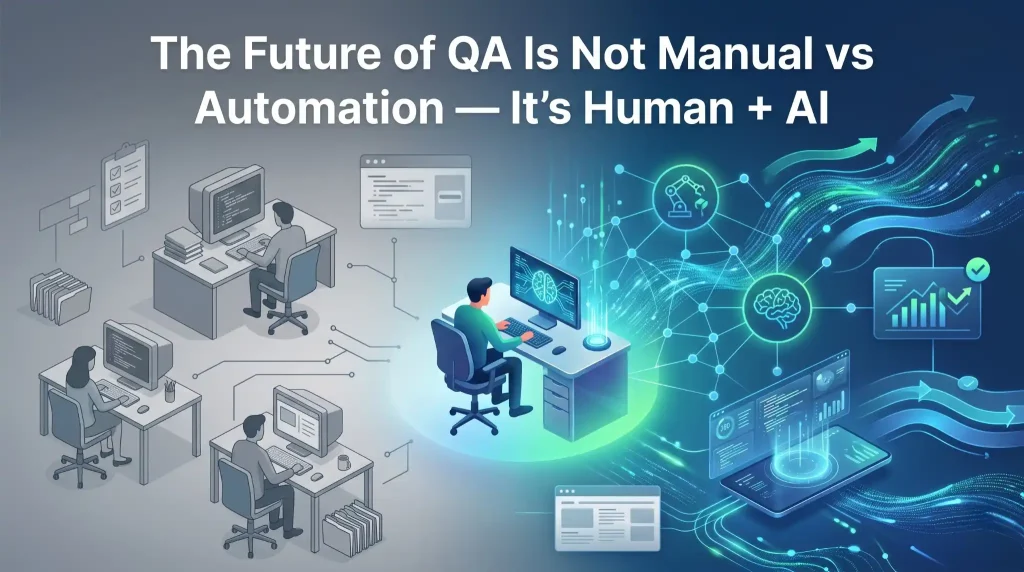
The future of QA is not about choosing between manual testing and automation. It is about combining human judgment with AI speed. AI can generate tests, analyze failures, and improve coverage, while QA engineers validate outcomes, understand risks, and make quality decisions.
This blog is a continuation of our previous articles — “AI Won’t Replace Testers — But It Will Replace How They Work,” “How Manual Testers Can Transition to AI-Driven QA in 6 Months,” “Why AI Testing Needs QA Engineers More Than Ever,” and “How to Build AI Testing Agents.”
Across these articles, one pattern becomes clear:
The debate is no longer “manual vs automation.”
The real shift is “human + AI.”
In modern software testing, AI is changing how QA teams design, execute, and improve testing workflows. However, the role of QA engineers remains critical because AI still needs human validation, business context, risk analysis, and decision-making. The strongest QA professionals will not compete with AI — they will learn how to use it as a productivity and quality multiplier.
The mebate Is No Longer Relevant
For years, testing conversations revolved around:
- Manual testing vs automation
- Scripted testing vs exploratory testing
- Selenium vs Playwright
These debates made sense when:
- Testing was effort-heavy
- Automation required significant coding
- Scaling testing was difficult
But today, AI has changed the context.
Continue Reading: playwright interview questions
What AI Has Changed
AI has introduced a new layer into testing.
It can:
- Generate test cases
- Suggest test coverage
- Assist in automation
- Analyze failures
- Improve workflows over time
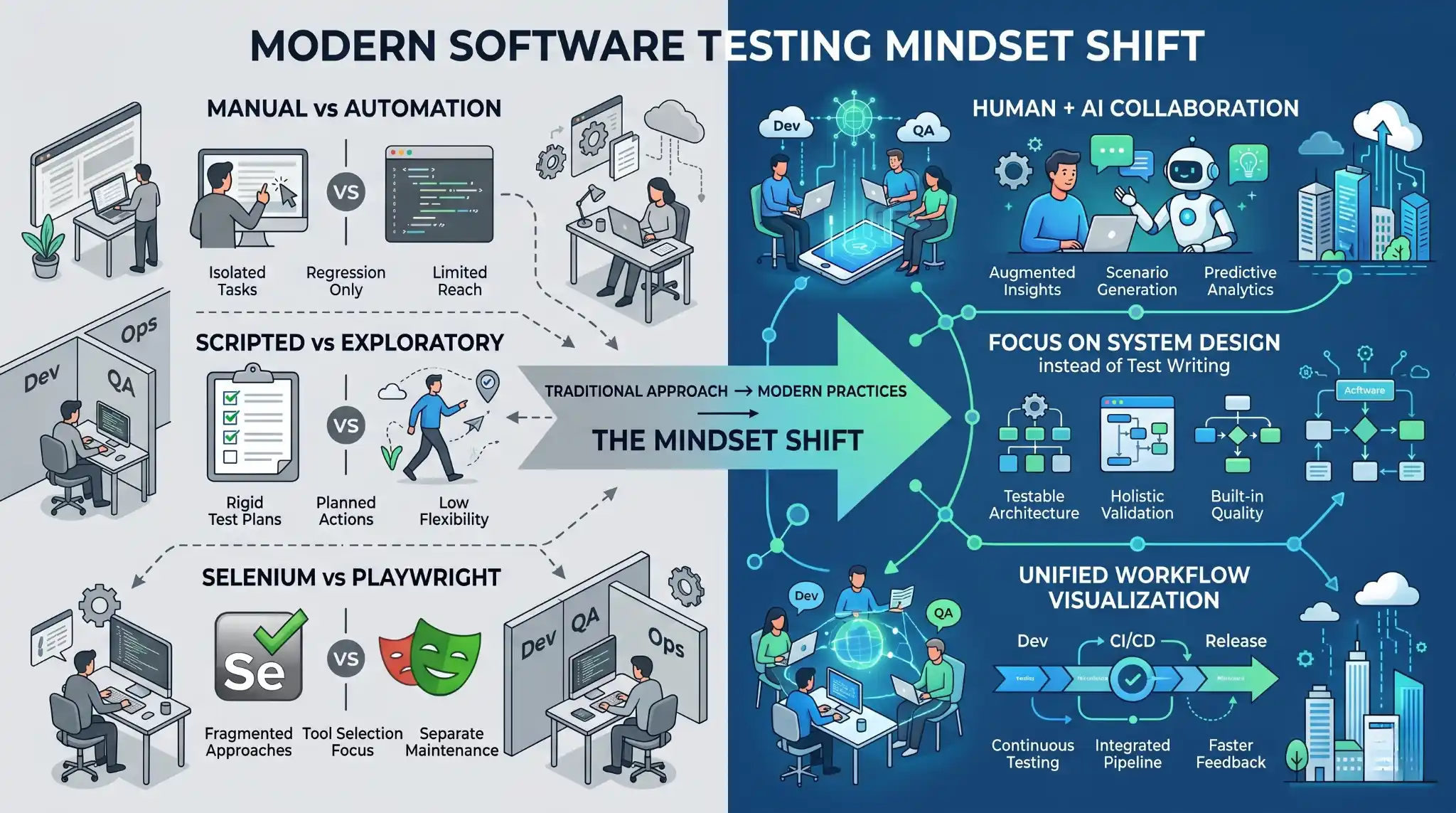
This means:
👉 The focus is no longer on how tests are written
👉 The focus is on how testing systems are designed
As this maturity grows, QA teams can move beyond simple AI assistance and learn how to build AI testing agents that support smarter testing workflows.
Human vs AI Is the Wrong Comparison
A common mistake is comparing humans and AI.
- Can AI replace testers?
- Can AI do everything automatically?
This comparison misses the point.
This is why many QA professionals are now realizing that AI won’t replace testers — it will replace the way testers work.
AI is:
- Fast
- Scalable
- Pattern-driven
Humans are:
- Context-aware
- Judgment-driven
- Responsible for decisions
These are not competing strengths.
They are complementary.
This is also why AI testing needs QA engineers more than ever — because AI can generate outputs, but humans must validate quality, risk, and correctness.
The New Model: Human + AI
The future of QA is built on collaboration.
What AI Does Best
- Handles repetitive tasks
- Processes large volumes of data
- Generates outputs quickly
- Identifies patterns
What Humans Do Best
- Understand business context
- Identify risk
- Make decisions
- Validate correctness
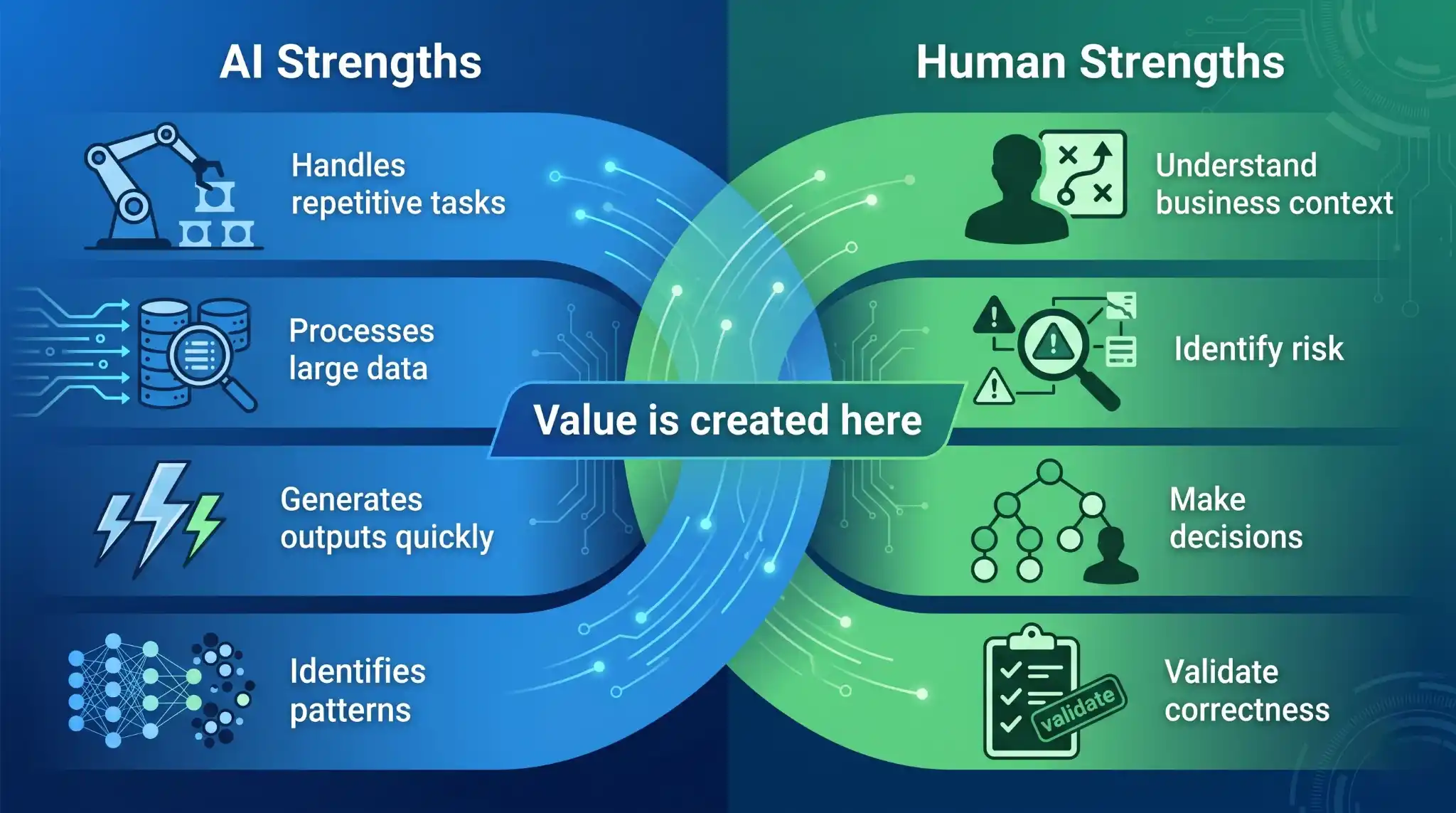
Where Value Is Created
The real value comes from combining both.
- AI accelerates execution
- Humans ensure correctness
- AI generates possibilities
- Humans validate outcomes
You Might Also Like: product based companies in chennai
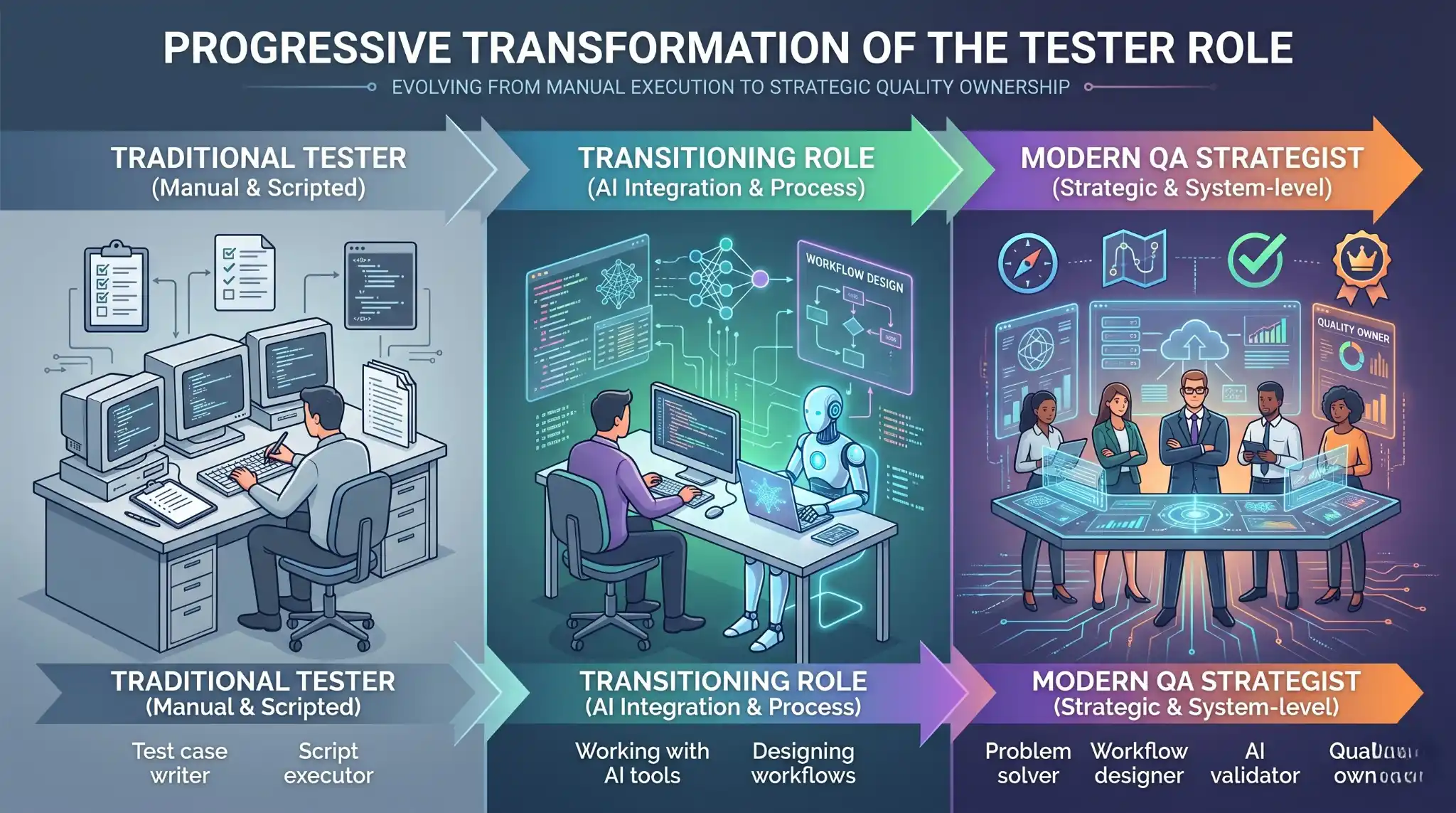
How the Role of Testers Is Evolving
Testers are no longer just:
- Test case writers
- Script executors
They are becoming:
1. Problem Solvers
Identifying what needs to be tested and why.
2. Workflow Designers
Building intelligent testing processes using AI.
3. AI Validators
Ensuring outputs generated by AI are correct and reliable.
4. Quality Owners
Taking responsibility for system behavior and risk.
Why This Shift Matters
In a conversation with Babu Manickam — CEO & Co-Founder of QEagle and Testleaf, with over 25+ years of experience in software testing and quality engineering — a key idea stands out:
The goal is not to replace testers with AI, but to help testers work smarter using AI.
This shift:
- Reduces manual effort
- Improves efficiency
- Increases testing coverage
- Enhances decision-making
More Insights: AI and ML engineer salary in india
What Happens If Testers Ignore This Shift
If testers continue to:
- Focus only on manual execution
- Avoid automation and AI
- Stick to old workflows
They risk becoming less relevant.
Not because testing disappears,
but because the way testing is done has changed.
What Happens If Testers Embrace This Shift
Testers who adopt AI:
- Work faster
- Solve bigger problems
- Contribute to system design
- Become more valuable in teams
For manual testers, this shift creates a clear opportunity to transition to AI-driven QA with the right learning path and practical skill development.
They move from:
- Task execution → impact creation
The Skills That Matter Going Forward
The future QA skillset includes:
- Understanding testing fundamentals
- Basic automation knowledge
- Ability to work with AI tools
- Problem-solving mindset
- Ability to validate AI outputs
This is not about mastering everything.
It is about adapting to a new way of working.
The Real Transformation
The biggest change is not technical.
It is mental.
- From manual effort → intelligent workflows
- From writing tests → designing systems
- From execution → decision-making
Final Thought
The future of QA is not about choosing between manual and automation.
It is about combining human intelligence with AI capabilities.
Because:
AI can generate tests.
But only humans can decide what truly matters.
The future of QA belongs to those who don’t compete with AI —
but learn how to work with it.
As AI in software testing continues to evolve, QA professionals must understand that the future is not about replacing human testers, but about improving how testing decisions are made. AI can support faster test creation, smarter defect analysis, and better coverage, but human judgment is still needed to understand business risk, validate results, and ensure product quality. Testers who learn to combine their testing knowledge with AI-driven tools will be better prepared for the next phase of quality engineering.
FAQs
Will AI replace QA testers?
AI will not fully replace QA testers. It will change how they work by automating repetitive tasks, generating test ideas, and analyzing failures. Human testers are still needed for judgment, risk analysis, and validation.
Is manual testing still relevant in the AI era?
Yes, manual testing is still relevant because exploratory thinking, user understanding, and business context require human judgment. However, testers must also learn automation and AI-assisted workflows.
What is Human + AI testing?
Human + AI testing is a QA model where AI supports test generation, automation, and analysis, while humans guide decisions, validate correctness, and manage product risk.
What skills should QA testers learn for the future?
QA testers should build strong testing fundamentals, basic automation knowledge, AI tool awareness, prompt writing ability, analytical thinking, and the ability to validate AI-generated outputs.
Why is manual vs automation no longer the main QA debate?
Because AI has changed the testing landscape. The real focus is no longer only how tests are executed, but how intelligent testing systems are designed and validated.
We Also Provide Training In:
- Advanced Selenium Training
- Playwright Training
- Gen AI Training
- AWS Training
- REST API Training
- Full Stack Training
- Appium Training
- DevOps Training
- JMeter Performance Training
Author’s Bio:

Content Writer at Testleaf, specializing in SEO-driven content for test automation, software development, and cybersecurity. I turn complex technical topics into clear, engaging stories that educate, inspire, and drive digital transformation.
Ezhirkadhir Raja
Content Writer – Testleaf