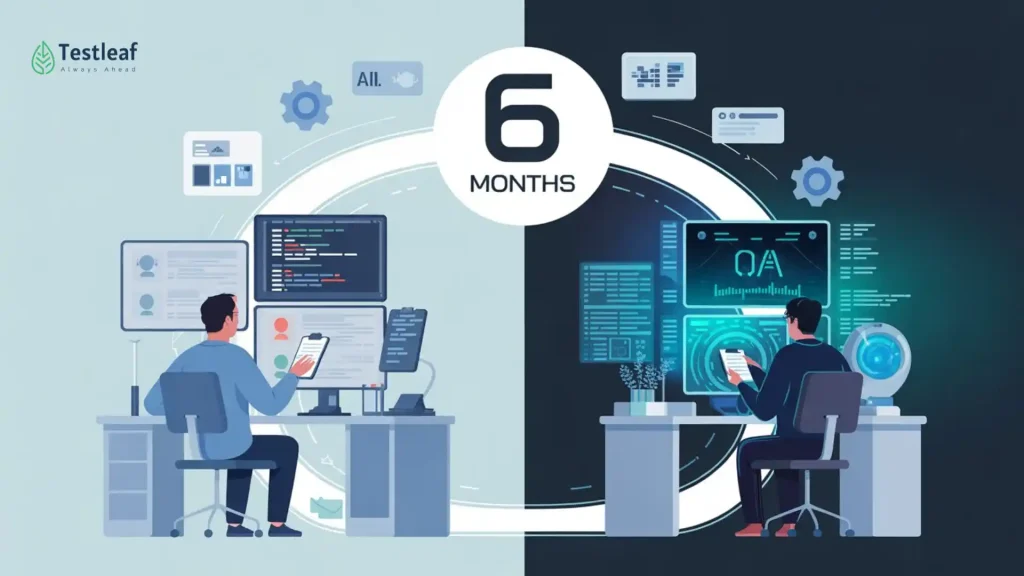
This blog is a continuation of our previous article — “AI Won’t Replace Testers — But It Will Replace How They Work.”
In that article, we explored how AI is changing the role of testers and why adapting to this shift is no longer optional.
In this blog, let’s take the next step:
How can a manual tester actually transition into AI-driven QA in a practical, step-by-step way?
Most manual testers today are not confused.
They are overwhelmed.
AI is everywhere.
Every post says “learn AI.”
Every tool claims to automate everything.
But no one answers the real question:
“What exactly should I learn — and in what order?”
In a recent conversation with Babu Manickam — CEO & Co-Founder of QEagle and Testleaf, with over 25+ years of experience in software testing and quality engineering, mentoring thousands of QA professionals into automation and AI-driven roles — one insight stood out:
You don’t need to become an expert developer to transition into AI-driven QA. You need to learn how to solve problems using AI.
This blog is a practical, no-fluff roadmap to help you do exactly that — in 6 months.
What is AI-driven QA?
AI-driven QA is the use of AI tools, automation, and workflows to improve testing efficiency, generate test cases, and validate intelligent systems.
In This Guide You’ll Learn:
- How to move from manual testing to AI QA
- What to learn each month
- Common mistakes to avoid
- Skills needed for AI-driven testing
Can a manual tester really transition into AI-driven QA without strong coding skills?
Yes—and this roadmap shows exactly how to do it step by step.
First, Let’s Be Clear: This Is Not a Shortcut
You cannot “learn AI testing” in a weekend.
But you also don’t need:
- A computer science degree
- Deep machine learning expertise
- Years of coding experience
What you do need is:
- Consistency
- Practical learning
- The right sequence
What should you learn first—automation or AI?
The answer is simpler than you think. You need the right sequence, not everything at once.
Popular Articles: playwright interview questions
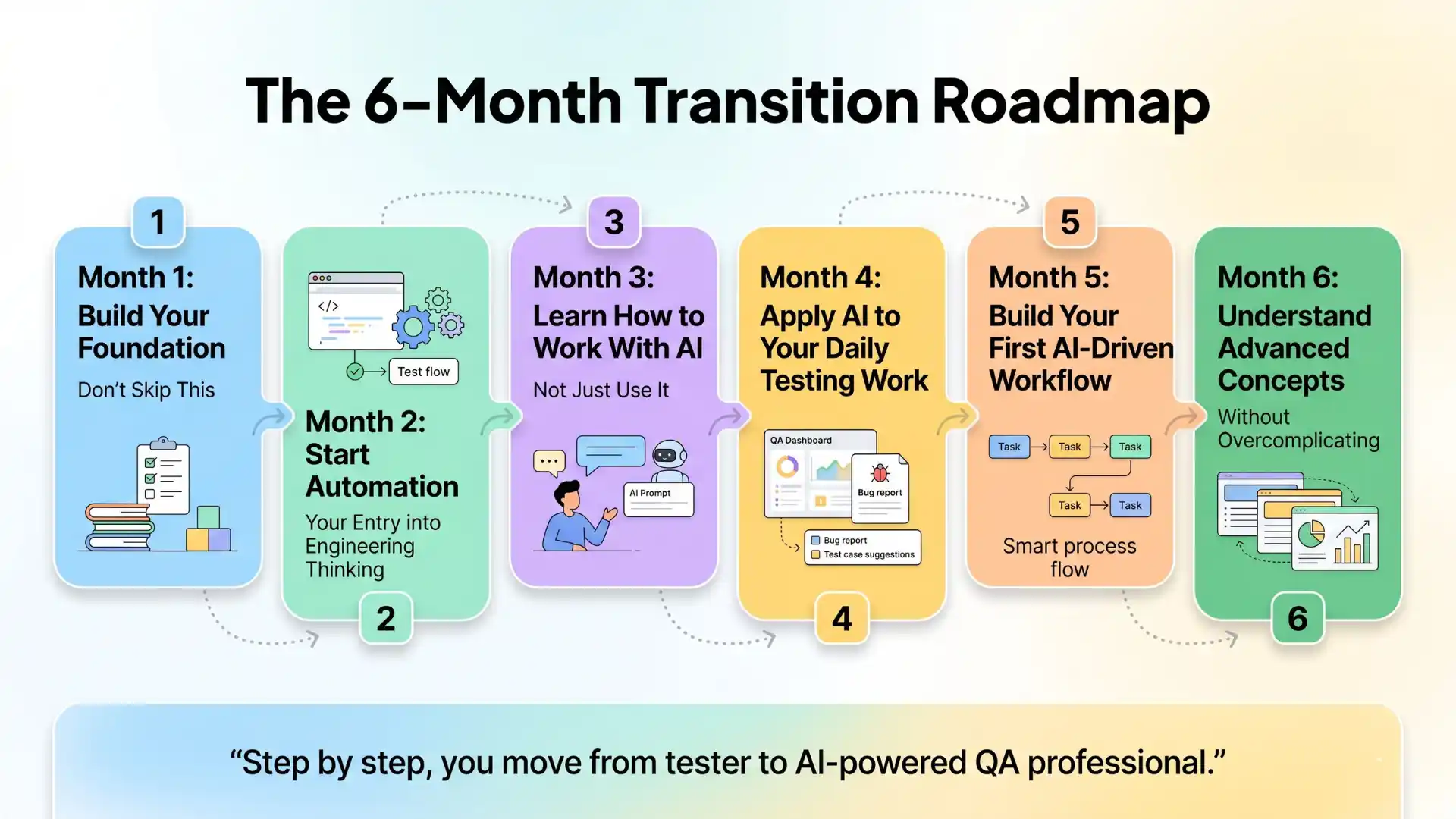
The 6-Month Transition Roadmap
This roadmap assumes:
- You are a manual tester
- You can spend around 30–60 minutes daily and additional time on weekends
Month 1: Build Your Foundation (Don’t Skip This)
Before jumping into tools, understand the basics.
Learn:
- What are Large Language Models (LLMs)
- How tools like ChatGPT actually work
- What happens when you give a prompt
- Why outputs vary (accuracy, hallucination)
Also explore:
- Differences between models (ChatGPT, Claude, LLaMA)
- Basic idea of embeddings
- Why context matters
This becomes your mental model layer.
Month 2: Start Automation (Your Entry into Engineering Thinking)
You don’t need advanced coding, but you need exposure.
Choose one:
- Playwright (recommended for modern workflows)
- Selenium (if already familiar)
Focus on:
- Writing basic test scripts
- Understanding locators
- Running tests
- Simple validations
The goal is confidence, not mastery.
Do you need to become a developer to start automation?
No. You only need enough understanding to think like an engineer.
Month 3: Learn How to Work With AI (Not Just Use It)
This is where most people go wrong.
They use AI tools, but don’t understand how to work with them.
Learn:
- Prompt engineering
- Context engineering
- API basics (how to call AI models programmatically)
Practice:
- Generate test cases using AI
- Refine outputs
- Compare results across different prompts
The goal is to understand how AI behaves.
Is using AI tools enough to succeed in testing?
No. The real skill is knowing how to work with AI, not just use it.
Month 4: Apply AI to Your Daily Testing Work
Now the shift becomes practical.
Look at your daily tasks and identify what takes the most time.
Examples:
- Writing test cases
- Regression selection
- Test data preparation
- API validations
Pick one problem and try solving it using AI.
For example:
- Generate test cases from requirements
- Convert test cases into automation scripts
- Create API test scenarios
The goal is to move from learning to applying.
Month 5: Build Your First AI-Driven Workflow
Instead of using AI manually, start building workflows.
Learn:
- Basic API integrations
- How to chain multiple steps together
- Introductory concepts of tools like LangChain
Build:
- Test case generator
- Regression test selector
- Selenium to Playwright converter
- API test generator from Swagger
The goal is to start thinking in workflows.
Month 6: Understand Advanced Concepts (Without Overcomplicating)
You don’t need deep expertise, but you should understand:
- RAG (Retrieval-Augmented Generation)
- Fine-tuning (basic understanding)
- Agent workflows
- How AI systems are tested
The goal is to be ready to work on real AI-driven projects.
What You Can Achieve in 6 Months
Following this roadmap will not make you an AI expert.
But it will make you:
- A tester who can work effectively with AI
- A QA professional who can automate intelligently
- Someone prepared for emerging testing roles
Why do most testers fail when learning AI?
Not because it’s hard—but because they follow the wrong approach.
Continue Reading: AI and ML salary in india
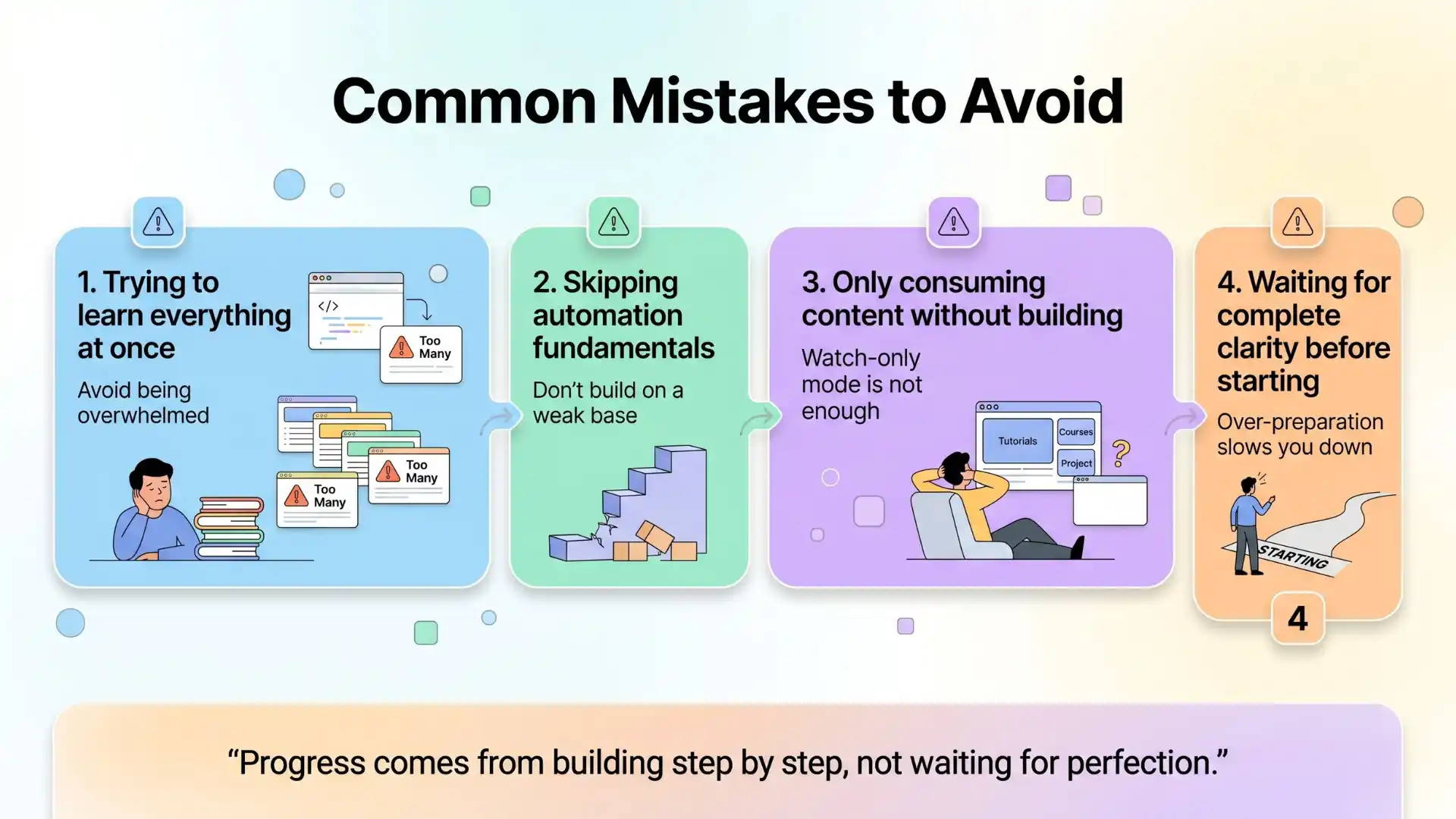
Common Mistakes to Avoid
- Trying to learn everything at once
- Skipping automation fundamentals
- Only consuming content without building
- Waiting for complete clarity before starting
Do You Need Strong Programming Skills?
No.
However, basic programming knowledge helps.
Even with limited understanding:
- You can build workflows
- You can use APIs
- You can solve real testing problems
Where Should You Learn From?
There is no shortage of learning resources.
But the real challenge is continuity and clarity.
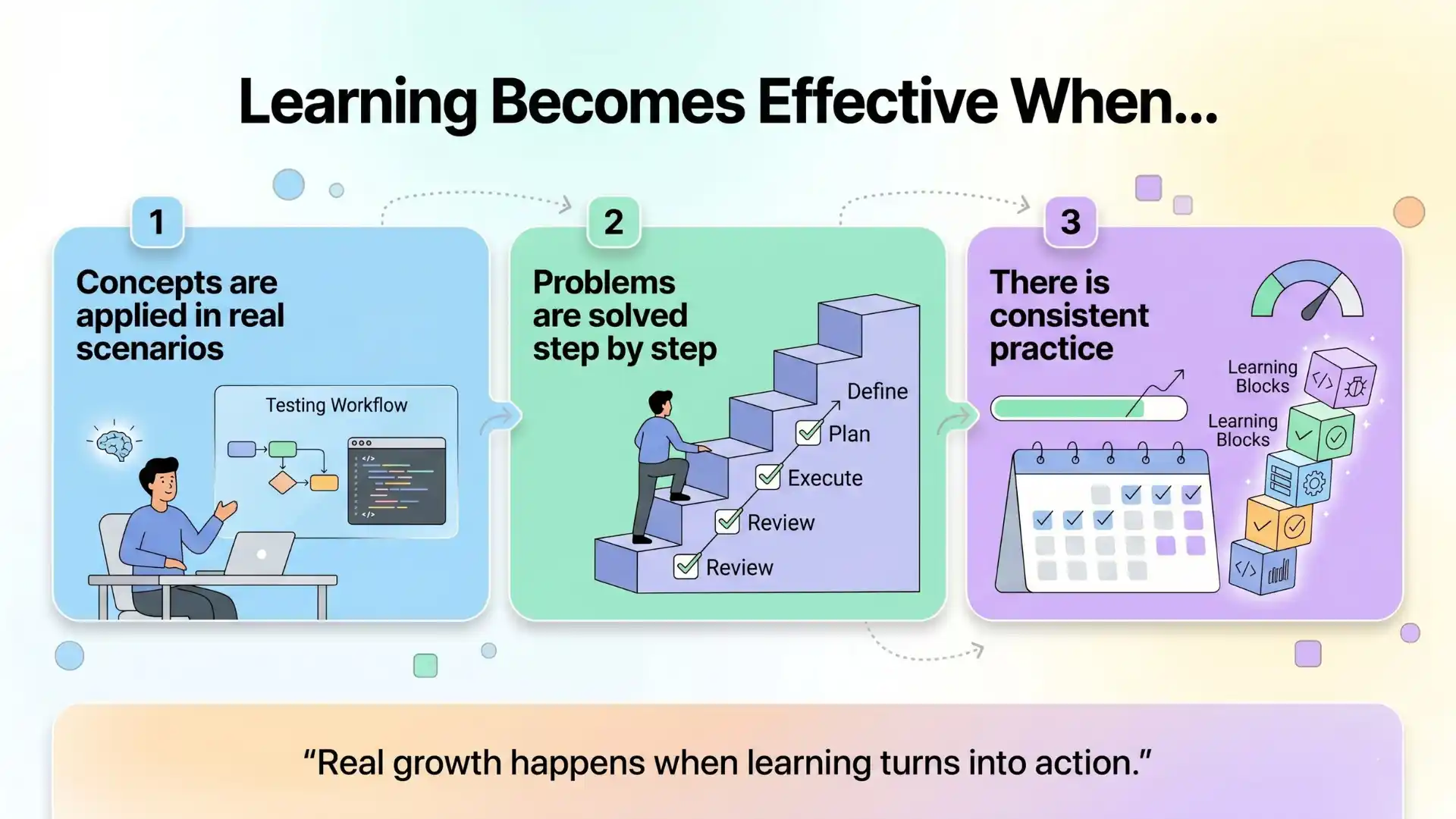
Learning becomes effective when:
- Concepts are applied in real scenarios
- Problems are solved step by step
- There is consistent practice
Other Recommended Reads: Congnizant java selenium interview questions
What About Jobs?
Currently:
- Most job openings still focus on Selenium and Playwright
- AI-focused QA roles are gradually emerging
However, the trend is clear.
Those who start early will have an advantage when demand increases.
Can you really transition into AI-driven QA in just 6 months?
Yes—if you focus on consistency, practical learning, and real problem-solving.
Key takeaways
- AI in testing is about solving problems, not just tools
- Automation is the foundation for AI-driven QA
- Real progress comes from building workflows
- Consistency beats intensity
Final Thought
The transition from manual testing to AI-driven QA is not about learning more tools.
It is about changing how you approach problems.
- From execution to problem-solving
- From scripts to workflows
- From manual effort to intelligent systems
Because in the end:
The testers who succeed in the AI era are not the ones who know more tools —
but the ones who know how to use AI to solve real testing problems.
FAQs
Can manual testers transition to AI-driven QA in 6 months?
Yes. Manual testers can transition to AI-driven QA in 6 months with a practical roadmap, consistent learning, automation basics, and hands-on use of AI in software testing.
What is AI-driven QA?
AI-driven QA is the use of AI tools, automation, and intelligent workflows to improve software testing, generate test cases, support analysis, and solve testing problems faster.
Do manual testers need coding skills to move into AI-driven QA?
No. Manual testers do not need advanced coding skills to begin. Basic programming and automation knowledge are enough to start working with AI in testing.
What should manual testers learn first to move into AI testing?
Manual testers should first learn automation fundamentals, understand how AI tools work, and then gradually apply AI in software testing through practical workflows.
Why is automation important before learning AI in testing?
Automation is important because it builds engineering thinking. It helps testers understand scripts, validations, and workflows before applying AI for software testing.
How is AI in software testing changing QA roles?
AI in software testing is shifting QA roles from manual execution to problem-solving, workflow design, intelligent automation, and better decision-making in testing.
What can QA engineers do with AI in testing?
QA engineers can use AI in testing to generate test cases, improve regression selection, prepare test data, create automation support, and build AI-driven testing workflows.
Is AI in software testing only for automation testers?
No. AI in software testing is useful for both manual and automation testers. Manual testers can use AI to improve productivity and move toward AI-driven QA roles.
What are the common mistakes to avoid while learning AI-driven QA?
Common mistakes include trying to learn everything at once, skipping automation fundamentals, consuming content without building, and waiting too long to start.
What is the best way to learn AI for software testing?
The best way to learn AI for software testing is through structured learning, real-world practice, consistent building, and step-by-step application in daily testing work.
We Also Provide Training In:
- Advanced Selenium Training
- Playwright Training
- Gen AI Training
- AWS Training
- REST API Training
- Full Stack Training
- Appium Training
- DevOps Training
- JMeter Performance Training
Author’s Bio:

Content Writer at Testleaf, specializing in SEO-driven content for test automation, software development, and cybersecurity. I turn complex technical topics into clear, engaging stories that educate, inspire, and drive digital transformation.
Ezhirkadhir Raja
Content Writer – Testleaf