Most Testers Are Learning the Wrong AI Tools
Table of Contents
ToggleIf you search for “best machine learning tools,” you’ll see long lists.
TensorFlow. PyTorch. Scikit-learn.
But here’s the problem:
👉 These lists don’t tell you what to actually use in testing
And that’s why most QA engineers struggle with AI in software testing.
What are the best AI tools for QA engineers?
The best tools depend on use case: GPT APIs for test case generation, TensorFlow or PyTorch for advanced models, and cloud AI tools like AWS or Azure for scalable testing workflows.
How to Choose the Right AI Tool
Instead of asking:
❌ “Which tool is best?”
Ask:
👉 “What problem am I solving?”
AI Tools by Real Testing Use Case
| Use Case | Tool | Why It Works |
|---|---|---|
| Test case generation | OpenAI GPT APIs | Converts requirements into test scenarios |
| Failure analysis | AI log tools | Finds root causes faster |
| Data generation | Synthetic data tools | Covers edge cases |
| CI/CD insights | AWS / Azure AI | Helps release decisions |
| Deep learning models | TensorFlow / PyTorch | Advanced AI workflows |
This is how AI for software testing should be applied.
Don’t Miss Out: playwright interview questions
1. AI Tools for Test Case Generation
Tools:
- OpenAI GPT APIs
- Prompt-based AI tools
What They Do:
- Convert user stories into test cases
- Suggest missing scenarios
- Improve coverage
Real Example:
Input:
“User logs in and places an order”
Output:
- Valid login
- Invalid login
- Session timeout
- Payment failure
This is the fastest-growing area of AI in testing.
2. AI Tools for Failure Analysis (Biggest ROI)
Tools:
- AI-powered log analyzers
- CI/CD insight platforms
What They Do:
- Summarize failures
- Detect flaky tests
- Suggest root cause
Real Example:
Instead of reading 500 lines of logs:
AI says:
“Login redirect failing only in Firefox”
This is where AI for software testing saves hours.
3. AI Tools for Test Data Generation
Tools:
- Synthetic data platforms
- AI data generators
What They Do:
- Create realistic test data
- Cover edge cases
- Protect sensitive data
Real Example:
Generate:
- Invalid email formats
- Boundary values
- Random user data
Data quality directly impacts AI in software testing outcomes.
4. AI + Automation Tools (Hybrid Approach)
Tools:
- Selenium + AI plugins
- Playwright + AI integrations
What They Do:
- Self-healing tests
- Smart element selection
- Reduced maintenance
Reality Check:
AI doesn’t replace Selenium.
👉 It enhances it.
5. Deep Learning Tools (Advanced Use)
Tools:
- TensorFlow
- PyTorch
- Scikit-learn
When to Use:
- Visual testing
- Anomaly detection
- Predictive analytics
When NOT to Use:
- Simple test automation
- Basic UI testing
Most QA engineers don’t need this initially.
6. Cloud AI Platforms (Scaling Testing)
Tools:
- AWS AI Services
- Azure AI
- Google AI
What They Do:
- Scale testing workflows
- Provide AI APIs
- Integrate with CI/CD
Ideal for enterprise-level AI in testing workflows.
Dive Deeper: selenium interview questions for 5 years experience
AI Tools Comparison
| Tool | Best For | Level |
|---|---|---|
| GPT APIs | Test generation | Beginner |
| TensorFlow | Deep learning | Advanced |
| PyTorch | Research models | Advanced |
| AWS AI | Scalable workflows | Intermediate |
| Azure AI | Enterprise integration | Intermediate |
Real-World AI Testing Workflow
Modern QA teams don’t use one tool.
They use a combined system:
- AI generates test cases
- Selenium/Playwright executes tests
- AI analyzes failures
- QA validates results
- AI suggests improvements
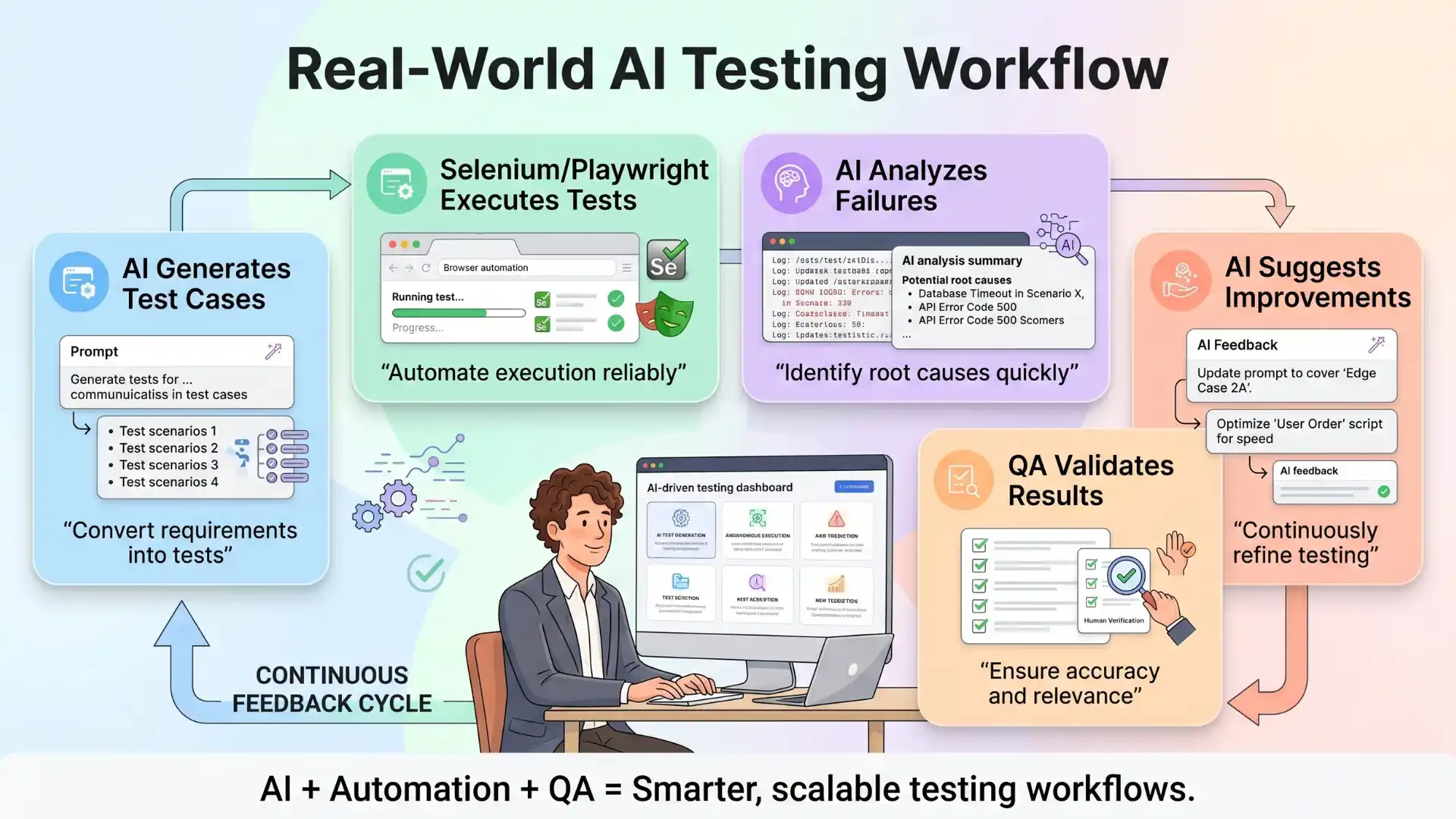
👉 This is the real future of AI in software testing.
Which AI tool should a QA engineer learn first?
Start with GPT APIs for test case generation. Then move to failure analysis tools.
Can AI replace automation testing tools?
No. AI supports tools like Selenium and Playwright, but execution still depends on them.
What are the best AI tools for beginners?
Start with:
- GPT APIs
- Simple data generators
- Basic CI insights
Manual testing interview questions
Common Mistakes Testers Make
- Learning TensorFlow without use case
- Relying fully on AI outputs
- Ignoring validation
- Not integrating AI into workflows
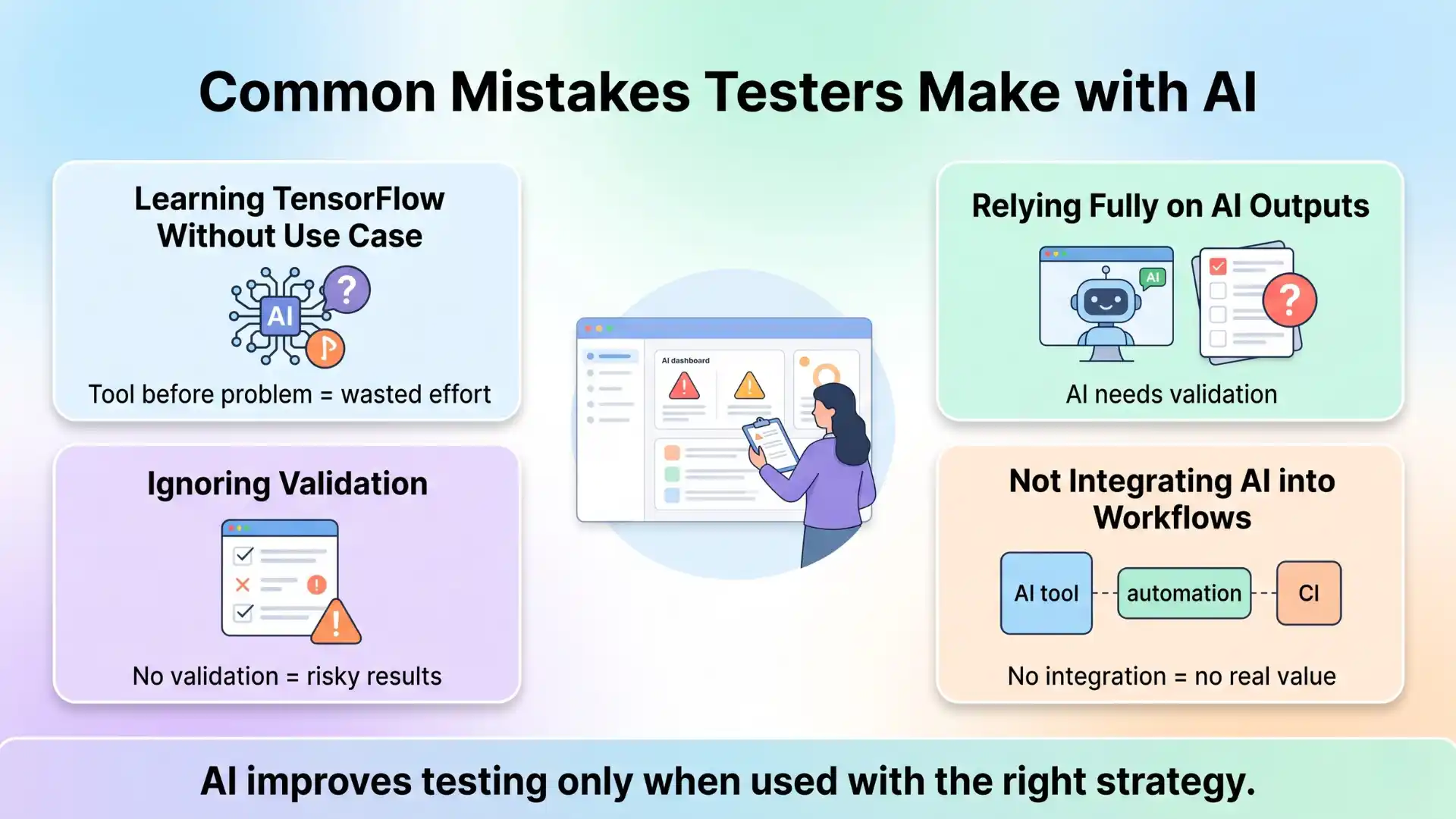
👉 Tools don’t matter.
👉 Usage matters.
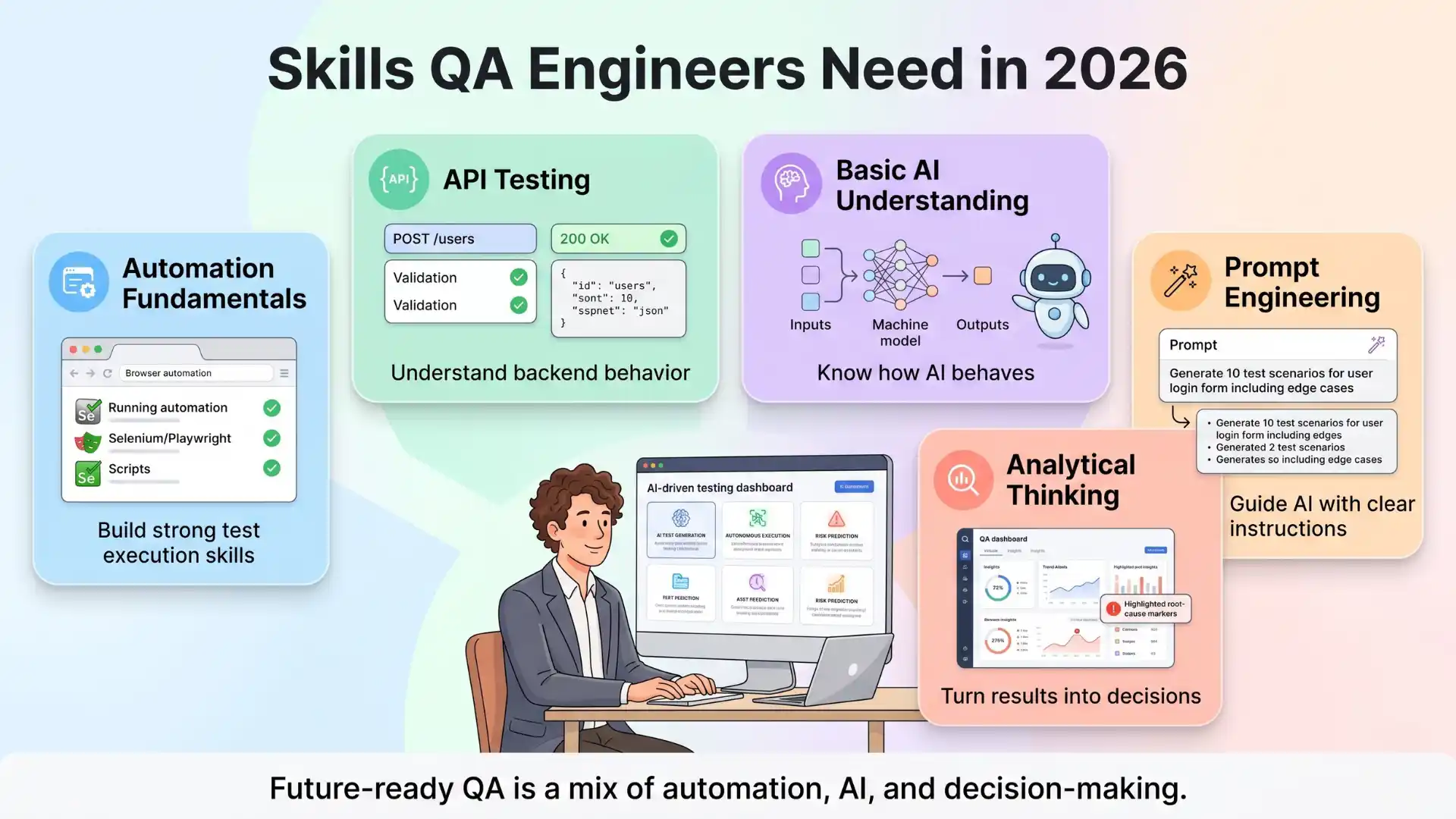
What Skills You Need in 2026
To succeed in AI-driven QA:
- Automation fundamentals (Selenium / Playwright)
- API testing
- Basic AI understanding
- Prompt engineering
- Analytical thinking
Key Takeaways
- AI tools should be chosen based on use case
- AI in testing improves speed and decision-making
- QA engineers remain critical
- Hybrid workflows deliver best results
- The future is AI-augmented QA
Final Thought
The future of testing is not:
👉 “Which tool is best?”
It is:
👉 “Which tool solves my problem?”
Selenium and Playwright still matter.
But the real advantage comes from:
👉 Using AI in software testing workflows intelligently
FAQs
What are the best AI tools for QA engineers in 2026?
The best AI tools include GPT APIs for test case generation, TensorFlow and PyTorch for advanced models, and cloud AI platforms like AWS and Azure for scalable workflows.
How is AI used in software testing?
AI in software testing is used for generating test cases, analyzing failures, creating test data, and improving decision-making in CI/CD pipelines.
Which AI tool should beginners in testing learn first?
Beginners should start with GPT-based tools for test case generation and then explore failure analysis and automation integrations.
Can AI replace Selenium or Playwright?
No, AI cannot replace Selenium or Playwright. It enhances these tools by improving efficiency and reducing manual effort.
What are the benefits of AI for software testing?
AI for software testing improves speed, reduces manual effort, enhances coverage, and provides insights for better testing decisions.
Do QA engineers need machine learning knowledge?
Basic understanding is helpful, but deep machine learning expertise is not required for most testing use cases.
What are common mistakes when using AI in testing?
Common mistakes include over-relying on AI outputs, ignoring validation, and choosing tools without understanding use cases.
We Also Provide Training In:
- Advanced Selenium Training
- Playwright Training
- Gen AI Training
- AWS Training
- REST API Training
- Full Stack Training
- Appium Training
- DevOps Training
- JMeter Performance Training
Author’s Bio:

Content Writer at Testleaf, specializing in SEO-driven content for test automation, software development, and cybersecurity. I turn complex technical topics into clear, engaging stories that educate, inspire, and drive digital transformation.
Ezhirkadhir Raja
Content Writer – Testleaf