
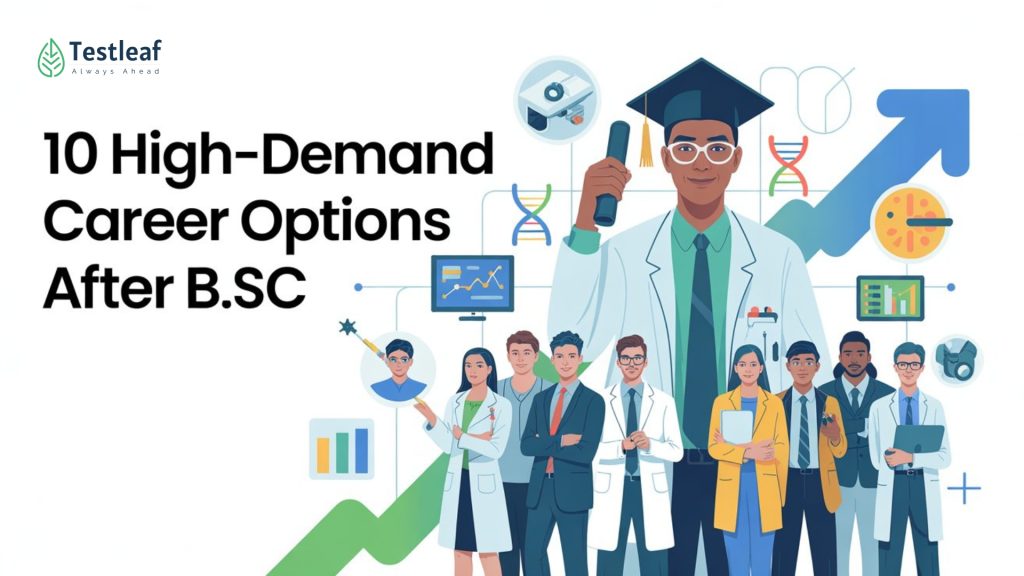
Choosing the right career after completing a B.Sc degree can be confusing. Many graduates struggle between higher studies, professional courses, and immediate job opportunities. In 2026, the good news is that a B.Sc background opens doors to high-growth, skill-based careers, especially in the technology and software domain.
This guide explains the best career options after B.Sc, focusing on job demand, growth, and long-term stability.
1. AI & Machine Learning Engineer
AI and machine learning engineers build intelligent systems that learn from data. This career is best suited for B.Sc graduates with strong analytical and mathematical skills.
As AI adoption increases across industries, skilled professionals in this domain will remain in high demand.
Key skills: Python, ML algorithms, data modeling
Job roles: ML Engineer, AI Engineer
Average salary: ₹10–25 LPA
Don’t Miss Out: playwright interview questions
2. Software Testing (Manual & Automation)
Software testing is one of the most practical and in-demand career options after B.Sc, especially for graduates from non-IT backgrounds. It focuses on validating software quality, functionality, and performance before release.
With structured training and hands-on practice, fresh graduates can enter IT roles without strong programming knowledge initially and gradually move into automation.
Key skills: Manual testing, Selenium, Playwright, API testing
Job roles: QA Engineer, Test Analyst, Automation Tester
Average salary (India): ₹4–10 LPA
3. Automation Engineer
Automation engineers design scripts and frameworks to automate testing processes, reducing manual effort and improving release speed. This role offers faster growth compared to pure manual testing roles.
It is ideal for B.Sc graduates who are comfortable with logic, problem-solving, and basic programming concepts.
Key skills: Selenium, Java/Python, CI/CD tools
Job roles: Automation Engineer, SDET
Average salary: ₹8–15 LPA


4. Data Analyst
Data analysts help organizations make data-driven decisions by interpreting large volumes of information. This role suits B.Sc graduates from Mathematics, Statistics, Computer Science, and Physics backgrounds.
The demand for analysts continues to rise across finance, healthcare, retail, and technology sectors due to increased data usage.
Key skills: SQL, Excel, Python, Power BI
Job roles: Data Analyst, Business Analyst
Average salary: ₹6–12 LPA
Additional Resources: automation testing interview questions
5. Full-Stack Developer
Full-stack developers work on both front-end and back-end components of applications. This career path is best suited for B.Sc Computer Science or IT graduates.
With businesses focusing on digital platforms, full-stack skills provide flexibility to work across startups, enterprises, and freelance projects.
Key skills: HTML, CSS, JavaScript, React, Node.js
Job roles: Software Developer, Full-Stack Engineer
Average salary: ₹6–14 LPA
6. Cyber Security Analyst
Cyber security analysts protect systems, networks, and data from cyber threats and attacks. With rising data breaches, this role has become critical across all industries.
B.Sc graduates with an interest in networking, security concepts, and ethical hacking can build long-term careers in this field.
Key skills: Network security, ethical hacking, risk assessment
Job roles: Security Analyst, SOC Analyst
Average salary: ₹7–16 LPA

7. Cloud Engineer
Cloud engineers manage cloud infrastructure and services used by modern applications. Companies are rapidly migrating from on-premise systems to cloud platforms.
This role offers global job opportunities and is suitable for B.Sc graduates who enjoy infrastructure, deployment, and system design.
Key skills: AWS, Azure, DevOps fundamentals
Job roles: Cloud Engineer, DevOps Engineer
Average salary: ₹8–18 LPA
8. Business Analyst
Business analysts act as a bridge between technical teams and business stakeholders. They analyze requirements and ensure that technology solutions meet business needs.
This role is suitable for B.Sc graduates who prefer analytical thinking, documentation, and communication over heavy coding.
Key skills: Requirement analysis, documentation, stakeholder management
Average salary: ₹6–12 LPA
Check Out These Articles: AI and ML Engineer salary in india
9. Government Jobs
Government jobs remain a popular option after B.Sc due to job stability, benefits, and long-term security. Graduates can prepare for exams like SSC, Banking, and State-level services.
This path requires consistent preparation and patience but offers structured career progression.
10. Higher Studies (M.Sc/ MBA)
Pursuing higher education is a good choice when aligned with clear career goals. An M.Sc helps deepen subject expertise, while an MBA opens doors to management and leadership roles.
Graduates should choose higher studies based on industry demand and personal interests rather than as a default option.
Why Software Testing Is a Smart Career Choice After B.Sc
Among all career options, software testing stands out due to its low entry barrier, high demand, and steady career growth. It allows graduates from science backgrounds to enter the IT industry without extensive coding experience at the beginning.
With the rise of AI in software testing, professionals who upskill in automation and modern tools will remain future-proof.
AI-powered testing tools are transforming how test cases are created, executed, and maintained. Skills in intelligent test automation, self-healing scripts, and AI-driven analytics significantly increase a tester’s value in the job market.
As organizations adopt faster release cycles and DevOps practices, testers who combine quality engineering skills with AI-enabled testing expertise will play a critical role in modern software development.
FAQs
1. What are the best career options after B.Sc in 2026?
The best career options after B.Sc in 2026 include software testing, data analytics, automation engineering, cloud computing, AI and machine learning, cyber security, and higher studies like M.Sc or MBA. These roles offer strong job demand and long-term growth.
2. Is software testing a good career after B.Sc?
Yes, software testing is a strong career choice after B.Sc, especially for science and non-IT graduates. It has a low entry barrier, high demand, and offers clear growth paths into automation, DevOps, and AI-driven testing roles.
3. Can non-IT B.Sc graduates enter the IT industry?
Yes, non-IT B.Sc graduates can enter IT roles by learning job-oriented skills such as software testing, data analysis, or cloud fundamentals. Many IT roles focus more on skills than academic background.
4. Which B.Sc career option has the highest salary in 2026?
AI and machine learning engineers, cloud engineers, and automation engineers are among the highest-paying career options after B.Sc in 2026, with salaries depending on skills, experience, and industry demand.
5. Should I choose higher studies or a job after B.Sc?
The choice depends on your career goals. Higher studies like M.Sc or MBA are useful for specialization and leadership roles, while skill-based careers like software testing and automation offer faster entry into the job market.
We Also Provide Training In:
- Advanced Selenium Training
- Playwright Training
- Gen AI Training
- AWS Training
- REST API Training
- Full Stack Training
- Appium Training
- DevOps Training
- JMeter Performance Training
Author’s Bio:


Content Writer at Testleaf, specializing in SEO-driven content for test automation, software development, and cybersecurity. I turn complex technical topics into clear, engaging stories that educate, inspire, and drive digital transformation.
Ezhirkadhir Raja
Content Writer – Testleaf