

Introduction
Have you ever thought about why Rest APIs are so powerful and highly used in software testing?
It is known that Rest API has grown exponentially over the years, and the term has been in use for many years since the testing world has grown.
In this article, let us look into the “Top 3 benefits of REST APIs”.
Key Takeaways
- REST APIs are essential for modern QA and automation workflows
- They improve scalability, flexibility, and system integration
- API testing helps detect issues earlier than UI testing
- Modern QA teams combine REST APIs with AI in software testing
REST APIs allow applications to communicate using HTTP methods like GET, POST, PUT, and DELETE. In testing, they help validate backend logic, improve scalability, and enable faster, more reliable automation.
What Is a REST API?
A REST API (Representational State Transfer) is a way for applications to communicate over the internet using standard HTTP methods.
In simple terms:
- The client sends a request
- The server processes it
- The server returns a response (usually JSON)
For testers, REST APIs are the backbone of modern applications. Every UI action—login, search, checkout—often depends on API calls.
Why REST APIs Matter in Software Testing
Most testers focus on UI.
But real problems often start at the API layer.
If an API fails:
- The UI breaks
- Data becomes inconsistent
- User experience suffers
Testing APIs helps:
- Detect defects earlier
- Validate business logic directly
- Reduce dependency on UI
This is why API testing is critical in modern QA workflows.
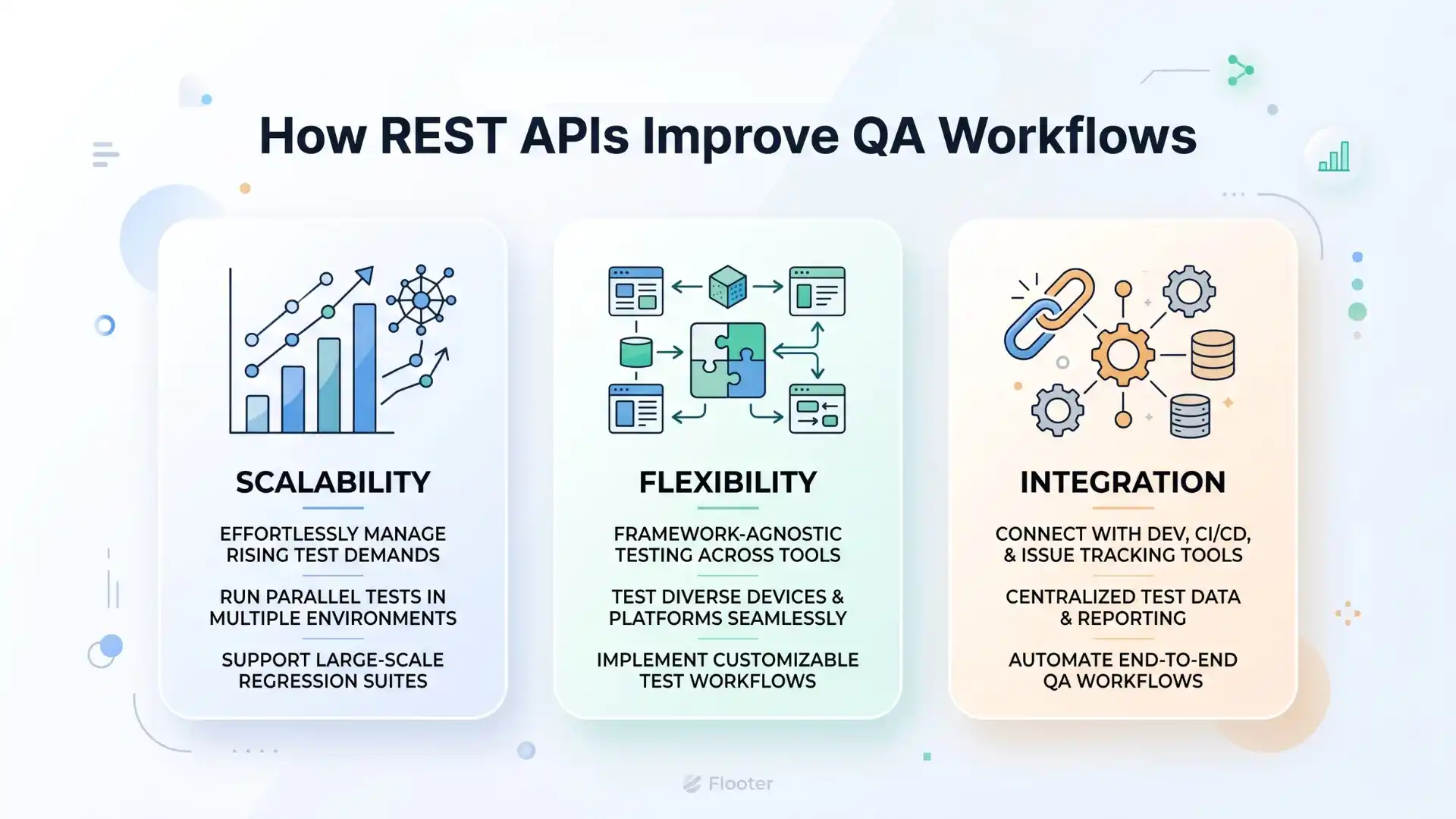
How REST APIs Improve QA Workflows
1. Scalability
REST APIs allow systems to handle large volumes of requests efficiently.
In real testing:
- You can simulate multiple users via API calls
- Validate system behavior under load
- Test backend performance without UI limitations
2. Flexibility
REST APIs work across platforms and environments.
In real testing:
- Same API can be tested on web, mobile, and microservices
- Easy integration with automation tools
- Faster adaptation to changes
3. Integration
Modern systems rely on multiple services.
REST APIs enable seamless communication between them.
In real testing:
- Validate data flow between services
- Test end-to-end workflows
- Ensure system reliability

REST vs SOAP vs GraphQL (For Testers)
| Aspect | REST | SOAP | GraphQL |
|---|---|---|---|
| Complexity | Simple | Complex | Moderate |
| Data Format | JSON | XML | JSON |
| Flexibility | High | Low | Very High |
| Performance | Fast | Slower | Optimized |
| Testing Ease | Easy | Hard | Moderate |
👉 REST remains the most widely used for testing due to simplicity and speed.
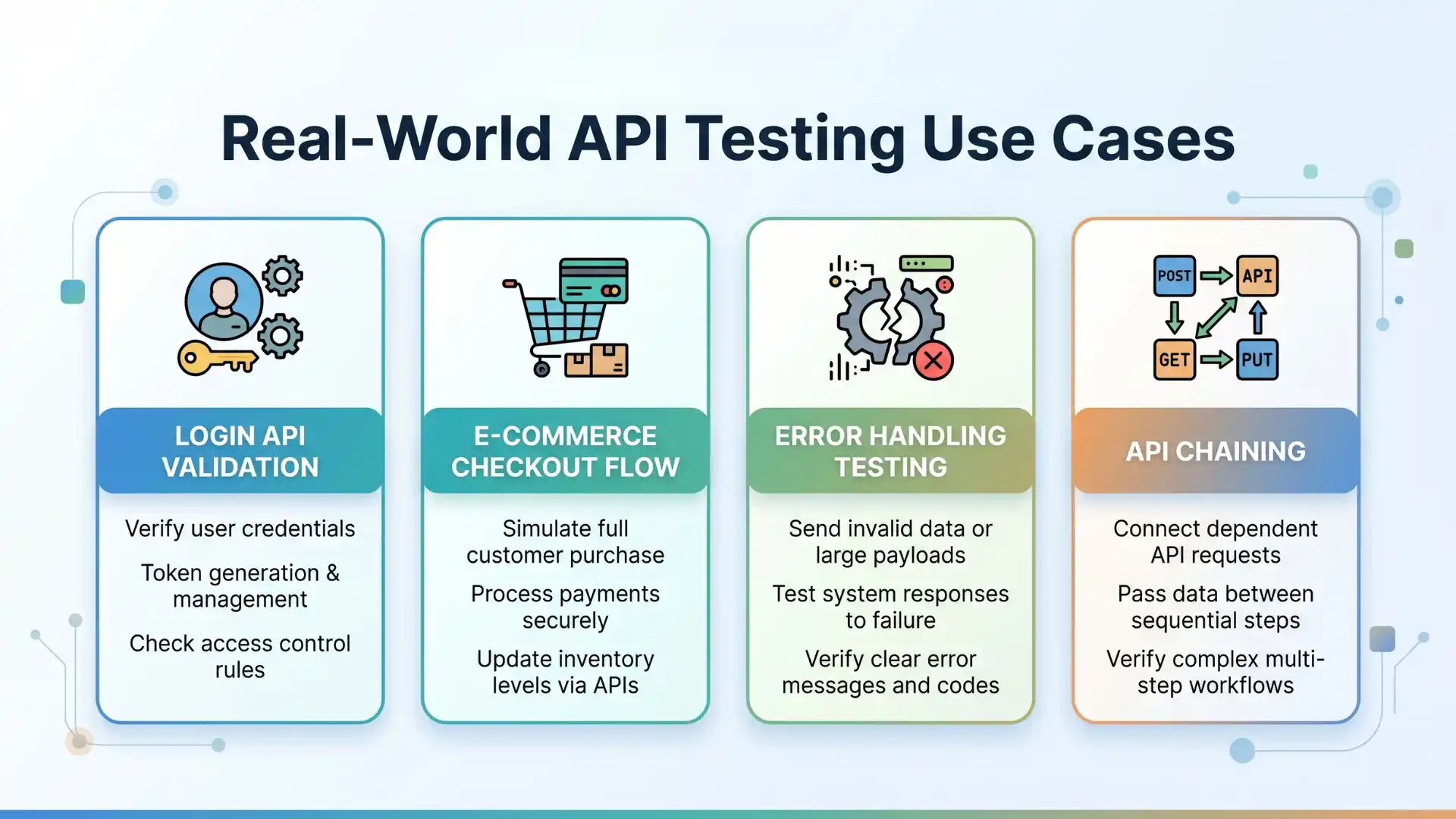
Real-World API Testing Use Cases
1. Login API Validation
- Verify status codes (200, 401)
- Validate tokens and authentication
- Check error messages
2. E-commerce Checkout Flow
- Validate order creation
- Check payment API responses
- Ensure correct data storage
3. Error Handling Testing
- Send invalid inputs
- Validate error responses
- Check system resilience
4. API Chaining
- Use one API response as input for another
- Validate full workflow
Tools for REST API Testing
Modern QA teams use:
- Postman → Manual API testing
- Playwright → API + UI automation
- Selenium → UI + API integration
- REST Assured → Java-based API testing
These tools help build scalable automation workflows.
The Shift: AI in API Testing
API testing is also evolving with AI in testing.
Modern QA teams use AI for software testing to:
- Generate API test cases
- Detect anomalies in responses
- Predict failure patterns
- Optimize test execution
This reduces manual effort and improves accuracy.
Challenges in REST API Testing
Despite its benefits, API testing has challenges:
- Requires understanding of request/response structure
- Needs proper test data management
- Difficult to debug complex workflows
- Dependency on backend availability
The solution is combining strong fundamentals with modern tools.
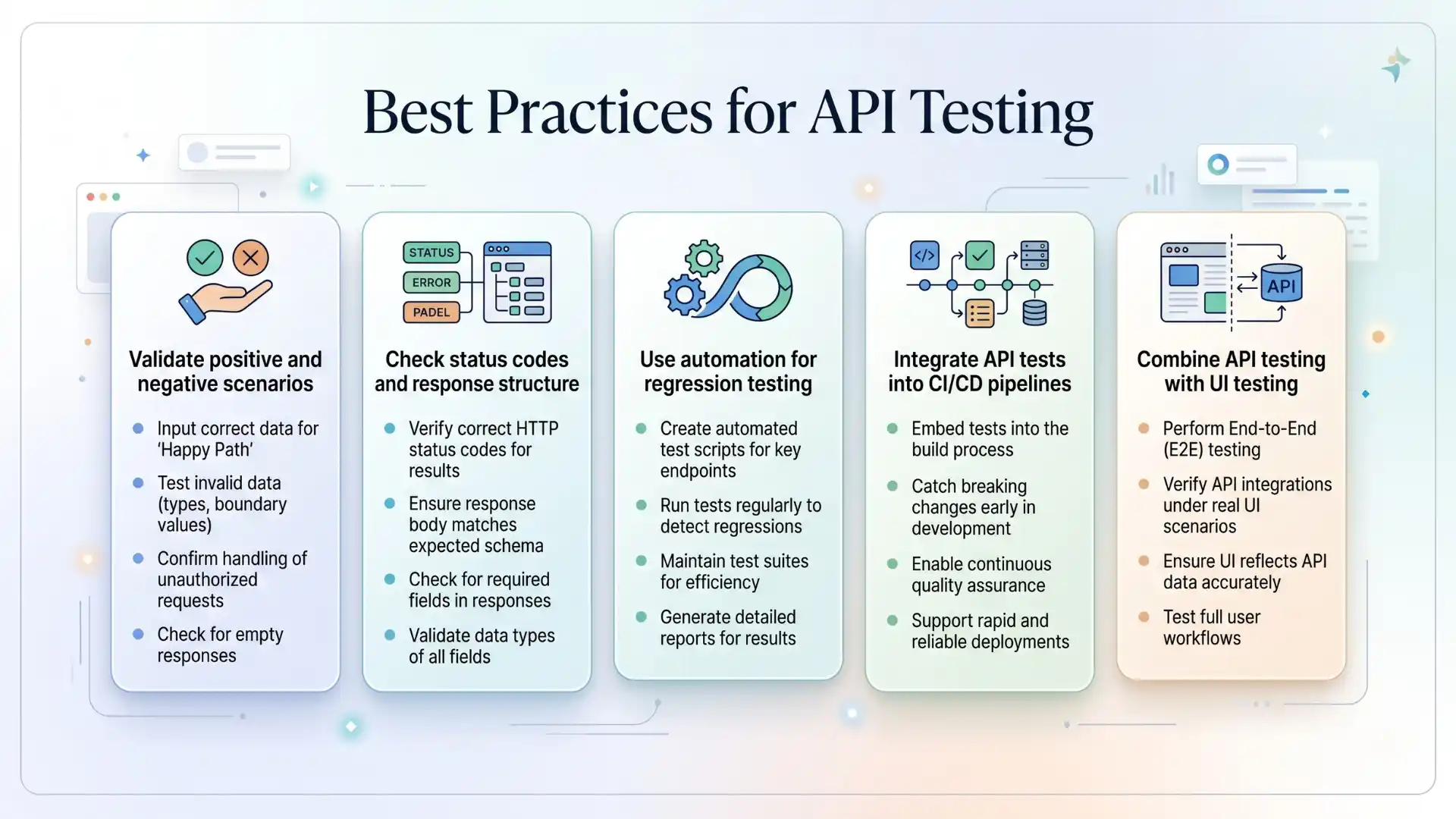
Best Practices for API Testing
- Validate both positive and negative scenarios
- Check status codes and response structure
- Use automation for regression testing
- Integrate API tests into CI/CD pipelines
- Combine API testing with UI testing
Who Should Learn REST API Testing?
This is essential for:
- QA engineers
- Automation testers
- SDETs
- Developers
- Anyone working in modern software systems
Final Thought
Most testers know what REST APIs are.
But very few use them effectively.
The difference between average testers and high-impact QA engineers is this:
👉 They don’t just test UI
👉 They understand systems
Because in modern QA:
Testing is not just about interfaces.
It’s about how everything connects.
FAQs
What is a REST API in software testing?
A REST API in software testing is an interface that allows testers to validate backend functionality using HTTP methods like GET, POST, PUT, and DELETE, ensuring correct data exchange and system behavior.
Why is API testing important in QA?
API testing is important because it helps detect defects early, validates business logic directly, reduces dependency on UI, and improves overall system reliability.
What are the benefits of REST APIs in testing?
REST APIs improve scalability, flexibility, and integration in testing, allowing QA teams to test systems faster, automate workflows, and validate backend processes efficiently.
What tools are used for REST API testing?
Common tools for REST API testing include Postman for manual testing, Playwright and Selenium for automation, and REST Assured for Java-based API validation.
How does REST API testing improve scalability?
REST API testing improves scalability by allowing testers to simulate multiple requests, validate system performance, and test backend services without relying on UI interactions.
What is the difference between REST and SOAP APIs?
REST APIs use JSON and are lightweight and flexible, while SOAP APIs use XML and are more structured but complex and slower to implement and test.
How is AI used in REST API testing?
AI in software testing is used in REST API testing to generate test cases, detect anomalies, optimize test execution, and improve failure analysis.
What are common challenges in API testing?
Common challenges include managing test data, understanding API structure, handling dependencies, and debugging complex workflows across multiple services.
Can API testing replace UI testing?
API testing cannot fully replace UI testing, but it complements it by validating backend logic and improving testing speed and reliability.
Who should learn REST API testing?
REST API testing is essential for QA engineers, automation testers, SDETs, and developers working with modern web and microservices-based applications.
Author’s Bio:


As CEO of TestLeaf, I’m dedicated to transforming software testing by empowering individuals with real-world skills and advanced technology. With 24+ years in software engineering, I lead our mission to shape local talent into global software professionals. Join us in redefining the future of test engineering and making a lasting impact in the tech world.
Babu Manickam
CEO – Testleaf