
Introduction
How do modern testing teams predict failures before execution?
How do AI systems automatically classify bugs without manual effort?
The answer lies in two powerful machine learning techniques: regression and classification.
Artificial Intelligence is rapidly transforming the QA landscape—from manual validation to predictive and intelligent testing. But most testers focus on tools without understanding the core concepts behind them.
If you want to grow in AI in software testing, mastering regression and classification is essential. These techniques are the backbone of intelligent automation, defect prediction, and data-driven testing.
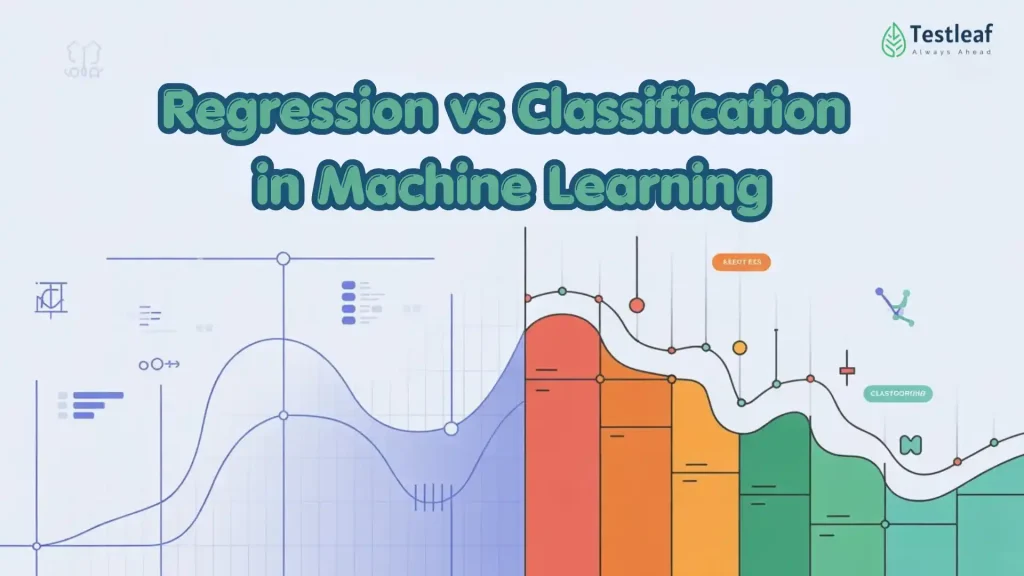
Regression predicts continuous numerical values, while classification predicts categorical outcomes or labels.
Key Takeaways
-
Regression predicts continuous numerical values
-
Classification predicts categorical outcomes
-
Both are essential for AI-powered testing systems
-
Regression is used for forecasting and performance prediction
-
Classification is used for decision-making and defect detection
-
Together, they enable predictive and intelligent automation
-
Learning these concepts is crucial for careers in AI in software testing
Regression vs Classification
| Feature | Regression | Classification |
|---|---|---|
| Output Type | Continuous values | Categories / Labels |
| Example | Predict app load time | Detect bug (Pass/Fail) |
| Algorithm | Linear Regression | Logistic Regression |
| Use Case | Performance prediction | Defect classification |
You Should Also Read: manual testing interview questions
What is Regression?
Regression is a machine learning technique used to predict numerical values.
Example:
-
Predicting application response time
-
Estimating server performance
-
Forecasting defect trends
In software testing, regression helps answer:
👉 “What will happen next?”
For example, regression models can predict how long your test suite will take or how your application behaves under load.
What is Classification?
Classification is used to predict categories or labels.
Example:
-
Pass vs Fail
-
Bug severity (High/Medium/Low)
-
Spam vs Not Spam
In testing, classification helps answer:
👉 “What category does this belong to?”
For instance, AI models can classify whether a test case will fail even before execution.


Key Differences Explained with QA Examples
Understanding the difference becomes easier with real scenarios:
| Scenario | Technique |
|---|---|
| Predict API response time | Regression |
| Predict API failure | Classification |
| Forecast system performance | Regression |
| Identify bug type | Classification |
👉 Simple rule:
-
If output is a number → Regression
-
If output is a label → Classification
More Insights: AI and ML engineer salary in india
When to Use Regression vs Classification
Use Regression When:
-
You need numerical predictions
-
You analyze trends over time
-
You forecast performance metrics
Use Classification When:
-
You categorize outcomes
-
You automate decision-making
-
You detect failures or anomalies
👉 Choosing the right technique improves accuracy and efficiency in AI-driven testing systems.
Real-World Use Cases in Software Testing
This is where most articles fall short—but this is your advantage.
1. Smart Test Case Prioritization
Classification models identify high-risk test cases and prioritize them.
2. Defect Prediction
Regression models estimate the number of defects likely to occur.
3. Flaky Test Detection
Classification helps detect unstable test cases automatically.
4. Performance Forecasting
Regression predicts system performance under different conditions.
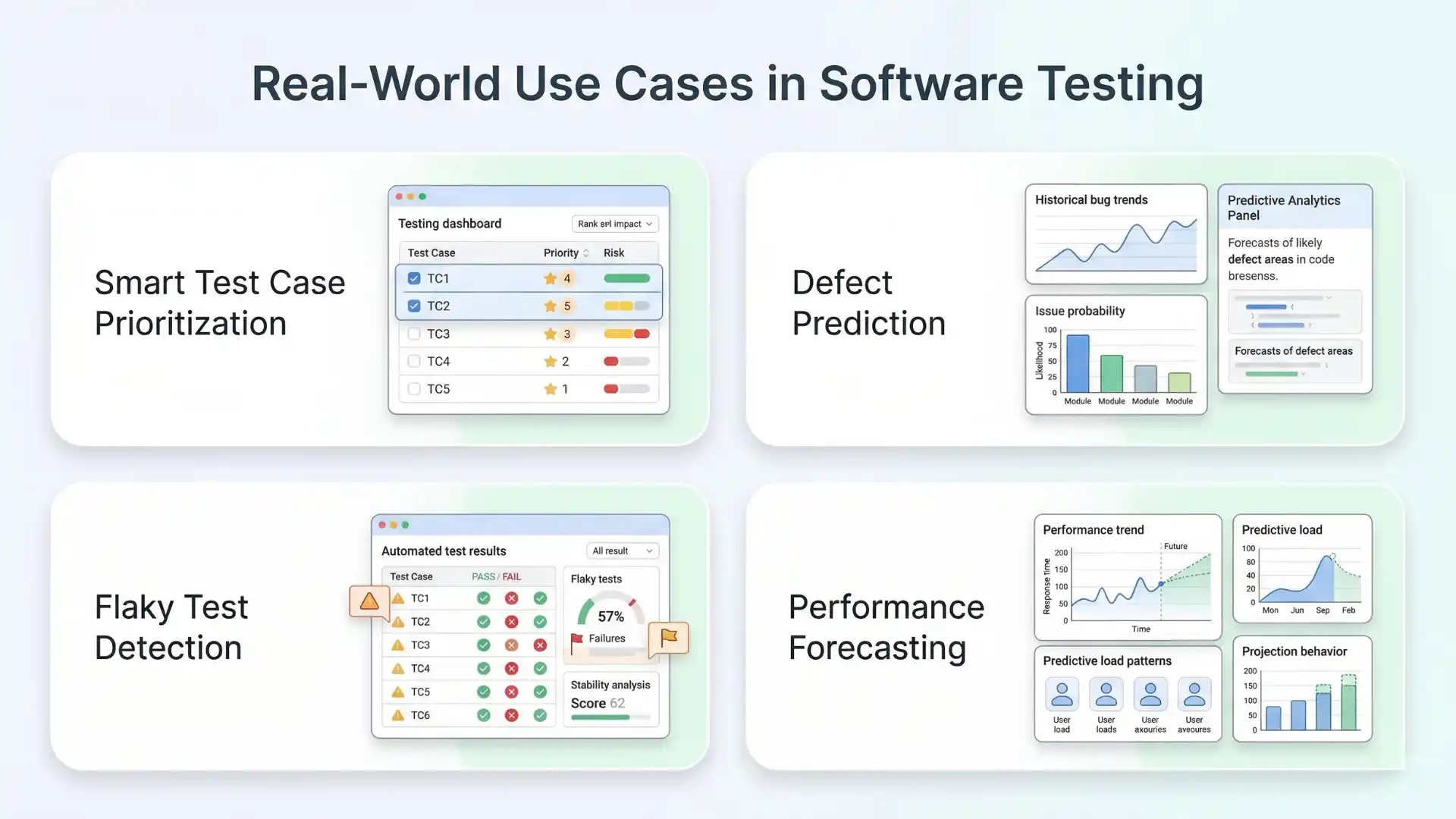

👉 These use cases clearly show how AI in software testing is moving toward predictive and intelligent automation.
How AI Enhances Automation Testing
Modern automation is no longer just about executing scripts—it’s about making intelligent decisions.
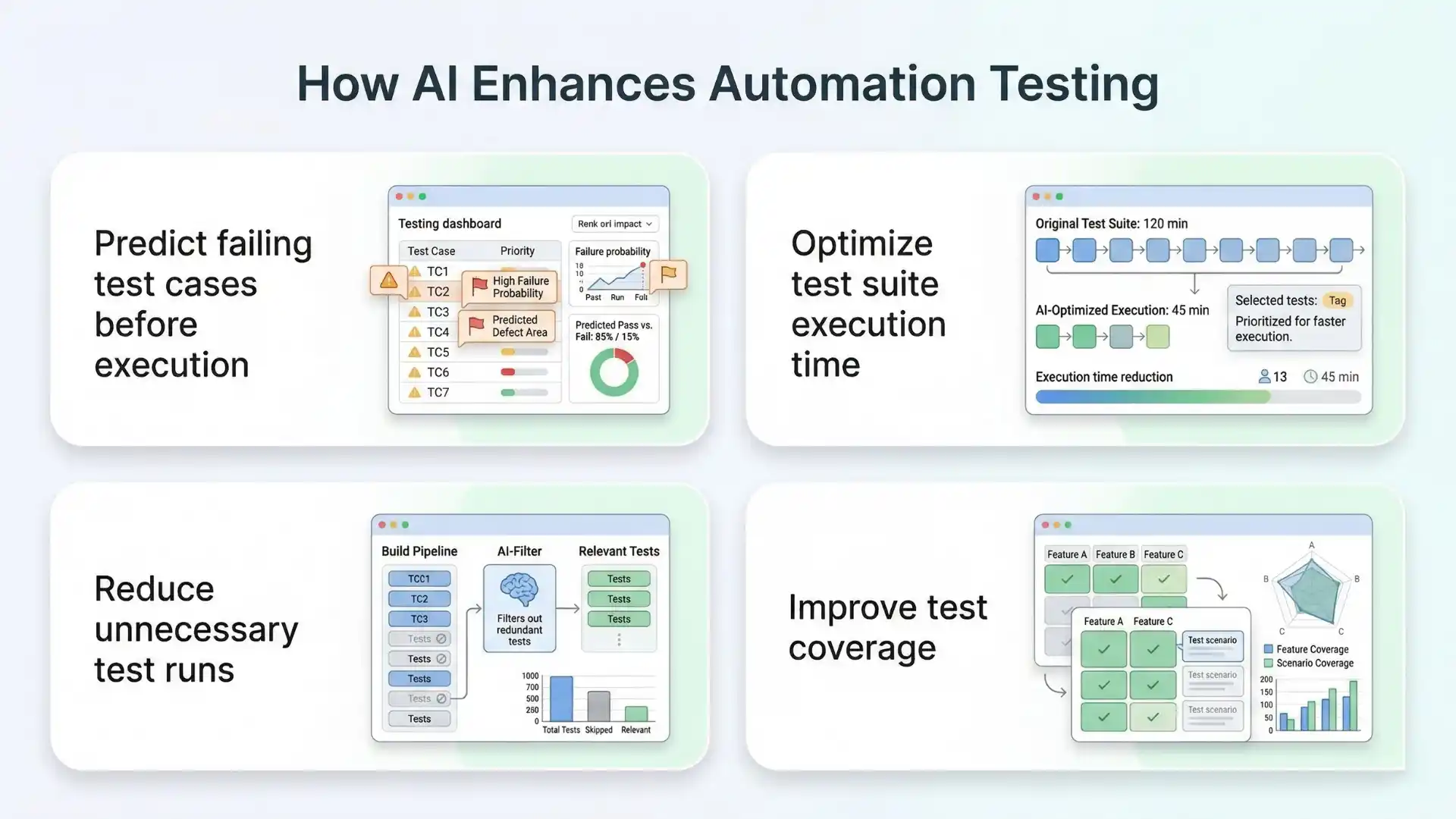
By combining machine learning with selenium automation testing, teams can:
-
Predict failing test cases before execution
-
Optimize test suite execution time
-
Reduce unnecessary test runs
-
Improve test coverage
Similarly, advanced tools highlighted in Top 10 AI Automation Testing Tools in 2025 are already using regression and classification to deliver smarter testing solutions.
👉 This is the future of QA: data-driven, AI-powered, and highly efficient.
You Might Also Like: Automation testing interview questions
How Regression and Classification Power AI Systems
Regression and classification are fundamental supervised learning techniques used across industries.
In software testing:
-
Regression predicts performance, execution time, and trends
-
Classification identifies failures, defects, and anomalies
In other industries:
-
Healthcare → Disease prediction and diagnosis
-
Finance → Risk analysis and fraud detection
-
E-commerce → Recommendation systems
This broad applicability makes these techniques essential for professionals who want to work with AI-driven systems.
For QA engineers, understanding these concepts enables the shift from manual testing → intelligent quality engineering.
Conclusion
Regression and classification are no longer just academic concepts—they are becoming the core intelligence behind modern testing systems.
Regression helps you predict outcomes, while classification helps you make decisions.
Together, they enable a powerful shift from:
👉 Manual testing → Predictive testing → Intelligent automation
As companies move toward AI-driven quality engineering, testers who understand these concepts will stand out.
In 2026 and beyond, success in QA will depend on how well you can combine automation skills with AI knowledge.
Do You Want to Become an AI-Driven QA Engineer?
The demand for AI-skilled testers is growing faster than ever.
Companies are actively hiring professionals who can combine:
-
Automation expertise
-
Machine learning knowledge
-
Real-world testing experience
Whether you are:
-
A manual tester transitioning to automation
-
An automation engineer exploring AI
-
A fresher entering the QA field
Now is the perfect time to upgrade your skills.
Because the future of testing is not manual…
It’s intelligent, predictive, and powered by AI.
FAQs
Which is better: regression or classification?
Neither is better. It depends on your problem. Use regression for numerical predictions and classification for categories.
Is logistic regression a regression or classification technique?
Despite its name, logistic regression is used for classification problems.
Can regression and classification be used together?
Yes. Many real-world systems combine both for better accuracy and insights.
How is this used in software testing?
Regression predicts performance trends, while classification helps identify bugs and failures.
Do QA engineers need machine learning knowledge?
Yes. With the rise of AI in software testing, machine learning knowledge is becoming a critical skill.
We Also Provide Training In:
- Advanced Selenium Training
- Playwright Training
- Gen AI Training
- AWS Training
- REST API Training
- Full Stack Training
- Appium Training
- DevOps Training
- JMeter Performance Training
Author’s Bio:


Content Writer at Testleaf, specializing in SEO-driven content for test automation, software development, and cybersecurity. I turn complex technical topics into clear, engaging stories that educate, inspire, and drive digital transformation.
Ezhirkadhir Raja
Content Writer – Testleaf