
Software testing is evolving faster than ever.
Automation alone is no longer enough. In 2026, intelligence will separate average testers from strategic quality engineers.
Three technologies are shaping this transformation:
- Retrieval-Augmented Generation (RAG)
- AI Agents
- Model Context Protocol (MCP)
Understanding these approaches is no longer optional. It is becoming essential for professionals working in AI in software testing.
The real question is:
Which one should you learn first?
RAG improves answer accuracy by retrieving real project context before generating outputs. AI Agents go further by planning steps and executing testing tasks. MCP standardizes secure integration between models and enterprise tools like CI/CD and test management. For QA engineers in 2026, learn Agents first for impact, then RAG for context, then MCP for scale.
Key Takeaways
- RAG = context accuracy, not autonomous execution.
- AI Agents = execution + autonomy (plan → act → evaluate).
- MCP = enterprise integration layer for secure, scalable connections.
The Industry Shift Toward Intelligent Testing
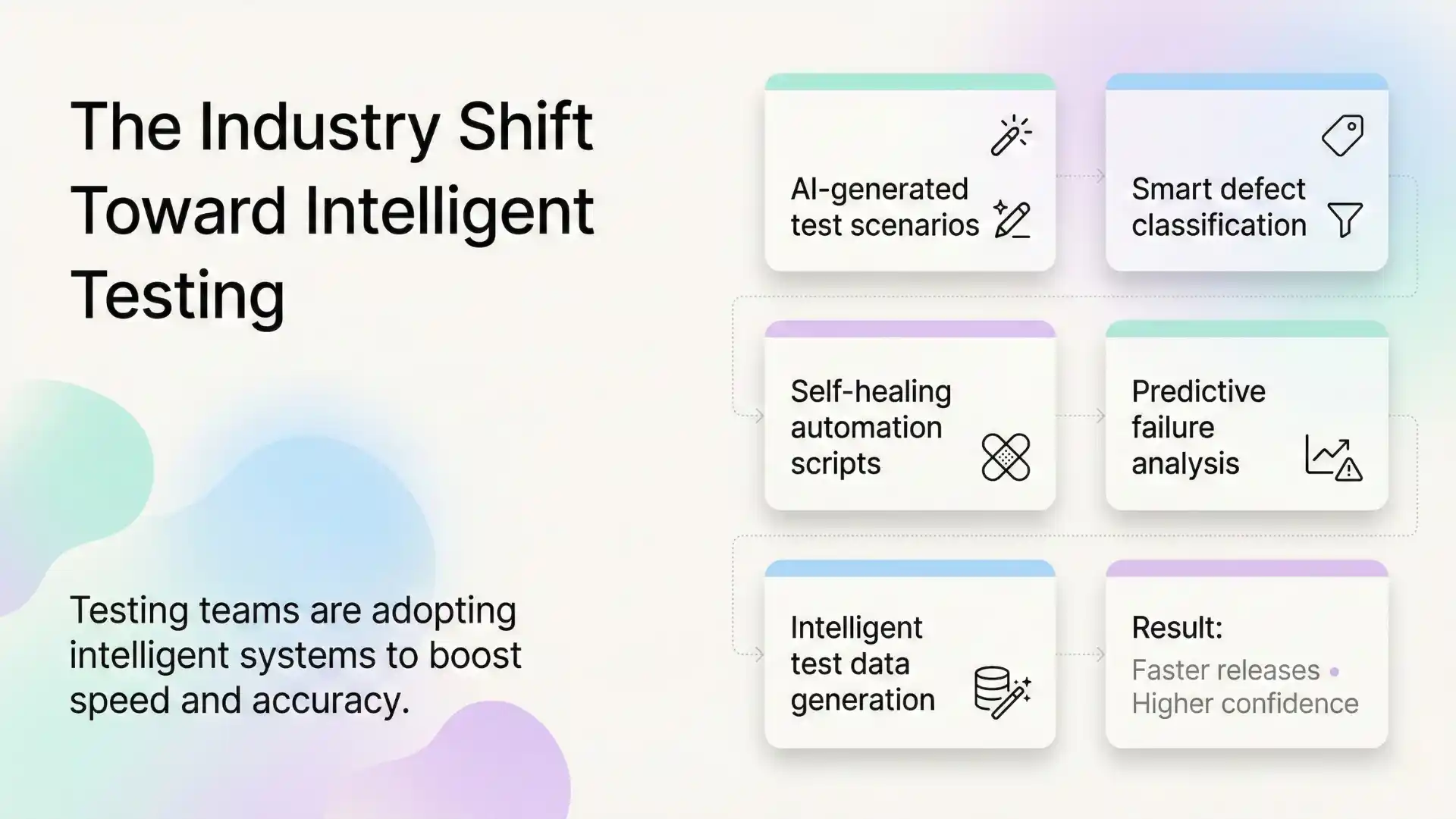
Testing teams are already adopting intelligent systems to improve speed and accuracy. Organizations now use:
- AI-generated test scenarios
- Smart defect classification
- Self-healing automation scripts
- Predictive failure analysis
- Intelligent test data generation

This shift is creating demand for new GenAI QA jobs/skills. Companies want testers who understand how intelligent systems work — not just how to execute scripts.
To prepare for this shift, QA engineers must understand RAG, AI Agents, and MCP at a practical level.
RAG: Adding Context to Test Intelligence
RAG (Retrieval-Augmented Generation) enhances an AI model by allowing it to retrieve relevant data before generating output.
Instead of relying only on pre-trained knowledge, it pulls live information such as:
- Requirement documents
- Previous defect logs
- System specifications
- Test repositories
Then it produces responses grounded in real project context.
Continue Reading: playwright interview questions
Why It Matters for Testers
With RAG, teams can:
- Generate test cases based on updated requirements
- Create regression suites referencing past defects
- Produce documentation-aware automation scripts
Many modern AI Test Automation tools use retrieval techniques internally to improve output accuracy.
However, RAG improves intelligence — it does not execute tasks independently. It enhances answers but does not manage workflows.
To automate decision-making, you need something more advanced.
AI Agents: From Assistance to Autonomy
AI Agents represent the next evolution.
They do more than generate responses. They can:
- Analyze objectives
- Break tasks into steps
- Invoke tools
- Execute actions
- Evaluate outcomes
In testing environments, this leads to the rise of Autonomous test agents.
These systems can:
- Review new feature updates
- Identify impacted modules
- Generate and execute relevant tests
- Log defects automatically
- Suggest potential root causes
This changes the role of QA engineers. Instead of manually designing every workflow, professionals supervise intelligent systems and refine outcomes.
This is where GenAI for testers becomes highly valuable. Understanding agent-based automation prepares you for advanced roles in intelligent quality engineering.


MCP: The Enterprise Integration Layer
MCP (Model Context Protocol) operates at the infrastructure level.
It standardizes how AI systems connect with external tools, APIs, and enterprise platforms.
In testing environments, MCP enables:
- Secure integration with CI/CD pipelines
- Standardized access to test management systems
- Controlled communication between AI models and automation tools
While MCP is less visible than agents or retrieval systems, it becomes critical in large organizations where governance and scalability matter.
For QA engineers working in enterprise environments, understanding MCP provides architectural awareness and credibility.
You Might Also Like: manual testing interview questions
How These Technologies Work Together
RAG, AI Agents, and MCP are not competitors.
They function as layered components:
- RAG improves contextual accuracy.
- Agents enable reasoning and execution.
- MCP ensures structured integration.
Together, they form the foundation of intelligent automation ecosystems.
Most competitor articles focus only on technical comparisons. They define each concept but rarely connect them to career progression or practical testing workflows.
That gap presents an opportunity.
RAG vs AI Agents vs MCP: Comparison for QA Engineers
| Feature | RAG | AI Agents | MCP |
|---|---|---|---|
| Primary Function | Context retrieval | Autonomous execution | System integration |
| Can Execute Tests? | No | Yes | No |
| Improves Accuracy? | Yes | Yes | Indirectly |
| Best Use Case | Test case generation | Intelligent automation workflows | Enterprise AI governance |
| Career Impact | Medium | High | Strategic |
| Learning Priority | Second | First | Third |
The Career Reality in 2026
The demand for intelligent testing expertise is increasing.
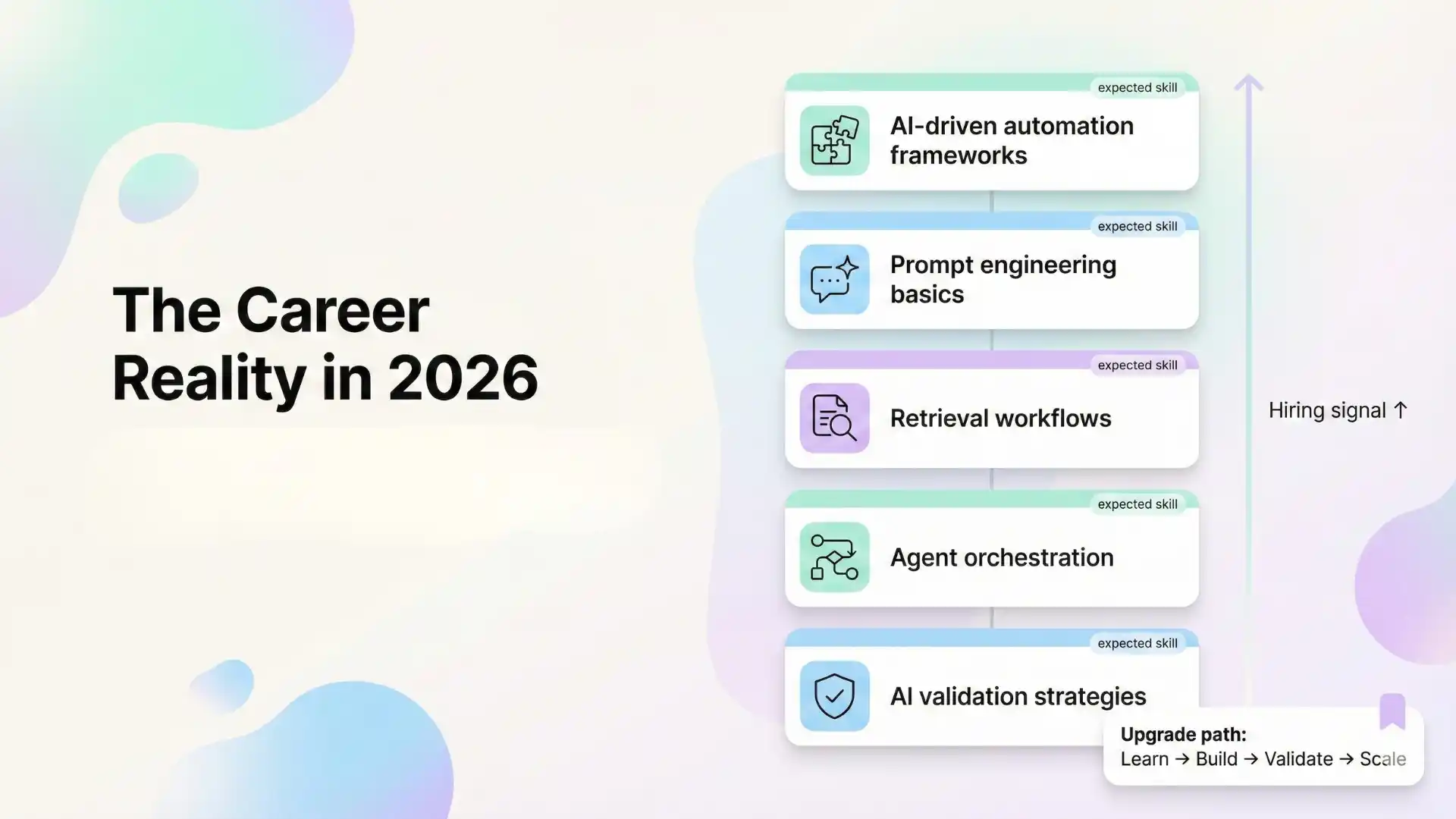
Organizations now expect QA professionals to understand:
- AI-driven automation frameworks
- Prompt engineering basics
- Retrieval workflows
- Agent orchestration
- AI validation strategies
Traditional automation knowledge is still valuable. But it is no longer sufficient for long-term growth.
Professionals who adapt will move into roles focused on designing intelligent systems rather than executing repetitive scripts.
This is the direction of modern AI in software testing.
What Should QA Engineers Prioritize?
If your goal is to stay competitive, follow a structured learning path.
1. Begin with AI Agents
Agent-based systems are driving immediate innovation in automation. Learning how they reason and execute tasks provides the strongest career impact.
2. Learn Retrieval Techniques
Understanding RAG improves your ability to design context-aware systems that generate accurate outputs.
3. Explore MCP Concepts
For those aiming at enterprise-level roles, understanding structured integration models adds long-term strategic value.
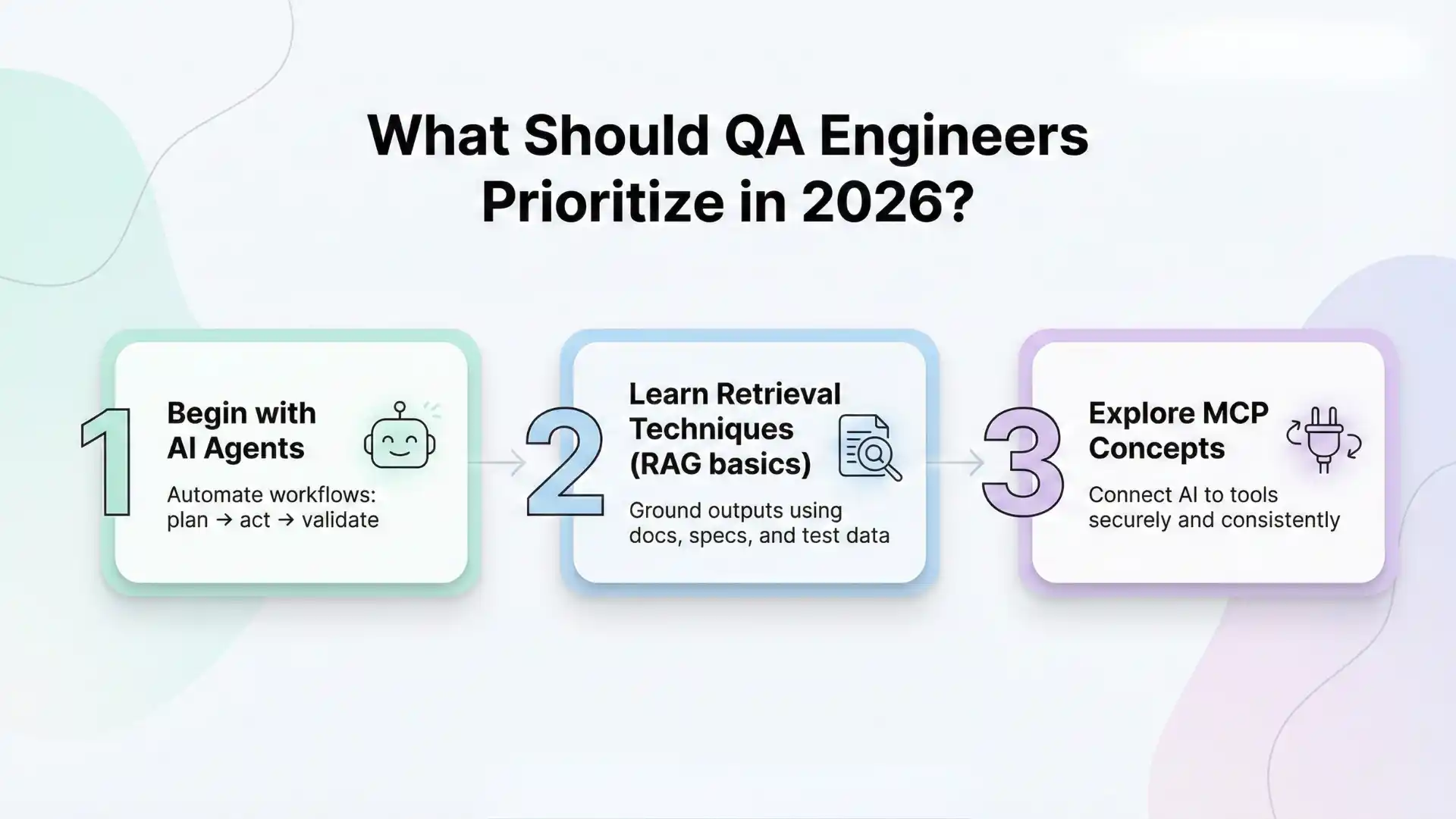
This layered approach ensures balanced expertise.
Recommended for You: Top 10 products based company in chennai
The Bigger Picture
The future of testing will not eliminate QA professionals. It will elevate them.
There will be two types of testers in 2026:
- Those who use intelligent tools.
- Those who design and optimize them.
The second group will:
- Lead automation initiatives
- Collaborate closely with AI engineering teams
- Architect intelligent testing workflows
- Command higher compensation
That distinction will define career growth.
Final Thoughts
RAG, AI Agents, and MCP are not just technical trends. They represent the structural evolution of modern testing systems.
If you want to remain relevant in 2026:
- Understand how context enhances intelligence.
- Learn how agents automate complex workflows.
- Recognize how integration frameworks support scalability.
Mastering these layers prepares you for advanced roles built around intelligent systems.
The future of quality engineering is already unfolding.
The only remaining question is:
Will you adapt early — or struggle to catch up later?
FAQs
Q1. What is RAG in software testing?
RAG (Retrieval-Augmented Generation) pulls relevant project information (requirements, defect logs, specs, repos) before generating output, so responses are grounded in your real context.
Q2. How are AI Agents used in QA automation?
AI Agents can analyze goals, break work into steps, invoke tools, execute actions, and evaluate outcomes—enabling autonomous test workflows like impact analysis, test execution, and defect logging.
Q3. What is MCP (Model Context Protocol) in simple terms?
MCP standardizes how AI systems connect to external tools and enterprise platforms. In testing, it supports controlled, secure integration with CI/CD, test management, and automation tools.
Q4. RAG vs AI Agents: which is better to learn first for QA engineers?
If your goal is career impact, start with AI Agents because they drive workflow automation today. Add RAG next to improve context accuracy and reduce hallucinations in test outputs.
Q5. Are RAG, Agents, and MCP competing technologies?
No—think layers: RAG improves contextual accuracy, Agents enable reasoning and execution, and MCP provides structured integration. Together they form intelligent testing ecosystems.
Q6. Why should QA engineers care about MCP in 2026?
In larger organizations, governance and scalability matter. MCP becomes important for standardization, controlled access, and enterprise-grade integrations across environments.
Q7. What learning path should QA engineers follow in 2026?
A practical order is: AI Agents → RAG → MCP. Agents give immediate automation leverage, RAG boosts accuracy with project context, and MCP helps you scale securely in enterprise setups.
We Also Provide Training In:
- Advanced Selenium Training
- Playwright Training
- Gen AI Training
- AWS Training
- REST API Training
- Full Stack Training
- Appium Training
- DevOps Training
- JMeter Performance Training
Author’s Bio:


Content Writer at Testleaf, specializing in SEO-driven content for test automation, software development, and cybersecurity. I turn complex technical topics into clear, engaging stories that educate, inspire, and drive digital transformation.
Ezhirkadhir Raja
Content Writer – Testleaf