

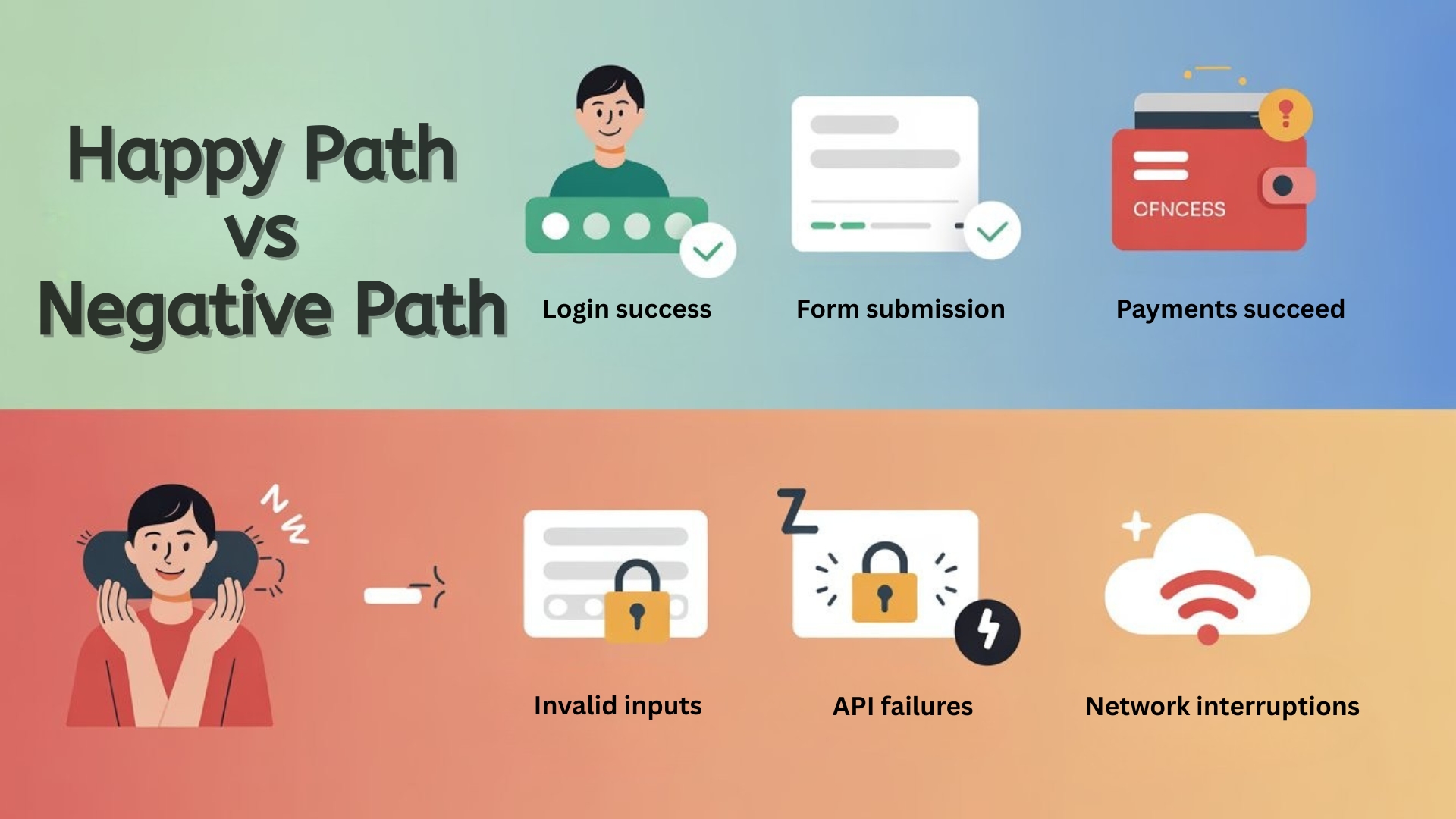
When I first started as a QA engineer, I was trained to focus on happy paths—the ideal workflows where everything goes right. Login succeeds, forms submit correctly, payments process without errors. It felt satisfying to see all tests pass, green builds on the CI/CD dashboard, and stakeholders breathing easy.
But reality soon taught me that happy paths tell only half the story. Users don’t always follow the ideal flow. They mistype data, attempt invalid operations, or trigger unexpected edge cases. If we only test the “perfect” scenarios, we leave our application vulnerable to failures in the real world.
This is where negative testing becomes a critical part of an SDET’s playbook. By intentionally validating failure paths, invalid inputs, and unexpected behaviors, QA can uncover hidden risks before they reach production. Here’s why I consider negative testing a future-proofing strategy for QA.
Understanding Negative Testing
Negative testing is the practice of verifying how an application handles invalid, unexpected, or extreme inputs. Unlike happy path testing, which ensures the application works as expected, negative testing ensures the application fails gracefully when conditions aren’t ideal.
Examples include:
- Entering invalid email formats or special characters in forms
- Submitting forms without required fields
- Performing actions the user shouldn’t have access to
- Simulating API failures or network interruptions
- Triggering edge-case workflows with unusual sequences of actions

The goal is not to break the application, but to validate robustness, resilience, and user safety.
Further Exploration: playwright interview questions
Why Negative Testing Matters
In my experience, negative testing delivers value in several key ways:
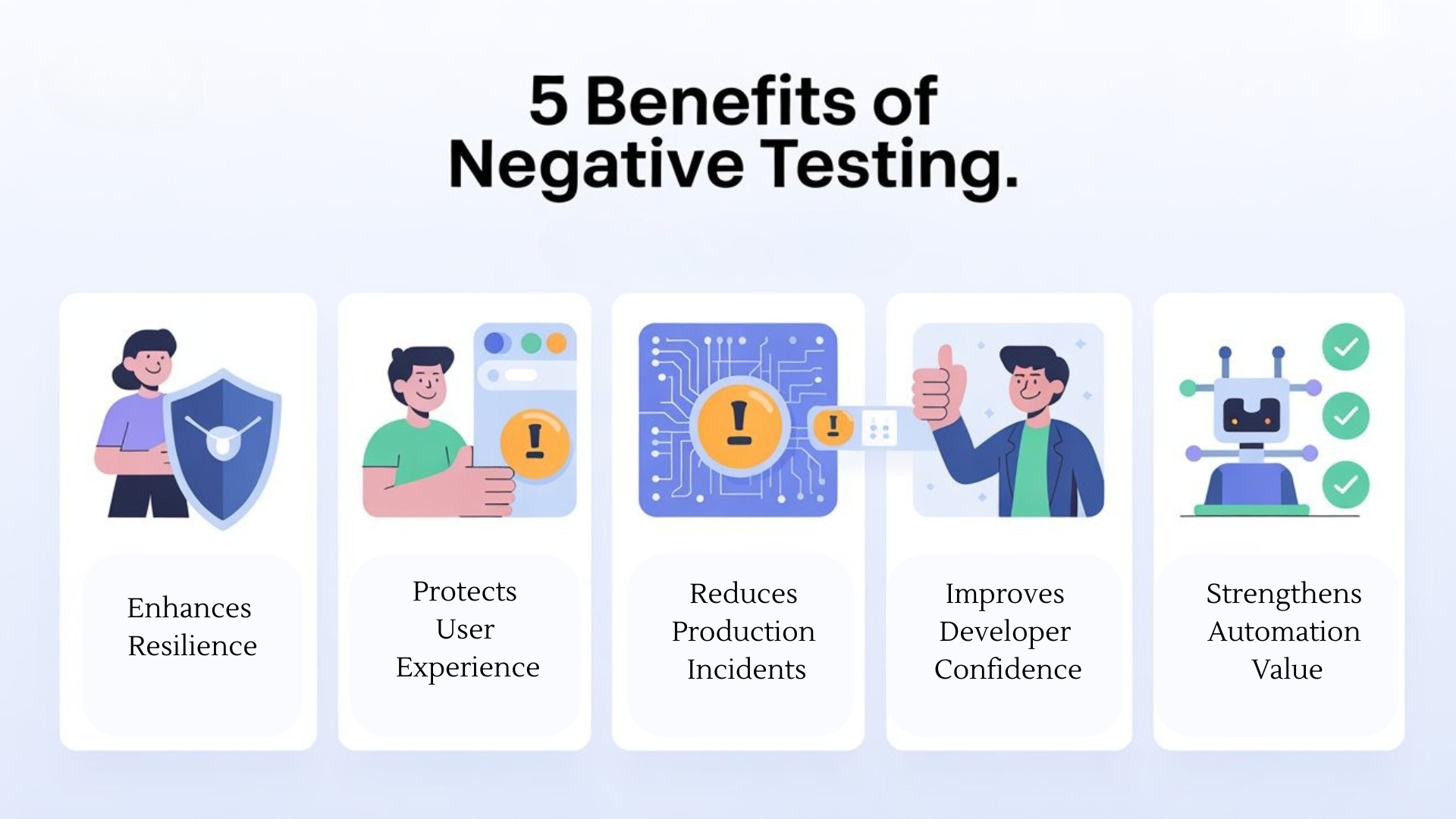
1. Enhances Application Resilience
Happy paths only ensure the app works when everything is perfect. Negative testing prepares the system for the unexpected, ensuring that errors are handled properly and don’t cascade into larger issues.
2. Protects User Experience
Users will always make mistakes. If an application crashes or produces confusing error messages, it undermines trust. Negative testing validates that the application guides users correctly, even in failure scenarios.
3. Reduces Production Incidents
By proactively testing invalid scenarios, we catch hidden defects before release. This reduces the likelihood of customer complaints, production outages, and emergency patches.
4. Improves Developer Confidence
When QA reports well-structured negative test results, developers gain clear insights into edge-case behavior, which helps them build more robust features.
5. Strengthens Automation Value
Integrating negative tests into automation frameworks ensures continuous coverage. It prevents gaps that might otherwise only appear in production.
How We Integrated Negative Testing into Our Framework
Early in my SDET career, negative testing was often ad hoc—added manually for specific scenarios. Over time, I realized that for negative testing to be effective, it needed strategy, structure, and automation.
Step 1: Identify Critical Failure Points
We started by mapping all user workflows and pinpointing where failures could occur:
- Input validation for forms
- Unauthorized actions
- API failures
- Network interruptions
Focusing on high-impact areas ensured that negative tests delivered maximum value without overloading the test suite.
Step 2: Parameterize Test Data
Negative scenarios often involve invalid or unexpected data. By integrating data generators and centralized test data into our framework, we could systematically test:
- Empty or null fields
- Invalid formats
- Maximum-length strings
- SQL injections or script attempts (for security testing)
Parameterized negative tests allowed us to cover multiple edge cases efficiently.
Step 3: Encapsulate in Page Objects
To avoid cluttering tests with repetitive negative checks, we incorporated validation methods into page objects:
public void verifyInvalidEmailError() {
Assert.assertTrue(emailError.isDisplayed(), “Expected error for invalid email”);
}
This made tests readable, reusable, and maintainable—a key principle in future-proof QA frameworks.
Step 4: Integrate with CI/CD Pipelines
Negative tests were added to smoke, regression, and sanity suites in the CI/CD pipeline. Automated pipelines now run both positive and negative scenarios, ensuring that failure paths are validated continuously, not just during manual exploratory testing.

Step 5: Capture Rich Evidence
Failures in negative tests often require context-rich evidence for developers to debug:
- Screenshots of error messages
- HAR files capturing failed API requests
- Logs detailing input and response data
This practice reduced back-and-forth between QA and Dev and accelerated defect resolution.
Other Helpful Articles: automation testing interview questions
Lessons Learned
From implementing negative testing, I’ve learned several key principles for future-proof QA:
1. Plan Negative Tests Like Any Other Scenario
Negative testing shouldn’t be an afterthought. Treat it as a core part of test design, with prioritization based on risk and impact.
2. Automation is Critical
Manual negative testing is useful for exploratory work, but automation ensures consistent, repeatable coverage, especially for regression suites.
3. Focus on Realistic Failures
Not every invalid input needs testing. Prioritize scenarios that users are likely to encounter or that could cause serious production issues.
4. Combine with Observability
Tools like HAR files, network logs, and videos are crucial. They allow developers to see exactly what went wrong, especially for failures caused by invalid API responses or complex workflows.
5. Iterate and Expand
As new features are added, revisit negative scenarios. A robust negative test strategy is evolving, not static.


The Impact on QA and Product Quality
Integrating negative testing transformed our QA process in several ways:
- Reduced Production Bugs: Many defects that previously escaped into production were caught during automated negative tests.
- Faster Debugging: Clear, reproducible failures with detailed evidence accelerated developer fixes.
- Increased Confidence: Stakeholders trusted that the application would behave correctly even under adverse conditions.
- Future-Proof Automation: The framework now supports both happy paths and negative scenarios, ensuring comprehensive regression coverage.
- Improved Thought Leadership: QA was recognized not just for finding bugs, but for proactively mitigating risks.
Conclusion
Happy paths are essential, but they tell only half the story. Negative testing is where QA adds true value—validating resilience, protecting user experience, and preventing hidden defects.
From my perspective as an SDET, future-proof QA isn’t just about automation or speed. It’s about designing frameworks that anticipate failure, embrace edge cases, and provide meaningful insights to developers and stakeholders. By integrating negative testing into automation, pipelines, and CI/CD processes, we future-proof the application, the release process, and the QA practice itself.
The lesson is clear: don’t stop at happy paths. Plan, automate, and validate failure paths. That’s how QA moves from reactive bug detection to strategic, thought-leadership-level impact.
FAQs
Q1. What is negative testing in QA?
Negative testing is the practice of checking how an application behaves with invalid, unexpected or extreme inputs, such as bad formats, missing fields, unauthorized actions or failed APIs. The goal is to make sure the system fails safely and predictably, not to crash the app.
Q2. Why is negative testing important beyond happy paths?
Happy paths prove that the system works when everything is perfect. Negative testing goes further by validating resilience when users make mistakes, inputs are invalid or integrations fail. It helps prevent real-world defects, protects user experience and reduces production incidents.
Q3. What are some examples of negative test scenarios?
Common negative tests include entering invalid email formats, submitting forms without required fields, performing actions without proper permissions, simulating API timeouts or failures, and triggering network interruptions during key workflows like login or payments.
Q4. How can I integrate negative testing into my automation framework?
You can start by identifying critical failure points, parameterizing invalid and edge-case data, and encapsulating validation checks inside page objects or helper methods. Then, wire these negative tests into your CI/CD smoke, regression and sanity suites so failure paths are validated on every run.
Q5. What kind of evidence should I capture for negative test failures?
Rich evidence speeds up debugging. Capture clear screenshots of error messages, HAR files for failed API calls, and logs showing input and response data. This context helps developers quickly understand what went wrong and fix the issue without multiple back-and-forth discussions.
Q6. How does negative testing impact product quality and releases?
A strong negative testing strategy reduces production bugs, accelerates defect resolution and increases stakeholder confidence. By covering both happy paths and failure paths in automation, you create more reliable regression suites and future-proof your QA process against real-world edge cases.
We Also Provide Training In:
- Advanced Selenium Training
- Playwright Training
- Gen AI Training
- AWS Training
- REST API Training
- Full Stack Training
- Appium Training
- DevOps Training
- JMeter Performance Training
Author’s Bio:


Content Writer at Testleaf, specializing in SEO-driven content for test automation, software development, and cybersecurity. I turn complex technical topics into clear, engaging stories that educate, inspire, and drive digital transformation.
Ezhirkadhir Raja
Content Writer – Testleaf