
Everyone is asking the same question:
It’s the wrong question.
The real shift is already happening — not in whether testers will exist, but in how testing work gets done.
In a recent conversation with Babu Manickam — CEO & Co-Founder of QEagle and Testleaf, with over 25+ years of experience in software testing and quality engineering, and a mentor to thousands of QA professionals transitioning into modern automation and AI-driven testing — one idea stood out clearly:
AI is not removing testing. It is removing repetitive testing work.
And that changes everything.
Will AI replace testers?
AI will not replace testers, but it will replace repetitive testing work. Testers will shift from executing tests to designing strategies, interpreting results, and validating intelligent systems.
This article is for:
- Manual testers exploring AI
- Automation testers adapting to modern QA
- SDETs and QA engineers
- Professionals transitioning into AI-driven testing roles
The Reality: Testing Is Not Going Away — It’s Evolving
For years, testing has involved:
- Writing test cases manually
- Executing repetitive scenarios
- Maintaining brittle automation scripts
But today, AI systems can:
- Generate test cases in seconds
- Suggest regression test coverage
- Convert automation scripts across frameworks
- Assist with API validation workflows
Tasks that once took hours can now be done in under a minute with high accuracy.
So no — AI is not eliminating testing.
👉 It is eliminating low-value manual effort.
Dive Deeper: playwright interview questions
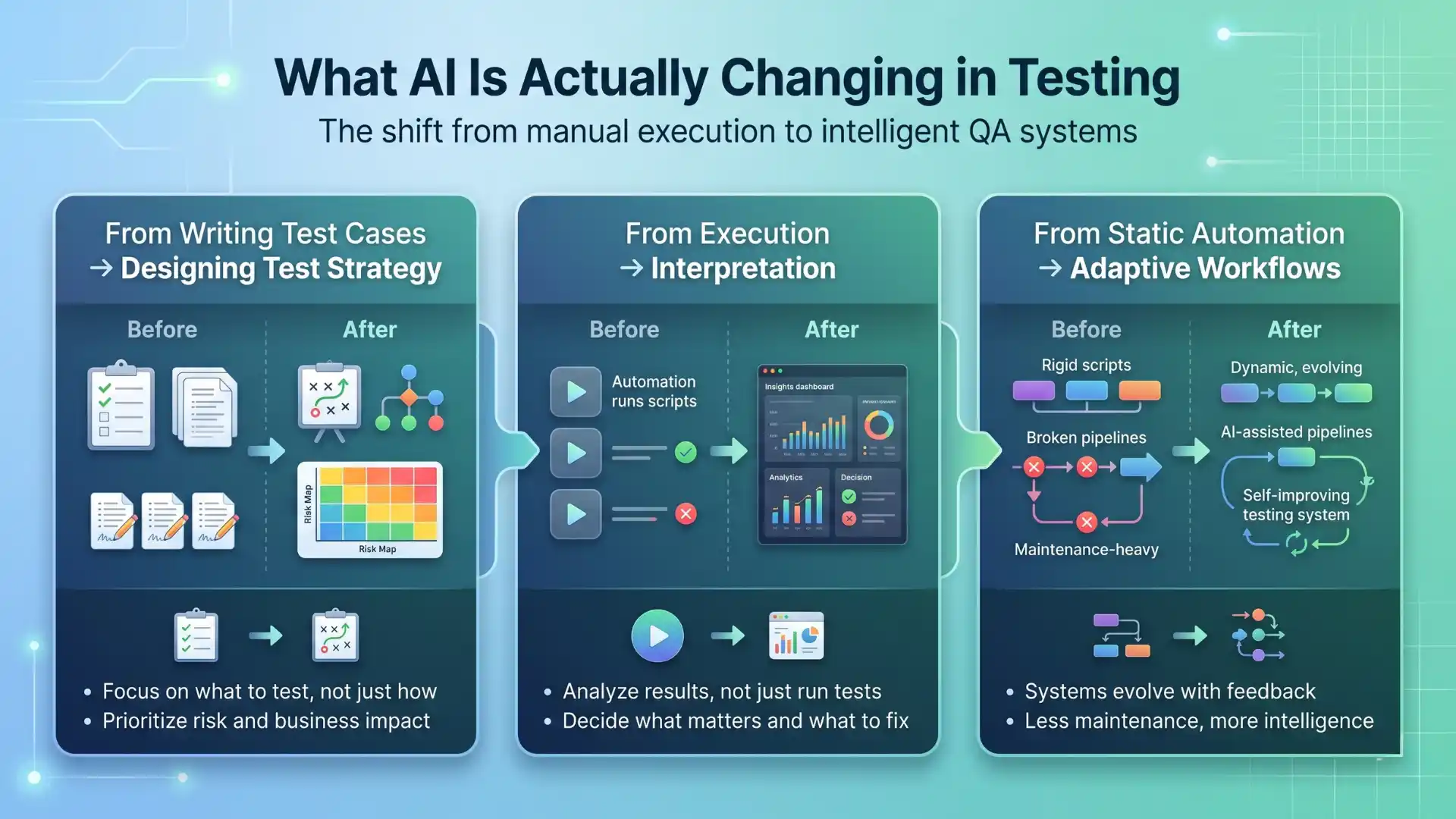
What AI Is Actually Changing in Testing
The biggest shift is not technical — it’s role-based.
1. From Writing Test Cases → Designing Test Strategy
AI can generate test cases.
But it cannot decide:
- What truly matters to test
- What carries business risk
- What edge cases could break the system
That responsibility still belongs to testers.
2. From Execution → Interpretation
AI can execute faster.
But it cannot confidently answer:
- Is this a real defect?
- Is this failure critical?
- Should this block a release?
👉 Testing is becoming less about doing, and more about deciding.
3. From Static Automation → Adaptive Workflows
Traditional automation is:
- Script-heavy
- Fragile
- Maintenance-intensive
AI-driven workflows are:
- Faster
- More flexible
- Capable of evolving with feedback
But they still need human supervision.

AI in software testing is commonly used for:
- Test case generation
- Regression optimization
- Script conversion
- API validation
- Failure analysis
- Workflow automation
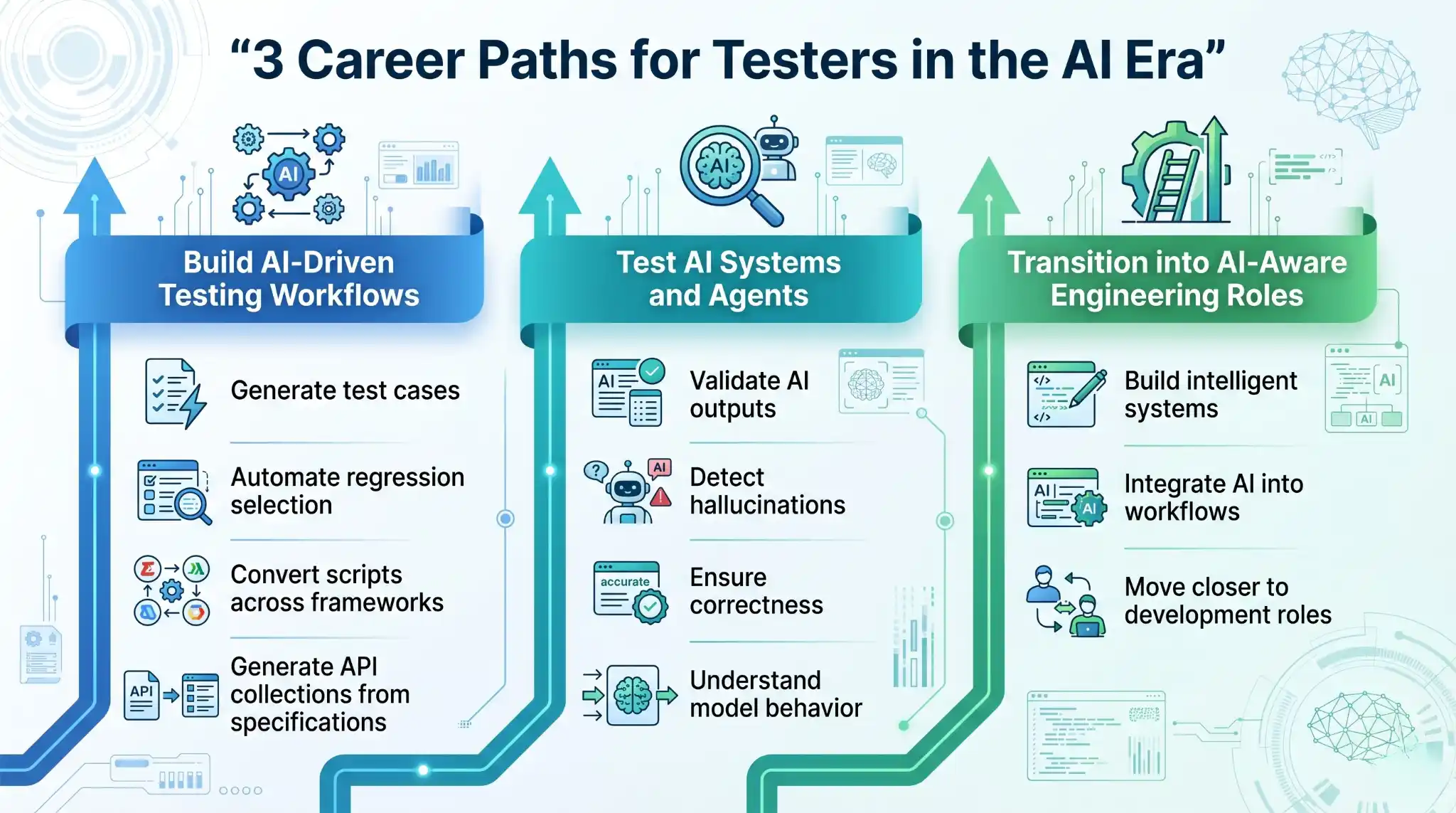
The 3 Career Paths for Testers in the AI Era
One of the most practical insights from the conversation with Babu Manickam was this:
Manual testers don’t have one path anymore — they have three.
Path 1: Build AI-Driven Testing Workflows
Testers can now:
- Build agents that generate test cases
- Automate regression selection
- Convert scripts (e.g., Selenium to Playwright)
- Generate API collections from specifications
This is not just automation — it’s workflow engineering.
Path 2: Test AI Systems and Agents
AI systems are not perfect.
They:
- Hallucinate
- Produce incorrect outputs
- Sometimes expose sensitive data
This creates a new role:
👉 AI testing specialist
Testing AI requires:
- Critical thinking
- Validation skills
- Understanding of model behavior
Path 3: Transition into AI-Aware Engineering Roles
For testers interested in deeper technical growth:
👉 This is the best time to evolve into an AI-aware engineer
Even those who started as manual testers can:
- Build intelligent systems
- Integrate AI into workflows
- Move closer to development roles

Other Useful Guides: Top 10 product based companies in chennai
The Biggest Misconception: “I Need to Become a Developer First”
Many testers hesitate because they think:
“I need to master programming before I start.”
That’s not true.
You don’t need to be an expert coder to begin.
But you do need:
- Basic programming understanding
- Familiarity with automation tools like Playwright or Selenium
- Curiosity to experiment with AI tools
👉 Even 25–30% technical understanding is enough to start building real solutions.
Modern QA teams using AI in software testing, along with tools like Playwright, Selenium, and AI-driven workflows, are redefining how testing is designed, executed, and validated.
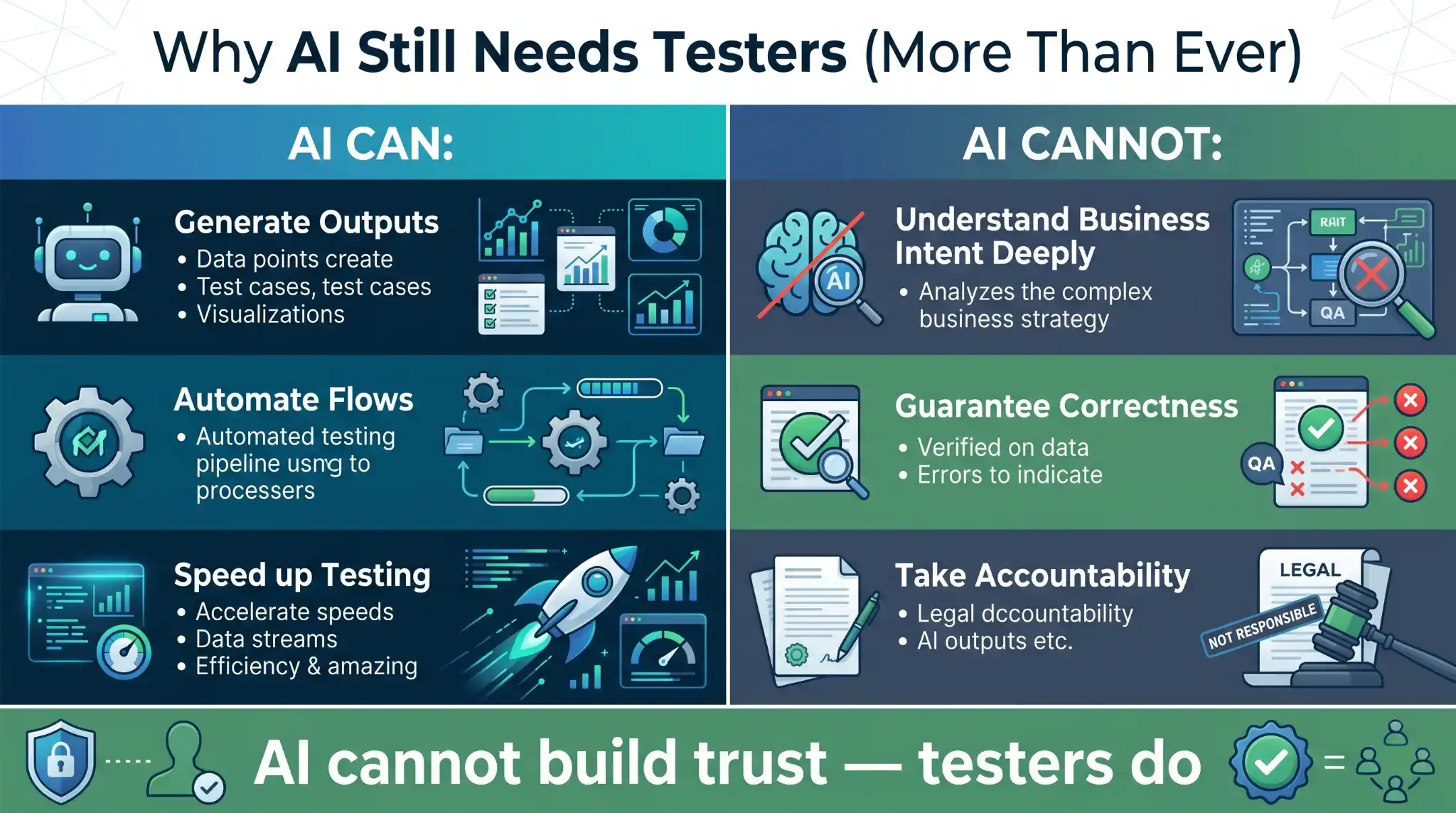
Why AI Still Needs Testers (More Than Ever)
Here’s the part most people ignore.
AI can:
- Generate outputs
- Automate flows
- Speed up testing
But it cannot:
- Understand business intent deeply
- Guarantee correctness
- Take accountability
And most importantly:
👉 AI cannot build trust — testers do.
That’s why the role is not disappearing.
It’s becoming more critical.
Other Recommended Reads: API testing interview questions
A Realistic Roadmap for Manual Testers
From the conversation, one thing was very clear:
This transition is achievable — but it requires focus.
A simple roadmap:
- Start with modern testing fundamentals
- Learn automation (Playwright or Selenium)
- Understand how AI models work (LLMs basics)
- Practice prompt and API-based workflows
- Use AI in your daily testing tasks
- Identify one repetitive task and automate it using AI
- Explore advanced concepts like RAG and agent workflows
With consistent effort:
👉 You can become confident in 4–6 months
Waiting too long is riskier than starting imperfectly.
The Market Is Changing — Slowly, Then Suddenly
Right now:
- Most jobs still demand Selenium or Playwright
- AI-specific QA roles are emerging, but not yet mainstream
But this will change quickly.
👉 The testers who start early will compete with fewer people
👉 The ones who delay will compete with everyone
QA professionals in fast-growing tech hubs like Chennai, Bengaluru, and Hyderabad are rapidly adopting AI-driven testing workflows to stay competitive.
Key Takeaways
- AI removes repetitive testing tasks, not testers
- QA roles are shifting from execution to decision-making
- Testers now need strategy, validation, and system thinking
- Early adopters will gain a strong career advantage
Final Thought
AI is not the end of testing.
It is the end of comfortable testing.
The future belongs to testers who:
- Understand systems, not just scripts
- Think in workflows, not just test cases
- Collaborate with AI, not compete with it
Because in the end:
AI won’t replace testers —
but it will replace the way testers work.
If you’re a tester thinking about your next step…
Start small.
Stay consistent.
Learn by doing.
That’s how transformation actually happens.
FAQs
What is AI changing in software testing?
AI is changing software testing by shifting QA work from manual execution to strategy, interpretation, and adaptive workflows. It reduces repetitive effort and helps testers focus on higher-value decisions.
How does AI change test design?
AI changes test design by reducing the focus on writing individual test cases and increasing the focus on test strategy, business risk, edge cases, and coverage decisions.
How does AI change test execution?
AI changes test execution by automating repetitive steps and helping QA teams move from simply running tests to interpreting results, identifying patterns, and making better release decisions.
What are adaptive workflows in testing?
Adaptive workflows in testing are AI-assisted testing processes that improve with feedback, adjust to changes, and reduce the maintenance effort required in traditional static automation.
Will AI replace writing test cases?
AI can generate test cases faster, but it does not replace human judgment. Testers still need to decide what should be tested, what carries business risk, and what quality signals matter most.
Why is interpretation important in AI-driven testing?
Interpretation is important in AI-driven testing because AI can generate results and outputs, but testers must still determine whether a failure is real, critical, or relevant to release quality.
What is the difference between static automation and adaptive workflows?
Static automation relies on fixed scripts and manual maintenance, while adaptive workflows use AI and feedback loops to evolve, adjust, and improve testing processes over time.
Why do testers still matter in AI-powered QA?
Testers still matter in AI-powered QA because they provide business context, quality strategy, validation, and accountability. AI can assist testing, but it cannot replace trust and human decision-making.
How can QA teams prepare for AI in testing?
QA teams can prepare for AI in testing by learning modern automation tools, understanding AI-assisted workflows, improving test strategy skills, and using AI to automate repetitive tasks.
What is the future of AI in software testing?
The future of AI in software testing is more adaptive, strategy-driven, and workflow-oriented. QA teams will increasingly use AI to improve speed, reduce manual effort, and make smarter quality decisions.
We Also Provide Training In:
- Advanced Selenium Training
- Playwright Training
- Gen AI Training
- AWS Training
- REST API Training
- Full Stack Training
- Appium Training
- DevOps Training
- JMeter Performance Training
Author’s Bio:


Content Writer at Testleaf, specializing in SEO-driven content for test automation, software development, and cybersecurity. I turn complex technical topics into clear, engaging stories that educate, inspire, and drive digital transformation.
Ezhirkadhir Raja
Content Writer – Testleaf