Most QA teams think they’re keeping up with modern software.
They’re not.
Release cycles are faster, systems are more complex, and automation alone is no longer enough. Test suites pass, but bugs still reach production. This gap exists because traditional testing focuses on execution—not intelligence. That’s exactly where AI in software testing is changing the game.
Key Takeaways
- AI in software testing helps QA teams move from execution to intelligent decision-making
- Modern QA challenges require data-driven, adaptive testing approaches
- AI improves defect detection, test prioritization, and debugging
- The future of QA is not automation alone, but intelligent quality engineering
AI in software testing uses machine learning and data-driven systems to improve test creation, execution, analysis, and optimization. It helps QA teams build faster, more reliable, and scalable testing workflows.
What Is AI in Software Testing?
AI in software testing refers to the use of machine learning and intelligent systems to improve how testing is performed. Instead of relying only on predefined scripts, AI systems analyze data, learn patterns, and make decisions.
In traditional testing, every test case is manually designed and maintained. In AI-driven testing, systems assist by suggesting test cases, detecting failures, and identifying risk areas.
This makes testing more adaptive and efficient, especially for modern applications that change frequently.
Popular Articles: playwright interview questions
Why QA Teams Need AI (Modern Problems)
Software development has evolved.
Applications are released faster, built with microservices, and updated continuously. But QA processes have not evolved at the same pace.
Teams face real problems such as:
- Flaky tests that fail randomly
- High maintenance effort
- Slow feedback cycles in CI/CD
- Increasing complexity in automation
Traditional testing struggles to handle this scale.
This is where AI for software testing becomes important. It helps teams reduce noise, detect issues early, and focus on meaningful testing.
The goal is not to replace testers, but to support better decision-making.

How AI in Testing Works (Step-by-Step)
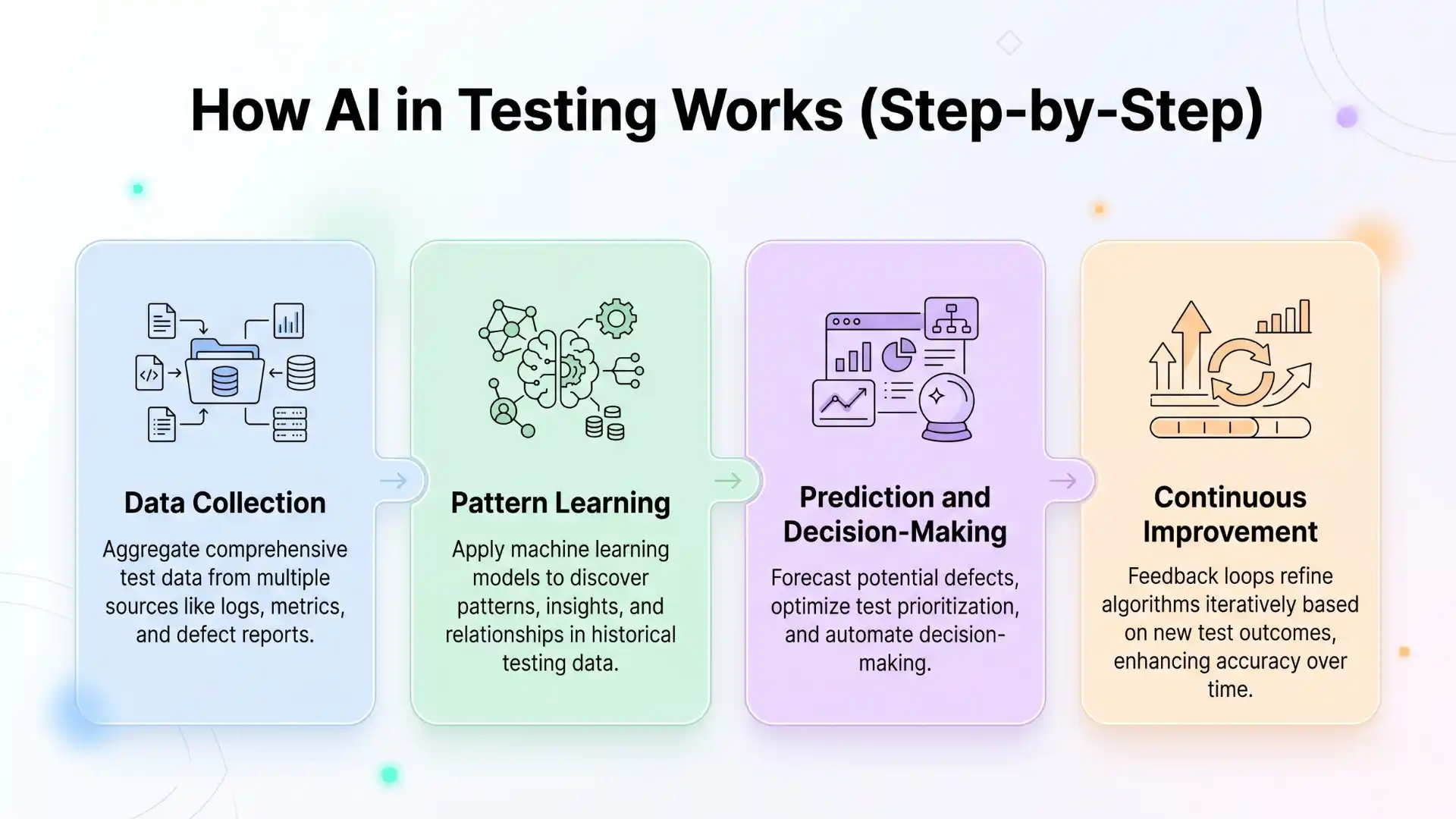
AI in testing is not magic. It follows a structured process:
1. Data Collection
AI systems collect data from:
- Test execution results
- Logs and traces
- Defect history
- User behavior
2. Pattern Learning
Machine learning models analyze this data to identify:
- Failure patterns
- Risk areas
- Test instability
3. Prediction and Decision-Making
Based on learned patterns, AI can:
- Predict defects
- Prioritize tests
- Detect anomalies
4. Continuous Improvement
The system improves over time as more data becomes available, making testing smarter with each cycle.
Types of AI in Testing
AI in testing is not a single concept. It includes multiple approaches:
1. Supervised Learning
Uses labeled data to predict outcomes.
Example: Predicting whether a test will fail based on past results.
2. Unsupervised Learning
Finds patterns in unlabeled data.
Example: Detecting anomalies in test execution or system behavior.
3. Reinforcement Learning
Learns from actions and outcomes over time.
Example: Optimizing test execution strategies based on feedback.
Each type plays a role in making testing smarter and more adaptive.
Don’t Miss Out: Highest paying companies in india
Core Applications of AI in Software Testing
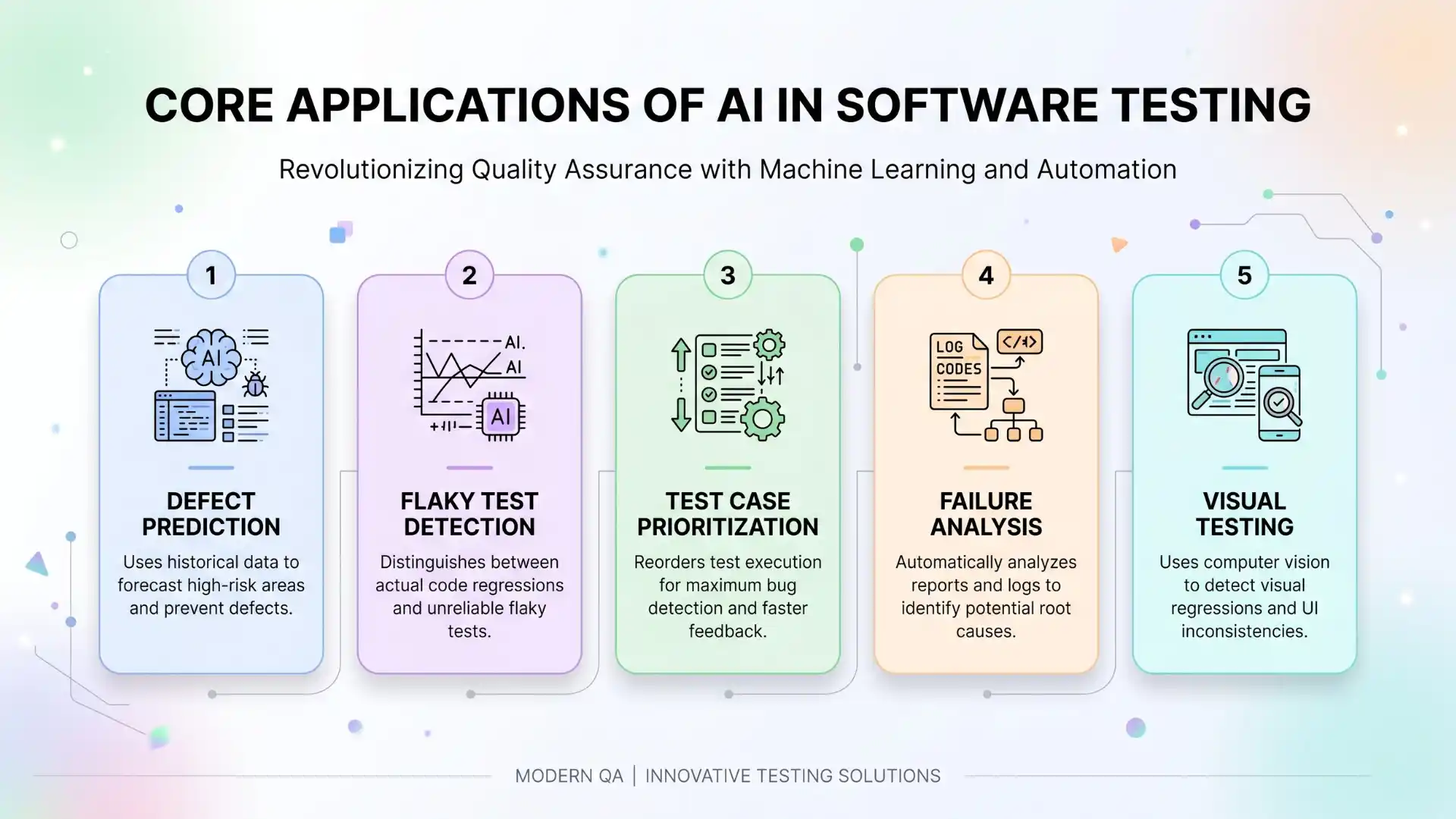
1. Defect Prediction
AI analyzes past defects and code changes to identify high-risk areas. This helps QA teams focus their testing efforts where it matters most.
2. Flaky Test Detection
AI identifies unstable tests by analyzing inconsistent execution patterns. This improves trust in automation.
3. Test Case Prioritization
AI ensures that the most critical tests run first, reducing execution time and improving CI/CD efficiency.
4. Failure Analysis
AI classifies failures into categories such as product issues, environment problems, or test errors, reducing debugging time.
5. Visual Testing
AI detects UI changes and visual inconsistencies that traditional testing may miss.
AI Testing Tools for Modern QA
AI in testing is supported by a combination of tools:
Playwright
Modern automation tool with strong reliability, auto-waits, and performance insights.
Selenium
Flexible and widely used, especially in enterprise environments.
Testim and mabl
AI-driven platforms that reduce maintenance and improve test stability.
Applitools
Visual AI testing for detecting UI inconsistencies.
The key is not choosing one tool, but building a system where tools work together.
Further Reading: Epam interview questions
Traditional Testing vs AI in Software Testing
| Aspect | Traditional Testing | AI in Testing |
|---|---|---|
| Approach | Rule-based | Data-driven |
| Execution | Fixed | Adaptive |
| Defect Detection | Reactive | Predictive |
| Maintenance | Manual | Reduced with AI |
| Decision Making | Human-only | AI-assisted |
Real-World Use Cases of AI in QA
AI in software testing is not theoretical. It is already used in real projects.
QA teams use AI for:
- Optimizing regression test suites
- Detecting performance issues in UI flows
- Improving CI/CD pipeline efficiency
- Reducing debugging time
- Enhancing cross-browser testing
For example, instead of running all tests, AI helps run only the most relevant ones based on recent changes.
This saves time and improves release speed.
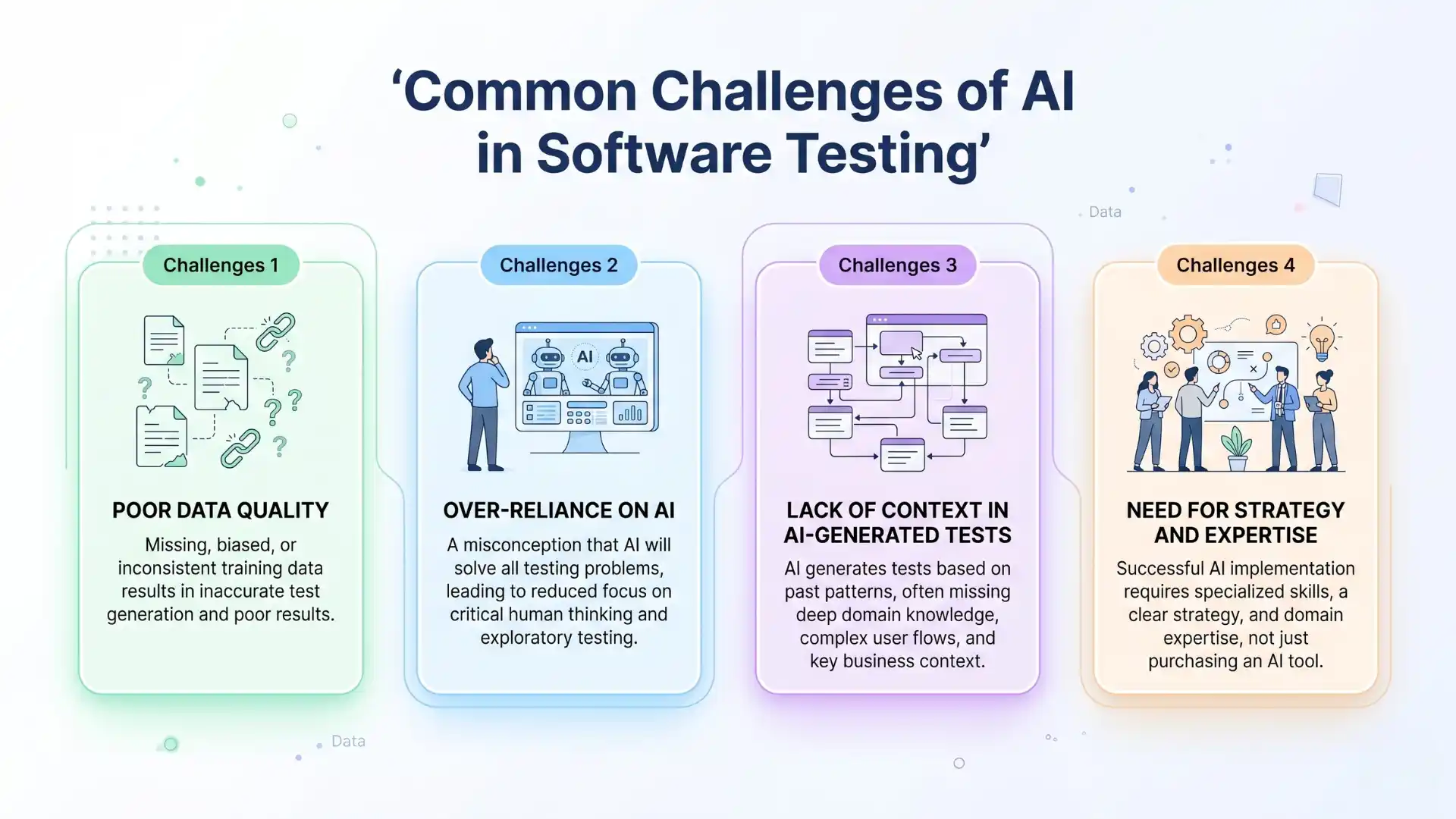
Challenges of AI in Software Testing
AI is powerful, but it is not perfect.
Common challenges include:
- Poor data quality leads to wrong predictions
- Over-reliance on AI can reduce human validation
- AI-generated tests may lack context
- Implementation requires strategy and expertise
AI works best when combined with strong testing fundamentals.
The Future of QA
The future of QA is not about more tests.
It is about smarter testing.
AI will continue to:
- Improve predictive testing
- Reduce manual effort
- Enhance decision-making
QA engineers will evolve into:
- Quality strategists
- Automation architects
- AI-assisted testers
The focus will shift from execution to intelligence.
Who Should Learn AI in Testing?
This tutorial is useful for:
- QA engineers
- Automation testers
- SDETs
- Test architects
- Engineering managers
who want to stay relevant in modern software testing.
Final Thought
AI in software testing is not a trend.
It is a shift in how quality is built.
The real value of AI in testing is not automation alone.
It is better decisions.
Because in modern QA:
Testing is not just about finding bugs.
It is about building confidence.
FAQs
What is AI in software testing?
AI in software testing is the use of machine learning and intelligent systems to improve test creation, execution, defect prediction, and failure analysis, making testing faster and more efficient.
How is AI used in software testing?
AI is used in software testing for defect prediction, flaky test detection, test prioritization, visual testing, and failure analysis to improve testing speed and accuracy.
What are the benefits of AI in testing?
The benefits include faster defect detection, reduced flaky tests, smarter test execution, improved debugging, and data-driven decision-making.
Can AI replace software testers?
No, AI cannot replace software testers. It supports them by improving efficiency and insights, while human expertise remains essential for strategy and validation.
What tools are used in AI for software testing?
Common tools include Playwright, Selenium, Testim, mabl, and Applitools, which help automate and enhance testing workflows using AI capabilities.
We Also Provide Training In:
- Advanced Selenium Training
- Playwright Training
- Gen AI Training
- AWS Training
- REST API Training
- Full Stack Training
- Appium Training
- DevOps Training
- JMeter Performance Training
Author’s Bio:

Content Writer at Testleaf, specializing in SEO-driven content for test automation, software development, and cybersecurity. I turn complex technical topics into clear, engaging stories that educate, inspire, and drive digital transformation.
Ezhirkadhir Raja
Content Writer – Testleaf