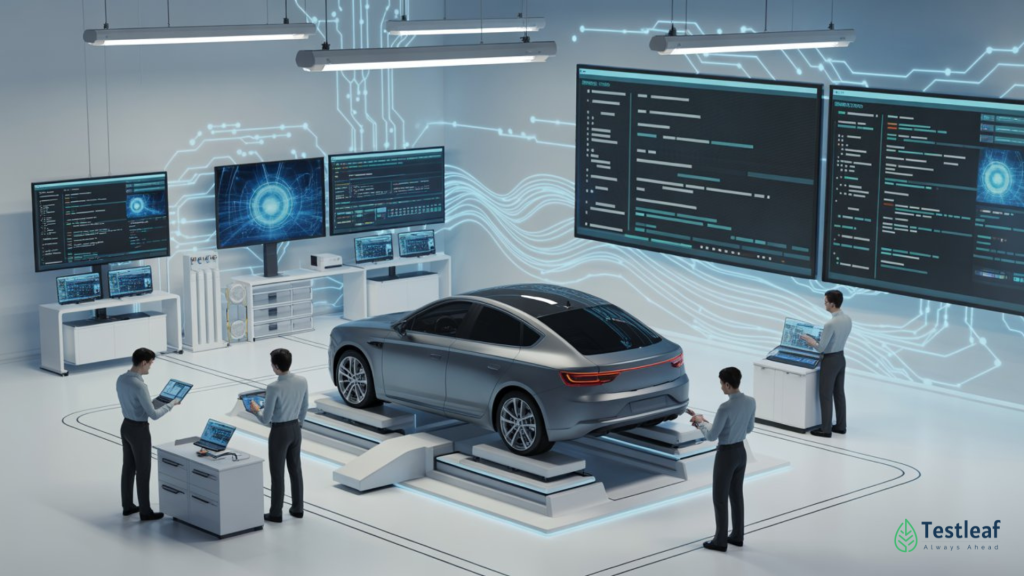
A car brakes.
But this time,
it wasn’t a rule.
It was a decision made by AI.
Now ask yourself:
👉 How do you test a decision?
👉 What is pass or fail?
👉 What if the same input gives a different output tomorrow?
This is the reality of modern automotive software.
AI is not just changing cars.
It is breaking traditional testing.
Why Automotive Software Testing Is Changing Fast
Cars are no longer machines.
They are intelligent systems.
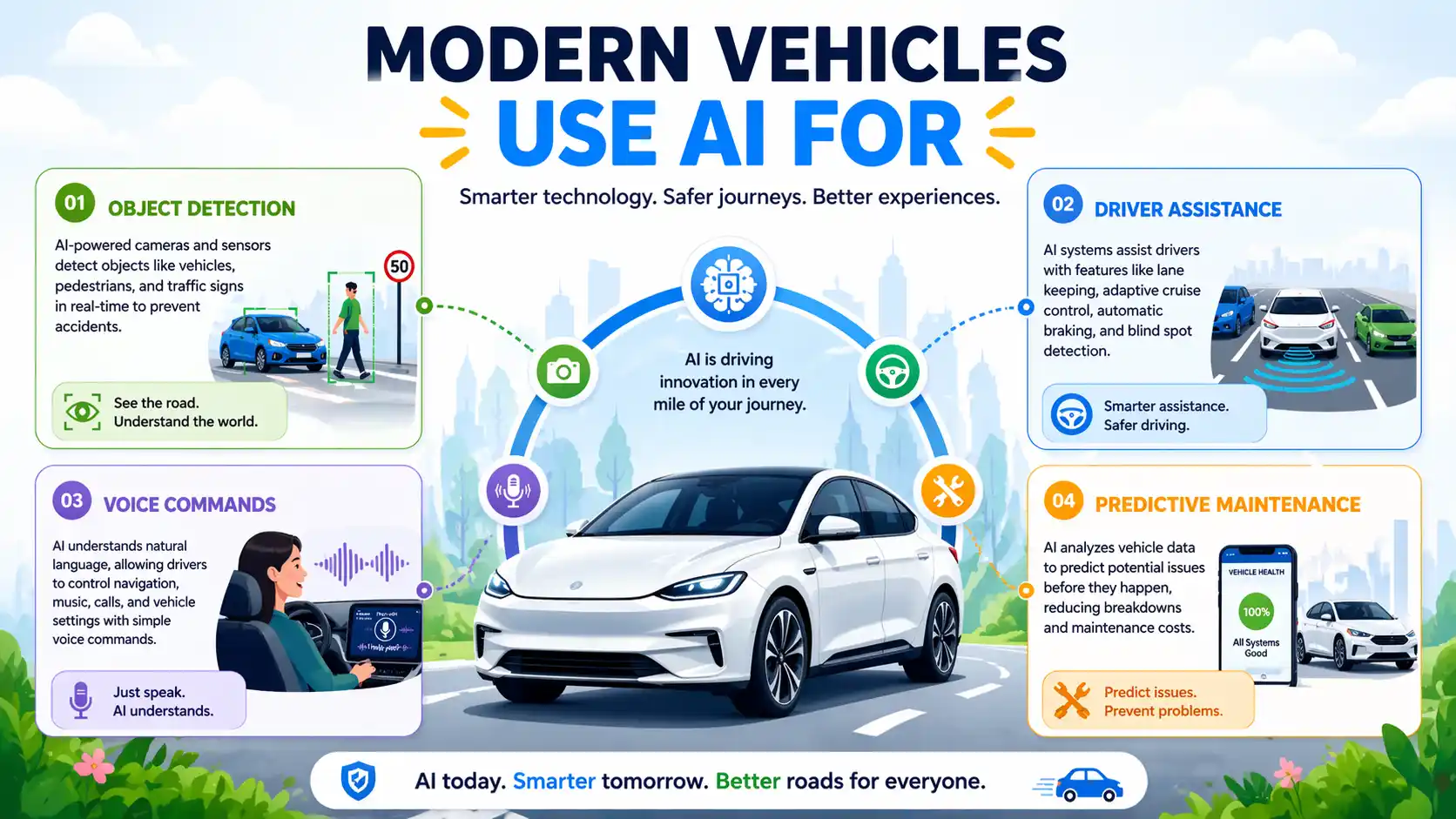
Modern vehicles use AI for:
- Object detection
- Driver assistance
- Voice commands
- Predictive maintenance
This means:
👉 You are no longer testing features
👉 You are testing learning systems
And learning systems behave differently.
The Core Challenge: AI Is Not Deterministic
Traditional software:
- Same input → Same output ✔
AI systems:
- Same input → Different output ❌
Why?
Because AI models:
- Learn from data
- Update over time
- Adapt to new patterns
👉 This breaks the core assumption of automation testing.
Additional Resources: playwright interview questions
Traditional Testing vs AI System Testing
| Aspect | Traditional Testing | AI System Testing |
| Logic | Rule-based | Learning-based |
| Output | Predictable | Probabilistic |
| Test cases | Fixed | Dynamic |
| Validation | Exact match | Confidence-based |
| Failures | Reproducible | Sometimes random |
👉 This is why your existing Selenium or Playwright skills are not enough alone.
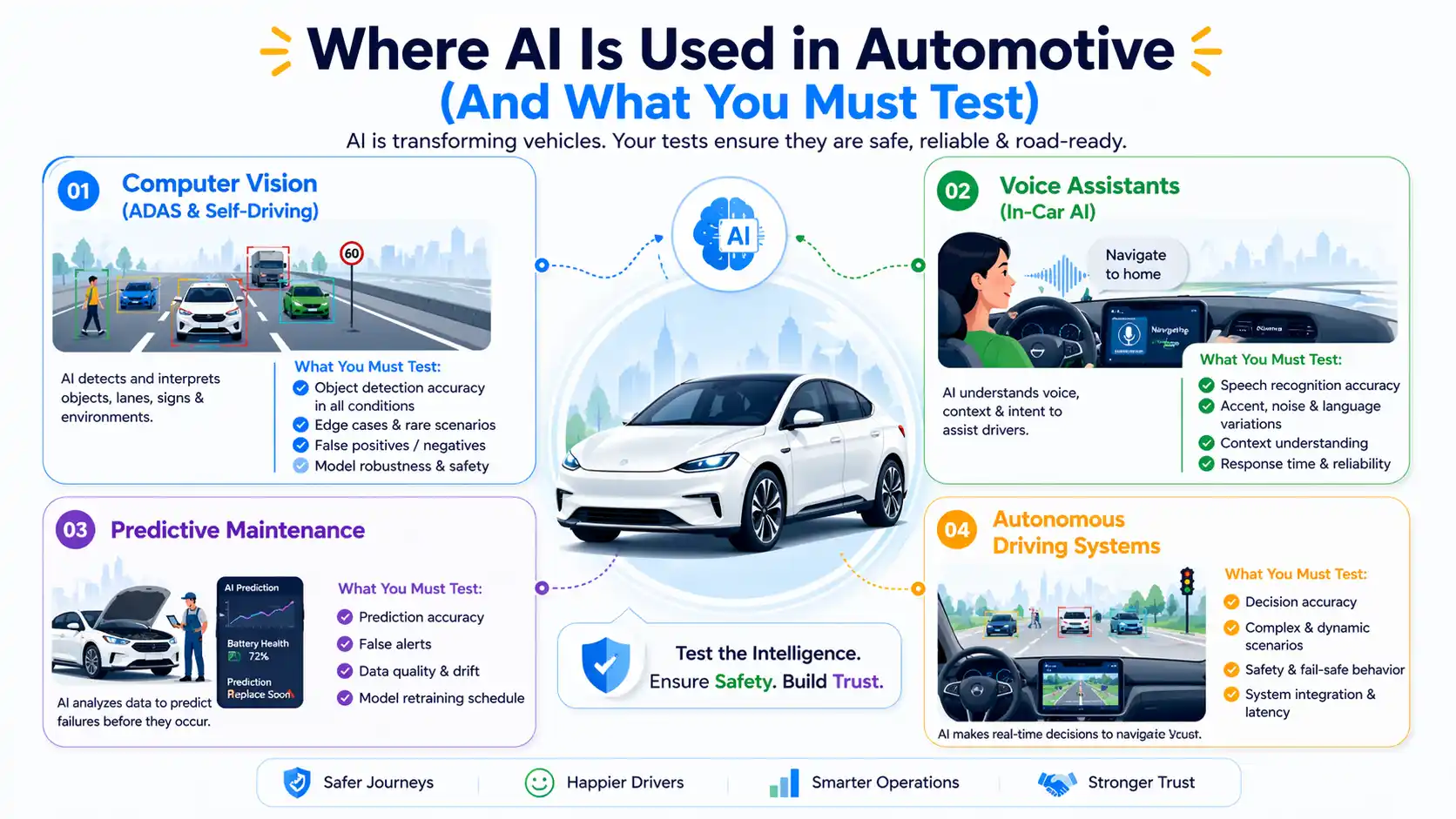
Where AI Is Used in Automotive (And What You Must Test)
1. Computer Vision (ADAS & Self-Driving)
AI detects:
- Pedestrians
- Vehicles
- Traffic signs
Testing challenge:
- Lighting conditions change
- Weather affects accuracy
- Edge cases are infinite
👉 Example:
Is a shadow a pedestrian?
AI might say yes sometimes.
2. Voice Assistants (In-Car AI)
Drivers say:
“Play music”
“Navigate home”
Testing challenge:
- Accent variation
- Noise interference
- Context understanding
👉 A button click is easy to test.
A voice command is not.
3. Predictive Maintenance
AI predicts:
- Engine failures
- Battery issues
Testing challenge:
- Model accuracy
- False positives
- Data quality
👉 You are testing predictions, not outputs.
4. Autonomous Driving Systems
This is the hardest.
Why?
- Infinite scenarios
- Real-world unpredictability
- Safety-critical decisions
👉 You cannot write test cases for:
- Every road
- Every weather
- Every human behavior
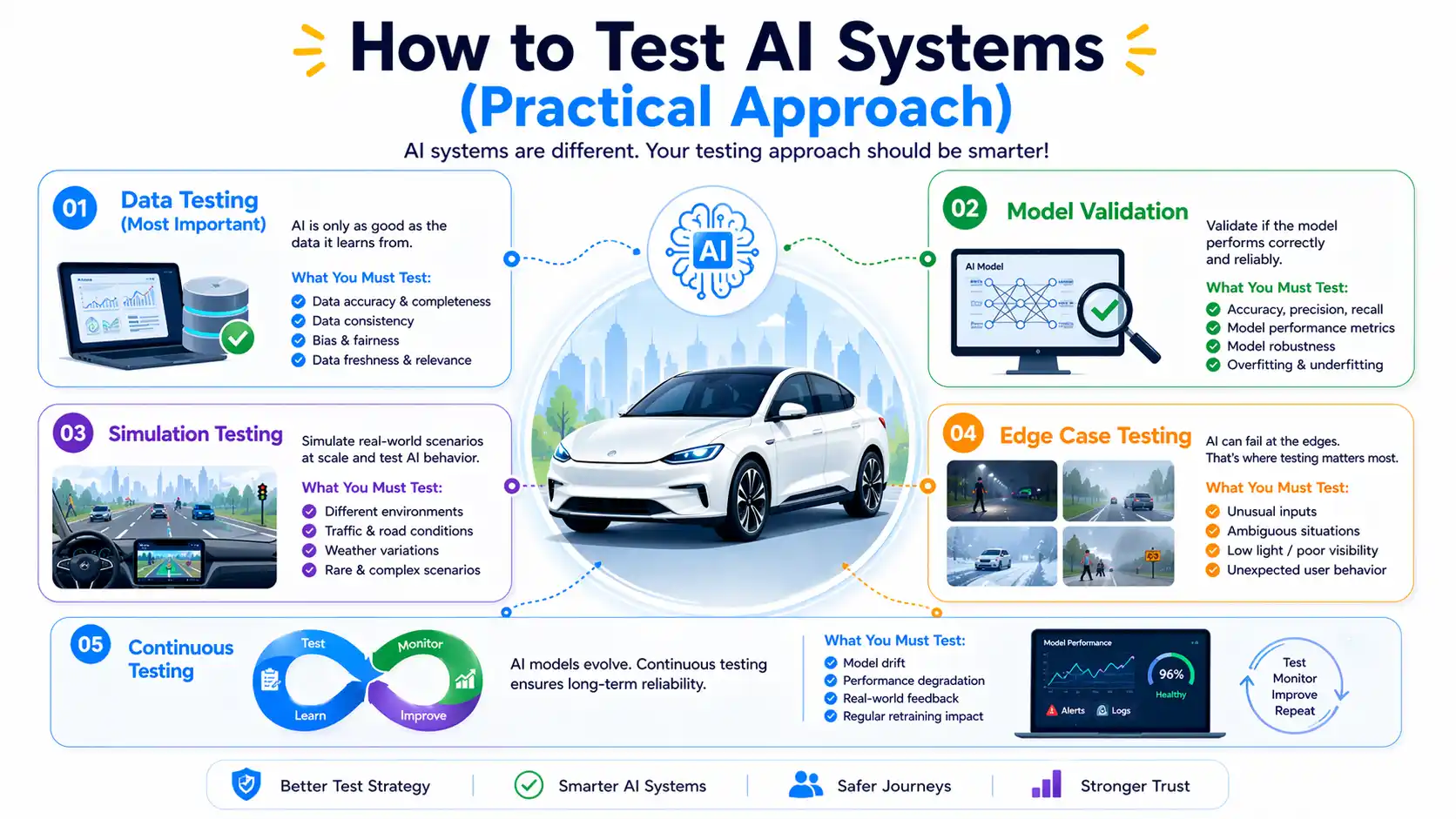
How to Test AI Systems (Practical Approach)
1. Data Testing (Most Important)
AI is only as good as its data.
Test:
- Data quality
- Bias
- Coverage
👉 Bad data = dangerous decisions
2. Model Validation
You don’t check “true or false”
You check:
- Accuracy
- Precision
- Recall
👉 Define acceptable thresholds instead of exact matches.
3. Simulation Testing
Real-world testing is limited.
So you use:
- Simulated environments
- Synthetic data
- Scenario replay
👉 This is how autonomous systems are tested at scale.
4. Edge Case Testing
Focus on:
- Rare events
- Unexpected inputs
Examples:
- Fog
- Night driving
- Sudden obstacles
👉 AI fails at edges, not at normal cases.
5. Continuous Testing
AI systems evolve.
So testing must:
- Run continuously
- Monitor drift
- Validate new data
👉 Testing is no longer a phase.
It is a continuous system.
Where Automation Testing Fits In
This is where your role evolves.
Automation testers must move from:
- Script execution ❌
to - System validation ✔
Modern QA involves:
- AI-assisted test case generation
- Flaky test detection
- Data-driven validation
- Model monitoring
Expert Insight
In a recent discussion, Babu Manickam emphasized:
Testers must move from validating code to validating intelligence.
That is the shift.
See Also: Highest paying companies in india
Key Skills QA Engineers Need Now
To stay relevant, you need:
- Basics of Machine Learning
- Data understanding
- API testing
- Simulation tools
- Automation frameworks (Playwright/Selenium)
👉 Not to become a data scientist,
but to test AI systems effectively

Common Mistakes Testers Make
❌ Treating AI like normal software
❌ Writing fixed test cases
❌ Ignoring data quality
❌ Not testing edge scenarios
👉 These mistakes lead to false confidence
The Future of Testing in Automotive
AI will:
- Increase system complexity
- Reduce predictability
- Demand smarter validation
This means:
👉 Testing will become more critical, not less
Final Thought
AI will not replace testers.
But it will replace:
- How you write tests
- How you validate systems
- How you define quality
Because when machines start making decisions…
👉 Someone has to test their intelligence.
AI in software testing is no longer optional—it is quickly becoming the foundation of how modern QA teams work. From generating smarter test cases to detecting flaky tests and validating intelligent systems, AI is reshaping every stage of testing. If you’re looking to understand how this shift applies in real-world QA workflows, you can explore it further in the “AI Master Class for QA Professionals – Master AI Agents” by Testleaf. In this session, Babu Manickam walks through practical use cases and shows how testers can confidently adapt to AI-driven systems.
FAQs
What is AI in software testing?
AI in software testing refers to using machine learning, AI models, and automation tools to generate test cases, detect defects, and validate intelligent systems more efficiently.
Why is testing AI systems difficult in automotive software?
Testing AI systems is difficult because they are non-deterministic, meaning the same input may produce different outputs, making validation and pass/fail conditions harder to define.
How do QA engineers test AI systems in automotive software?
QA engineers test AI systems using data validation, model evaluation, simulation testing, API testing, and continuous monitoring to ensure accuracy and reliability.
What are the biggest challenges in AI in software testing?
The biggest challenges include handling unpredictable outputs, ensuring data quality, testing edge cases, managing model drift, and validating AI decisions instead of fixed results.
Can automation testing tools like Selenium or Playwright test AI systems?
Yes, but they must be combined with AI-specific approaches such as data-driven testing, simulation environments, and model performance validation.
Why is simulation important for testing AI in automotive systems?
Simulation allows QA teams to test AI behavior across thousands of real-world scenarios like weather, traffic, and road conditions that cannot be tested manually.
What skills are required to work with AI in software testing?
QA engineers need automation testing knowledge, API testing skills, basic machine learning understanding, and experience with data analysis and AI workflows.
How is AI in software testing changing the role of QA engineers?
AI is shifting QA roles from writing manual test scripts to validating intelligent systems, focusing more on data, models, and system-level testing.
How can QA professionals start learning AI in software testing?
QA professionals can start by learning LLMs, AI agents, prompt engineering, and real-world testing workflows through hands-on training and expert-led sessions.
We Also Provide Training In:
- Advanced Selenium Training
- Playwright Training
- Gen AI Training
- AWS Training
- REST API Training
- Full Stack Training
- Appium Training
- DevOps Training
- JMeter Performance Training
Author’s Bio:

Content Writer at Testleaf, specializing in SEO-driven content for test automation, software development, and cybersecurity. I turn complex technical topics into clear, engaging stories that educate, inspire, and drive digital transformation.
Ezhirkadhir Raja
Content Writer – Testleaf