Introduction
Artificial Intelligence (AI) is no longer a futuristic concept—it has become a foundational technology shaping the modern digital economy. From personalized recommendations on streaming platforms to intelligent chatbots, autonomous systems, and AI-powered software development tools, AI is transforming how organizations operate and how people interact with technology.
Across industries such as healthcare, finance, retail, cybersecurity, and software engineering, businesses are rapidly adopting AI-driven solutions to automate workflows, extract insights from data, and deliver smarter digital experiences.
As a result, the demand for professionals with Artificial Intelligence skills is growing at an unprecedented rate. Companies are actively seeking individuals who can build intelligent systems, analyze complex datasets, automate business processes, and develop innovative AI-powered products.
For students, IT professionals, and software testers exploring new career opportunities, learning AI skills can open doors to some of the most exciting and high-paying roles in the technology sector.
In this guide, we will explore:
- The most important skills required for a career in Artificial Intelligence
- Modern AI tools and technologies professionals should learn
- The most in-demand AI career roles
- A practical roadmap to start a career in AI
- Future trends shaping AI careers through 2030
Also, Know More About: playwright interview questions
Why Artificial Intelligence Skills Are in High Demand
The global adoption of Artificial Intelligence is accelerating rapidly as organizations aim to improve efficiency, automate repetitive tasks, and make smarter business decisions using data.
Several key factors are driving this demand:
1. Automation of Business Processes
Organizations are using AI to automate manual tasks such as customer support, document processing, data analysis, and software testing.
2. Data-Driven Decision Making
Companies are generating enormous volumes of data. AI systems help analyze this data to uncover patterns, predict trends, and support strategic decisions.
3. AI-Powered Software Development
AI coding assistants and automated testing tools are transforming how software is developed and validated.
4. Rise of Generative AI
Generative AI technologies are enabling machines to create text, images, audio, and code, revolutionizing industries such as media, marketing, design, and software engineering.
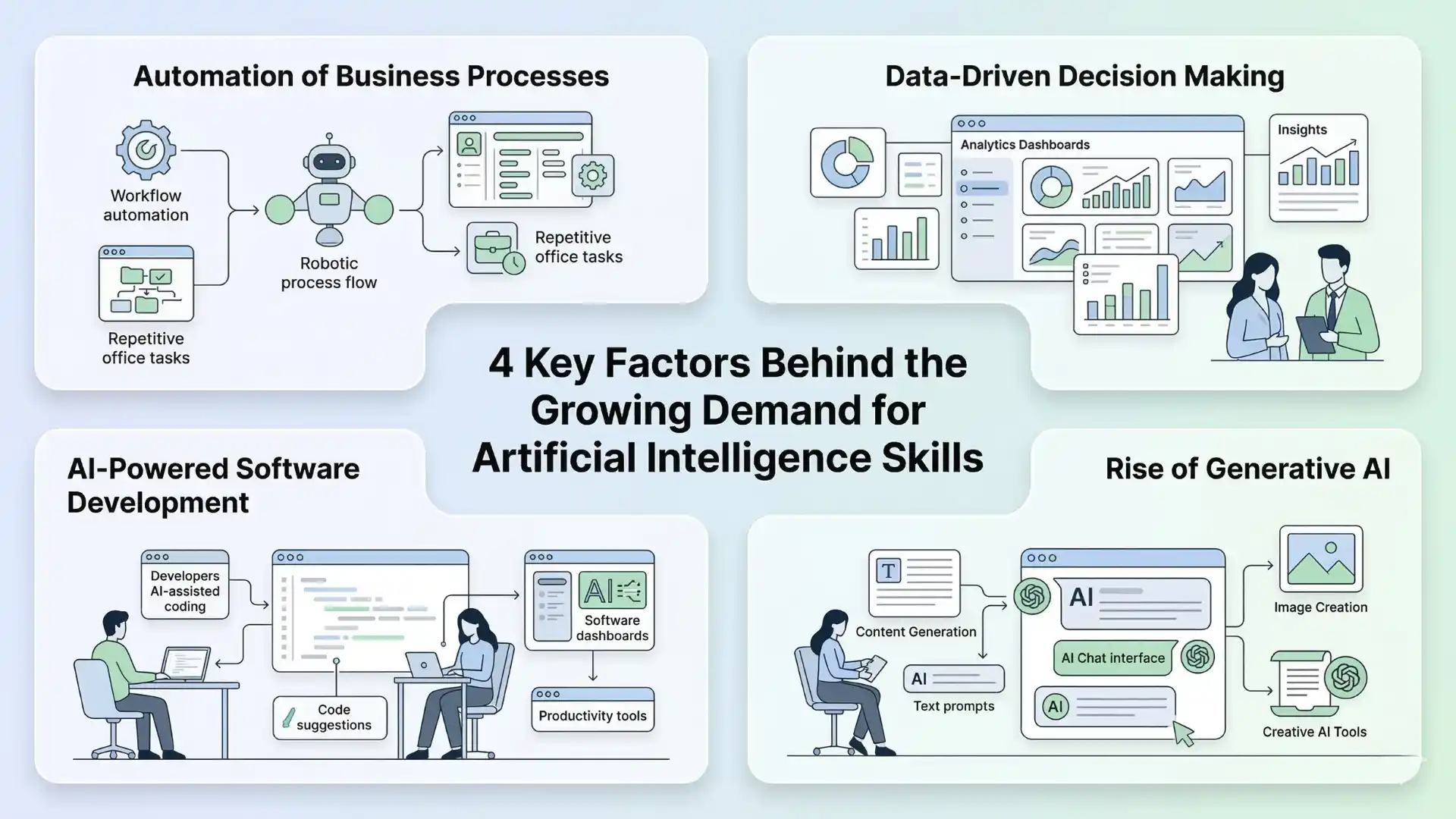
Because of these trends, professionals who understand both AI theory and practical implementation will have a major advantage in the technology job market.
Top Skills Required for a Career in Artificial Intelligence
To succeed in AI-related roles, professionals need a combination of programming knowledge, mathematical understanding, data analysis skills, and familiarity with modern AI tools.
Below are the most important skills to develop for a successful AI career.
1. Programming Skills
Programming is the foundation of Artificial Intelligence development. AI models, algorithms, and automation systems are implemented through programming languages.
Popular programming languages used in AI include:
- Python
- R
- Java
- C++
Among these, Python is the most widely used language in AI due to its extensive ecosystem of machine learning libraries and frameworks.
Common Python libraries used in AI development include:
- TensorFlow
- PyTorch
- Scikit-learn
- Pandas
- NumPy
Strong programming skills enable professionals to build models, automate workflows, and integrate AI systems into real-world applications.
2. Machine Learning
Machine Learning (ML) is a core branch of Artificial Intelligence that allows systems to learn from data and improve performance without explicit programming.
Important machine learning concepts include:
- Supervised learning
- Unsupervised learning
- Reinforcement learning
- Model training and evaluation
- Feature engineering
Machine learning skills are essential for roles such as:
- AI Engineer
- Machine Learning Engineer
- Data Scientist
3. Deep Learning
Deep learning is a subset of machine learning that uses neural networks to model complex patterns in data.
Deep learning powers many modern AI systems including:
- Image recognition
- Voice assistants
- Autonomous vehicles
- Facial recognition systems
Popular deep learning frameworks include:
- TensorFlow
- PyTorch
- Keras
Understanding neural networks and deep learning architectures is critical for building advanced AI systems.
4. Data Science and Data Analysis
Artificial Intelligence systems rely heavily on high-quality data. AI professionals must understand how to collect, clean, process, and analyze data effectively.
Important data-related skills include:
- Data preprocessing
- Statistical analysis
- Data visualization
- Feature engineering
- Exploratory data analysis
These skills help improve the accuracy and reliability of machine learning models.
5. Natural Language Processing (NLP)
Natural Language Processing enables machines to understand and process human language.
NLP technologies are widely used in:
- Chatbots
- Virtual assistants
- Sentiment analysis tools
- Language translation systems
- AI search engines
With the rise of large language models, NLP skills have become increasingly valuable in AI development.
6. Generative AI
Generative AI is one of the fastest-growing areas in Artificial Intelligence. It focuses on creating new content such as text, images, audio, and code using AI models.
Applications of generative AI include:
- AI chatbots
- Automated content generation
- AI coding assistants
- Image generation tools
- AI-powered design systems
Professionals who understand generative AI technologies are in extremely high demand across industries.
7. Prompt Engineering
Prompt engineering has emerged as an important skill in the age of generative AI.
It involves designing structured prompts that guide AI models to produce accurate and useful outputs.
Important techniques include:
- Zero-shot prompting
- Few-shot prompting
- Chain-of-thought prompting
- Role prompting
- Structured output prompting
Prompt engineering is particularly valuable for professionals working with AI chatbots, automation systems, and AI copilots.
8. AI Agents and Automation
AI agents are intelligent systems capable of performing tasks autonomously by interacting with digital environments.
These systems are increasingly used in:
- Workflow automation
- Customer support automation
- AI-powered research tools
- Autonomous coding assistants
- Software testing automation
Understanding AI agents and autonomous systems is becoming a key skill for modern AI engineers.
9. MLOps (Machine Learning Operations)
MLOps focuses on deploying, managing, and maintaining machine learning models in production environments.
Key aspects of MLOps include:
- Model deployment
- Continuous integration and delivery for ML models
- Model monitoring
- Performance optimization
- Automated retraining pipelines
Organizations rely on MLOps specialists to ensure AI models operate reliably in real-world systems.

10. Cloud AI Platforms
AI applications often require significant computational resources. Cloud platforms provide scalable infrastructure for building and deploying AI solutions.
Popular cloud platforms used for AI development include:
- Amazon Web Services (AWS)
- Microsoft Azure
- Google Cloud Platform
Cloud knowledge enables professionals to deploy AI solutions at scale.
11. AI Model Evaluation
Building AI models is only part of the process. Professionals must also evaluate model performance to ensure accuracy and reliability.
Model evaluation includes:
- Accuracy measurement
- Bias detection
- Dataset quality analysis
- Performance validation
- Model drift monitoring
This skill is particularly important in AI testing and quality assurance roles.
12. AI Ethics and Responsible AI
As AI systems become more powerful, ethical considerations are increasingly important.
AI professionals must understand issues related to:
- Data privacy
- Algorithmic bias
- Transparency in AI decisions
- Responsible AI development
Many organizations now have dedicated teams focused on ethical AI governance.
Explore More: Top 10 Product based companies in chennai
Top Careers in Artificial Intelligence
Artificial Intelligence offers a wide range of career opportunities across industries.
Below are some of the most in-demand AI roles.
AI Engineer
AI Engineers design and build intelligent systems that perform complex tasks such as prediction, classification, and automation.
Key responsibilities include:
- Developing AI models
- Implementing machine learning algorithms
- Integrating AI systems into applications
- Building AI-driven products
Machine Learning Engineer
Machine Learning Engineers focus on building scalable machine learning systems.
Their work includes:
- Designing ML pipelines
- Training and optimizing models
- Managing large datasets
- Deploying models to production environments
Data Scientist
Data Scientists analyze large datasets to identify insights that help businesses make better decisions.
They use:
- Statistical analysis
- Machine learning
- Data visualization techniques
Data scientists play a key role in data-driven organizations.
AI Research Scientist
AI Research Scientists develop new algorithms and techniques that push the boundaries of artificial intelligence.
They often work in:
- research laboratories
- universities
- large technology companies
This role usually requires advanced degrees in AI, computer science, or related fields.
AI Product Manager
AI Product Managers combine technical knowledge with business strategy to build AI-powered products.
They coordinate between:
- engineering teams
- stakeholders
- customers
to deliver valuable AI solutions.
AI Test Engineer
AI Test Engineers validate and test AI models and intelligent systems.
Their responsibilities include:
- Testing AI algorithms
- Validating datasets
- Evaluating model accuracy
- Ensuring AI systems behave reliably
This role is especially relevant for professionals transitioning from traditional software testing.
Other Recommended Reads: AI and ML engineer salary in india
AI Career Roadmap for Beginners
Starting a career in Artificial Intelligence requires both theoretical knowledge and hands-on practice.
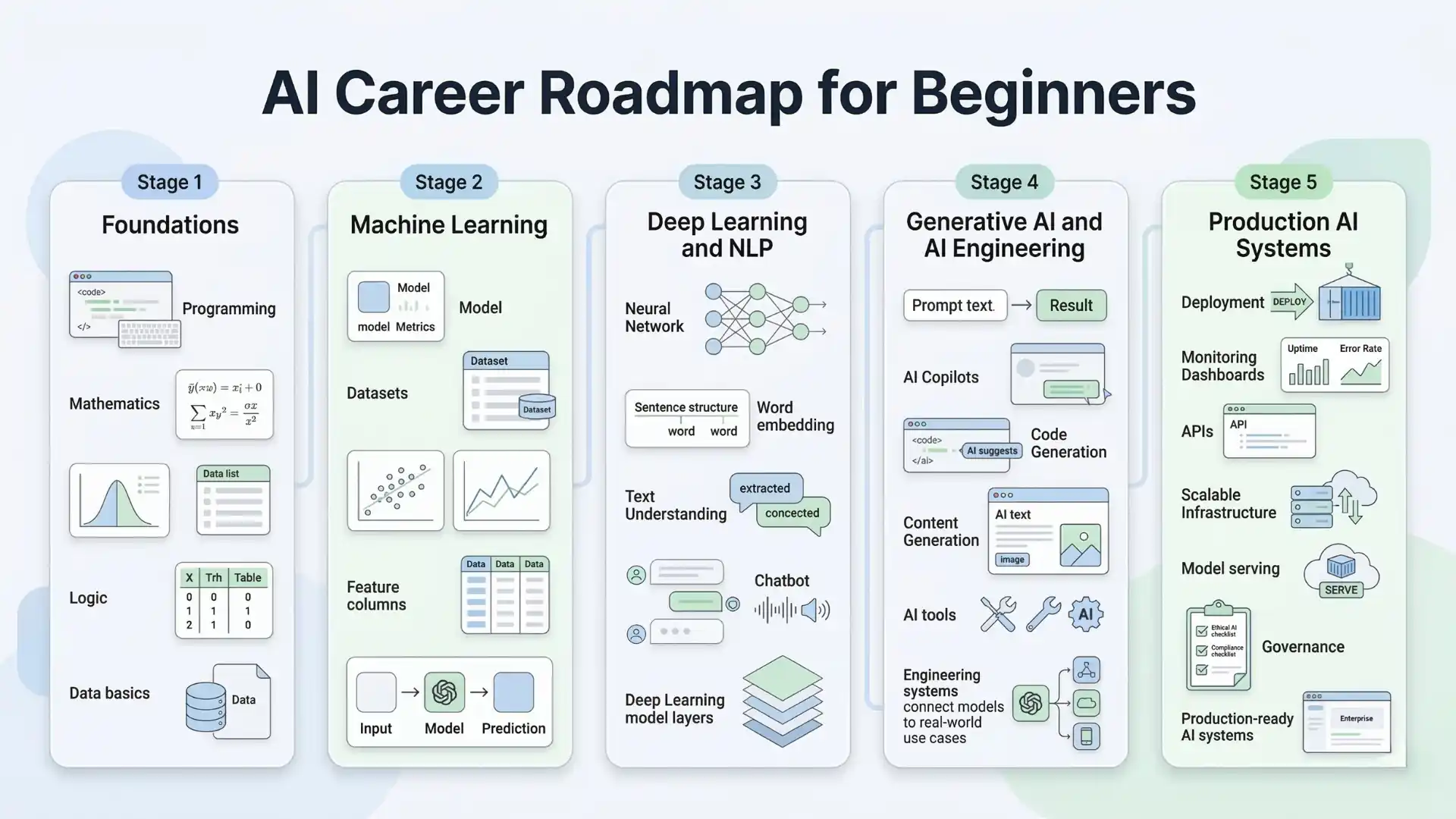
A recommended roadmap includes the following stages:
Stage 1: Foundations
Learn:
- Python programming
- Basic statistics
- Data analysis fundamentals
- Introduction to AI concepts
Stage 2: Machine Learning
Develop skills in:
- machine learning algorithms
- model training and evaluation
- data preprocessing
- building simple ML projects
Stage 3: Deep Learning and NLP
Learn:
- neural networks
- deep learning frameworks
- natural language processing
- computer vision basics
Stage 4: Generative AI and AI Engineering
Build expertise in:
- Generative AI models
- prompt engineering
- AI agents and automation
- AI system design
Stage 5: Production AI Systems
Focus on:
- MLOps
- cloud deployment
- scalable AI architecture
- monitoring AI systems in production
AI Career Opportunities for Software Testers
Software testers and QA professionals can also transition into AI-related roles.
With the rapid growth of AI-powered systems, testing intelligent applications has become a specialized skill.
Potential career paths include:
- AI Test Engineer
- AI Automation Engineer
- AI Model Validator
- AI Quality Engineer
Testers who learn machine learning fundamentals and AI model validation techniques can play an important role in ensuring AI systems operate reliably.
Future Trends in Artificial Intelligence Careers (2026–2030)
Artificial Intelligence continues to evolve rapidly. Several trends will shape the future of AI careers.
Important trends include:
- Autonomous AI agents performing complex tasks
- Generative AI transforming creative industries
- AI-driven software development and testing
- AI-powered decision support systems
- Responsible AI governance and regulation
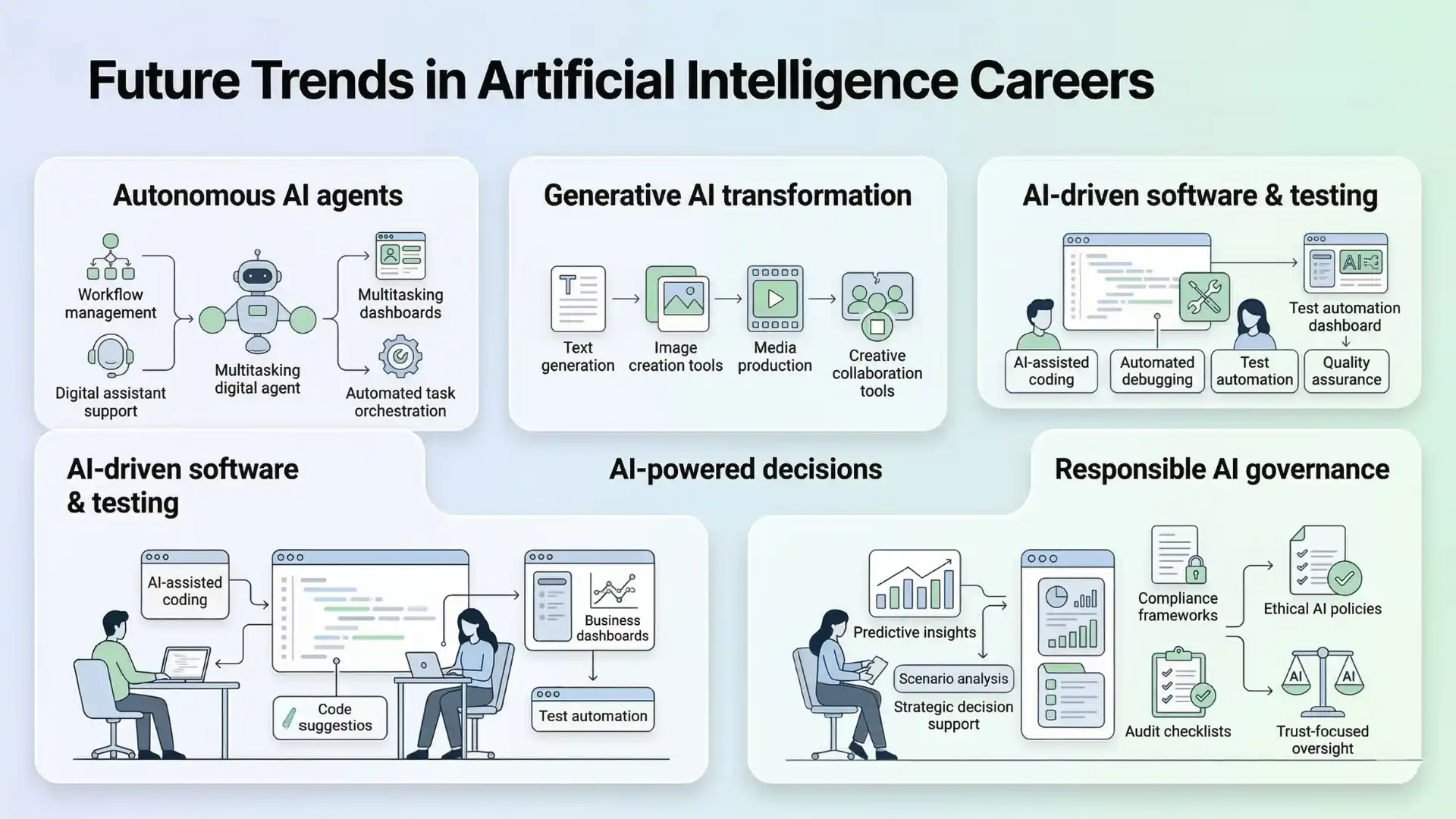
Professionals who stay updated with these developments will have strong career opportunities in the coming decade.
Key Takeaways
- Artificial Intelligence is one of the fastest-growing technology fields.
- Skills in machine learning, deep learning, and generative AI are highly valuable.
- Programming languages such as Python play a critical role in AI development.
- Emerging technologies like AI agents, MLOps, and cloud-based AI platforms are shaping the future of AI careers.
- Popular AI roles include AI Engineer, Machine Learning Engineer, Data Scientist, and AI Product Manager.
- Software testers can transition into AI careers by learning AI testing and automation techniques.
- Hands-on projects and practical experience are essential for success in the AI industry.
Conclusion
Artificial Intelligence is transforming industries and creating new career opportunities across the global technology landscape.
Professionals who develop the right combination of programming expertise, machine learning knowledge, and data analysis skills can build successful careers in this rapidly evolving field.
Whether you are a student exploring future career paths, an IT professional upgrading your skills, or a software tester transitioning into AI, learning Artificial Intelligence can open the door to some of the most exciting and in-demand roles in the digital economy. The growing adoption of AI in software testing is also creating new possibilities for QA professionals to leverage intelligent automation and improve software quality.
As organizations continue adopting AI technologies, the demand for skilled AI professionals will only continue to grow. Developing AI skills today can position you for long-term success in the technology careers of tomorrow.
FAQs
What skills are required for a career in Artificial Intelligence?
The most important skills required for a career in Artificial Intelligence include programming, especially Python, machine learning, deep learning, data science, statistics, and natural language processing. Professionals should also understand generative AI, cloud platforms, and MLOps to build and deploy AI solutions effectively.
What are the top careers in Artificial Intelligence?
Some of the top careers in Artificial Intelligence include AI Engineer, Machine Learning Engineer, Data Scientist, AI Research Scientist, AI Product Manager, and AI Test Engineer. These roles focus on developing AI systems, analyzing data, and building intelligent applications.
Is Artificial Intelligence a good career in 2026?
Yes, Artificial Intelligence is one of the fastest-growing career fields in 2026. As organizations adopt AI technologies across industries such as healthcare, finance, e-commerce, and software development, the demand for AI professionals continues to increase.
Can software testers transition into Artificial Intelligence careers?
Yes, software testers can transition into AI-related careers by learning machine learning fundamentals, data analysis, and AI model validation. With the growing use of AI in software testing, professionals can move into roles such as AI Test Engineer, AI Automation Engineer, or AI Quality Engineer.
How can beginners start a career in Artificial Intelligence?
Beginners can start a career in Artificial Intelligence by learning programming languages like Python, understanding machine learning concepts, practicing with datasets, building AI projects, and gaining hands-on experience with AI tools and cloud platforms.
Which programming language is best for Artificial Intelligence?
Python is considered the best programming language for Artificial Intelligence because it has powerful libraries such as TensorFlow, PyTorch, and Scikit-learn. These tools simplify machine learning and deep learning development.
What is the future scope of Artificial Intelligence careers?
The future of Artificial Intelligence careers is extremely promising. Emerging technologies such as generative AI, AI agents, autonomous systems, and AI-driven automation are expected to create new job roles and expand opportunities for skilled professionals.
We Also Provide Training In:
- Advanced Selenium Training
- Playwright Training
- Gen AI Training
- AWS Training
- REST API Training
- Full Stack Training
- Appium Training
- DevOps Training
- JMeter Performance Training
Author’s Bio:

Content Writer at Testleaf, specializing in SEO-driven content for test automation, software development, and cybersecurity. I turn complex technical topics into clear, engaging stories that educate, inspire, and drive digital transformation.
Ezhirkadhir Raja
Content Writer – Testleaf