As software systems become increasingly distributed and API-driven, API automation testing tools have moved from being optional utilities to becoming a critical pillar of software quality. In 2026, the integration of artificial intelligence (AI) is reshaping how teams design, execute, and maintain API tests—shifting testing from script-heavy execution to intelligent, insight-driven automation.
This article explores the top 15 AI-powered API automation testing tools in 2026, explains how AI is practically used in real testing environments, and outlines what QA teams should look for when selecting tools that can scale with modern software architectures.
Why AI Is Redefining API Automation Testing
Traditional API automation relies heavily on manually written scripts, static assertions, and frequent maintenance as APIs evolve. While effective in controlled environments, this approach struggles to keep pace with microservices, frequent releases, and continuous integration pipelines.
AI introduces a layer of intelligence that enhances—not replaces—existing automation practices. In modern API testing, AI is primarily used to:
- Suggest relevant test cases based on API schemas and usage patterns
- Identify abnormal responses and failure trends
- Reduce test flakiness through smart retry and classification mechanisms
- Assist in maintaining tests when APIs undergo minor changes
The result is faster feedback, better coverage, and reduced maintenance effort, allowing testers to focus on validation strategy rather than repetitive scripting.
A Reality Check: What “AI-Powered” Really Means in API Testing
While many platforms today are marketed as AI-powered API automation testing tools, it is important to clarify what AI actually delivers in real-world testing environments. In 2026, most tools do not function as fully autonomous systems that replace human testers. Instead, they rely on AI-assisted intelligence to enhance specific testing tasks.
These capabilities commonly include automated test suggestions, intelligent failure analysis, smart assertion recommendations, and maintenance optimization through pattern recognition. Human testers continue to define test objectives, review outcomes, and make release decisions.
This collaborative model—where AI augments human expertise rather than replacing it—is what makes modern API automation tools practical, scalable, and trustworthy in production environments.
How We Evaluated These Tools
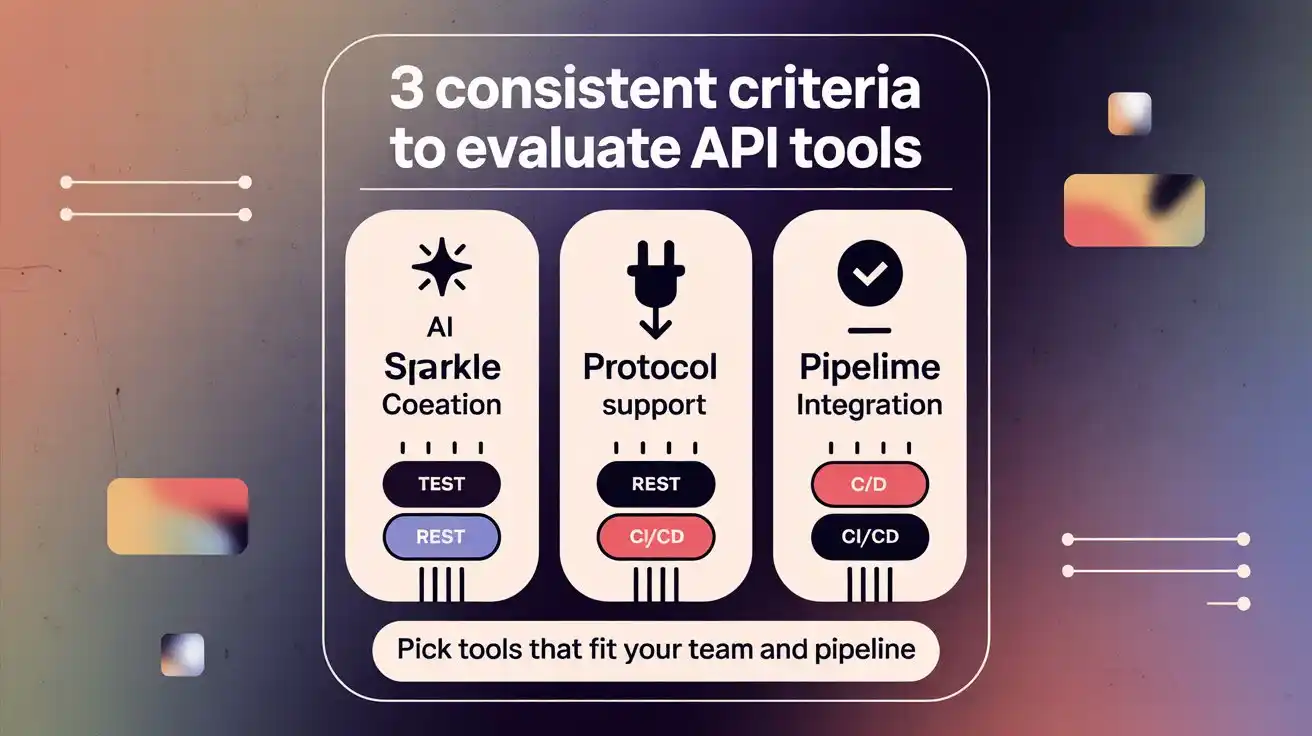
To ensure practical relevance and credibility, each tool listed below was assessed using three consistent criteria:
- AI-Assisted Capabilities – Real, usable intelligence rather than marketing claims
- API Protocol Support – REST, GraphQL, SOAP, gRPC, and event-based APIs
- Workflow Integration – Ease of use, CI/CD compatibility, and team adoption
This approach mirrors how authoritative business and technology publications structure forward-looking content: start with context, validate claims, and then present actionable options.
Top 15 AI-Powered API Automation Testing Tools in 2026 (Detailed Explanation)
1. Postman (with AI Assist)
Postman has evolved beyond manual API testing by introducing AI-assisted test suggestions and smarter validations. Its AI features analyze API responses and collections to recommend assertions and detect anomalies.
Why it matters:
It reduces manual effort while keeping testers in control.
Best for: Teams already using Postman who want AI assistance without changing tools.
2. TestSigma
TestSigma uses natural language processing (NLP) to convert plain English test steps into executable API tests. Its AI engine maps intent to API actions and optimizes test execution based on past results.
Why it matters:
Makes API automation accessible to non-programmers.
Best for: Agile teams and business testers.
3. Tricentis NeoLoad (API + AI Analytics)
NeoLoad applies AI to performance trend analysis, bottleneck detection, and anomaly identification for APIs under load. It does not replace test design but enhances insight quality.
Why it matters:
Identifies performance risks earlier in CI/CD pipelines.
Best for: Enterprise-scale performance testing.
4. SmartBear ReadyAPI (AI Enhancements)
ReadyAPI uses AI to assist with assertion generation, test data parameterization, and impact analysis when APIs change.
Why it matters:
Reduces repetitive configuration and improves coverage consistency.
Best for: Complex, integration-heavy API environments.
5. Katalon Studio
Katalon integrates AI to optimize test execution, suggest validations, and improve failure diagnostics. It blends low-code usability with intelligent insights.
Why it matters:
Balances simplicity and power for growing QA teams.
Best for: Mid-sized teams adopting structured automation.
6. Sauce Labs API Testing
Sauce Labs focuses on AI-driven failure analysis and test stability, helping teams distinguish between real defects and flaky failures in CI pipelines.
Why it matters:
Improves confidence in automated test results.
Best for: Cloud-native and DevOps-driven teams.
7. mabl
mabl uses machine learning to maintain tests automatically, detect patterns in failures, and suggest improvements. Its AI reduces maintenance rather than creating tests independently.
Why it matters:
Lowers long-term automation costs.
Best for: Lean QA teams with frequent releases.

8. Testim (API Layer)
Testim applies ML to stabilize API tests, classify failures, and improve reliability. AI helps adjust tests when minor API changes occur.
Why it matters:
Reduces flaky test noise in continuous testing.
Best for: Continuous integration environments.
9. Parasoft SOAtest
Parasoft uses AI-assisted analytics for change impact analysis, helping teams understand which API tests are most relevant after updates.
Why it matters:
Avoids unnecessary test execution while maintaining coverage.
Best for: Regulated and enterprise systems.
10. Functionize
Functionize applies self-learning models to optimize test execution paths and adapt validations over time based on historical behavior.
Why it matters:
Improves automation maturity over long-term use.
Best for: Large automation programs.
11. RestAssured (with AI Plugins)
RestAssured remains developer-centric, but AI plugins add response anomaly detection and intelligent reporting.
Why it matters:
Enhances existing frameworks without replacing them.
Best for: Developer-led API testing teams.
12. Applitools (API Validation Context)
Applitools extends its visual AI intelligence to validate API-driven UI behavior, ensuring backend changes do not impact user experience.
Why it matters:
Connects API quality with frontend reliability.
Best for: End-to-end test strategies.
13. HeadSpin
HeadSpin applies AI to monitor APIs in real-world conditions, providing predictive alerts based on traffic and performance trends.
Why it matters:
Moves API testing closer to production monitoring.
Best for: Observability-driven QA teams.
14. RoboTest (AI-Assisted Open Source)
RoboTest experiments with AI for API discovery and test coverage suggestions, driven by community contributions.
Why it matters:
Allows experimentation without vendor lock-in.
Best for: Teams with customization and ML expertise.
15. AI-Integrated In-House Frameworks
Many mature organizations embed AI into their custom API automation frameworks for log analysis, test prioritization, and defect prediction.
Why it matters:
Tailored intelligence aligned with business context.
Best for: Advanced engineering teams.
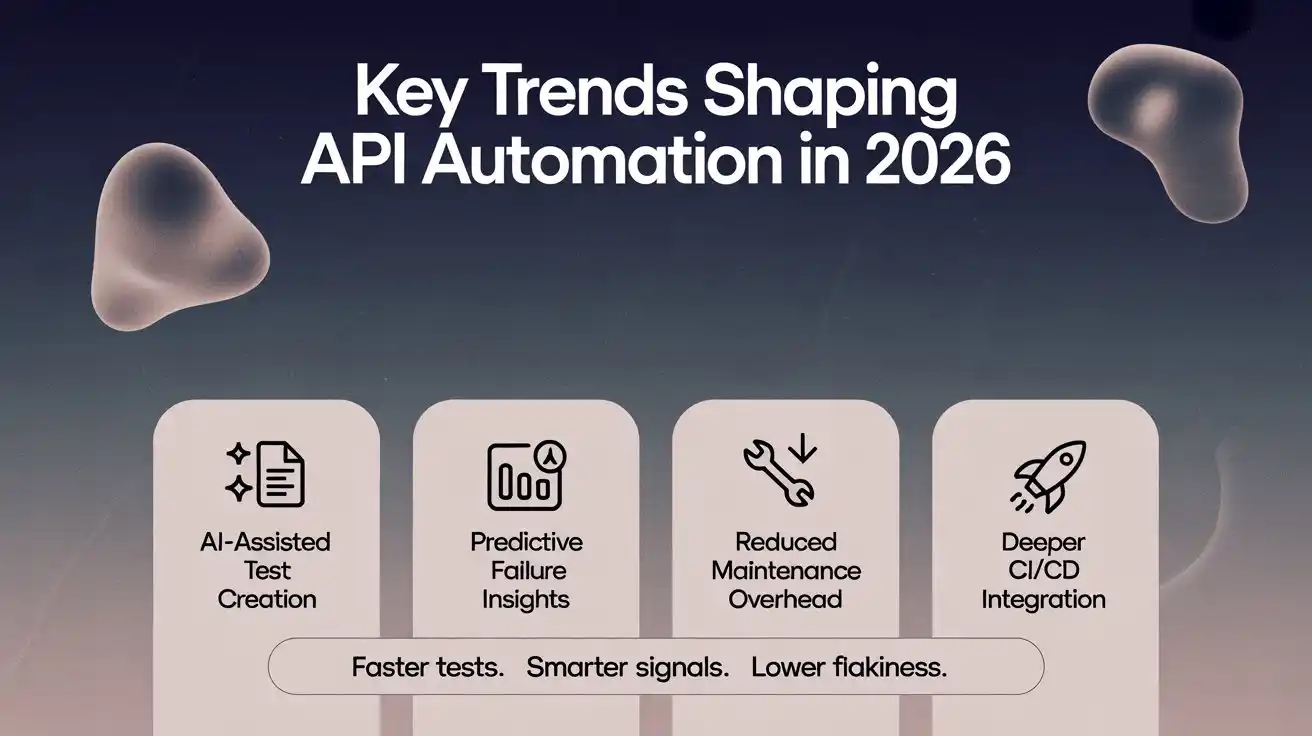
Key Trends Shaping API Automation in 2026
AI-Assisted Test Creation
Tools increasingly generate baseline tests automatically using schemas and traffic patterns.
Predictive Failure Insights
AI highlights risky endpoints and recurring defects before release.
Reduced Maintenance Overhead
Pattern recognition helps tests adapt to minor API changes without constant rewrites.
Deeper CI/CD Integration
API testing becomes a continuous quality signal rather than a post-build activity.
How to Choose the Right Tool
When selecting an AI-powered API automation testing tool in 2026, teams should:
- Prioritize practical AI capabilities, not buzzwords
- Ensure compatibility with existing API protocols
- Validate CI/CD and DevOps integration
- Match tool complexity with team skill levels

The right tool should simplify workflows and improve confidence—not introduce new operational burdens.
Final Thoughts
AI is not replacing testers, but it is changing how effective testers work. In 2026, successful API automation strategies combine AI-assisted tools with experienced QA judgment, enabling faster releases, better defect detection, and scalable quality practices.
Organizations that adopt intelligent API automation today are better positioned to handle tomorrow’s complexity—without sacrificing reliability or trust.
FAQs
1. What are AI-powered API automation testing tools?
AI-powered API automation testing tools use AI-assisted intelligence to improve test creation, failure analysis, and maintenance. They help testers reduce manual effort while keeping human control over quality decisions.
2. Do AI API testing tools replace manual testers?
No. These tools do not replace testers. They assist testers by suggesting tests, detecting anomalies, and reducing maintenance, while humans define strategy and validate results.
3. Which is the best AI-powered API automation testing tool in 2026?
The best tool depends on team needs. Postman suits API developers, TestSigma works well for non-technical testers, while Tricentis and Parasoft fit enterprise environments.
4. How does AI help in API automation testing?
AI helps by identifying test gaps, suggesting assertions, detecting flaky failures, analyzing trends, and adapting tests to minor API changes.
5. Are AI-powered API testing tools suitable for CI/CD pipelines?
Yes. Most modern AI-assisted API testing tools integrate seamlessly with CI/CD pipelines, enabling continuous testing and faster feedback.
We Also Provide Training In:
- Advanced Selenium Training
- Playwright Training
- Gen AI Training
- AWS Training
- REST API Training
- Full Stack Training
- Appium Training
- DevOps Training
- JMeter Performance Training
Author’s Bio:

Content Writer at Testleaf, specializing in SEO-driven content for test automation, software development, and cybersecurity. I turn complex technical topics into clear, engaging stories that educate, inspire, and drive digital transformation.
Ezhirkadhir Raja
Content Writer – Testleaf