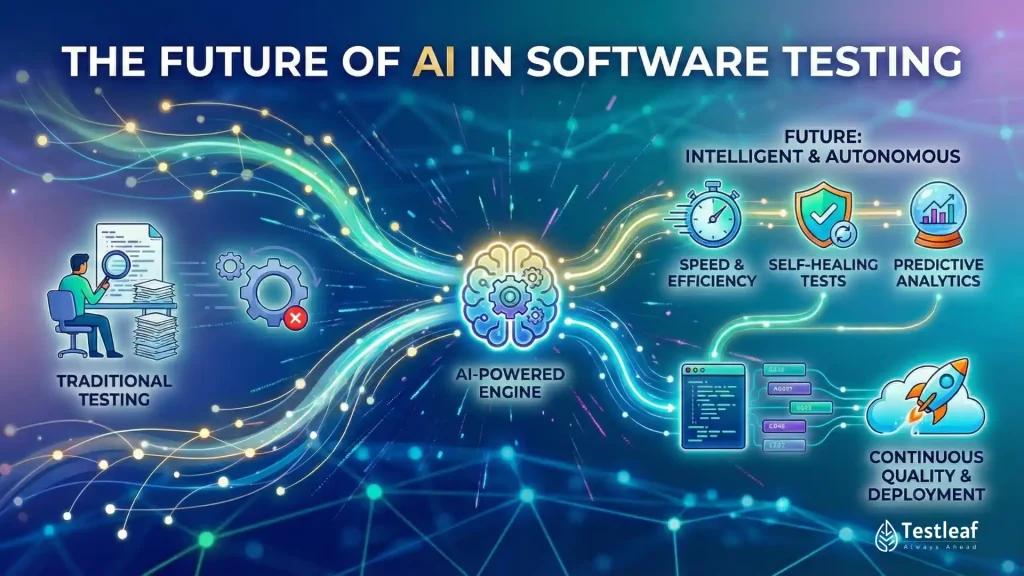
The conversation around AI in software testing has been noisy.
Will AI replace testers?
Will automation become fully autonomous?
Is manual testing dead?
These questions miss the real transformation happening beneath the surface.
The future of AI in software testing is not about replacement.
It is about redefinition.
We are moving from test automation to autonomous quality engineering — a shift that will permanently change how software quality is designed, measured, and governed.
This article is not about hype. It is about structural change.
What is AI in software testing?
AI in software testing uses machine learning and generative AI to predict defects, generate test cases, optimize test execution, and enable autonomous quality engineering.
Key Takeaways
-
AI shifts testing from execution to prediction
-
Autonomous quality engineering is the next evolution
-
Generative AI accelerates test creation
-
Human validation remains critical
-
QA roles are evolving into strategic positions
Other Helpful Articles: manual testing interview questions
1️⃣ From Scripted Automation to Intelligent Systems
For two decades, automation focused on execution speed and regression efficiency. Selenium scripts, CI pipelines, and framework design dominated QA strategy.
AI introduces something fundamentally different:
- Predictive defect analysis
- Risk-based test prioritization
- Intelligent test generation
- Self-healing test maintenance
According to the World Quality Report by Capgemini and Sogeti, over 60% of organizations are already investing in AI-driven quality engineering initiatives. The reason is simple: modern release cycles are too fast for traditional testing strategies.
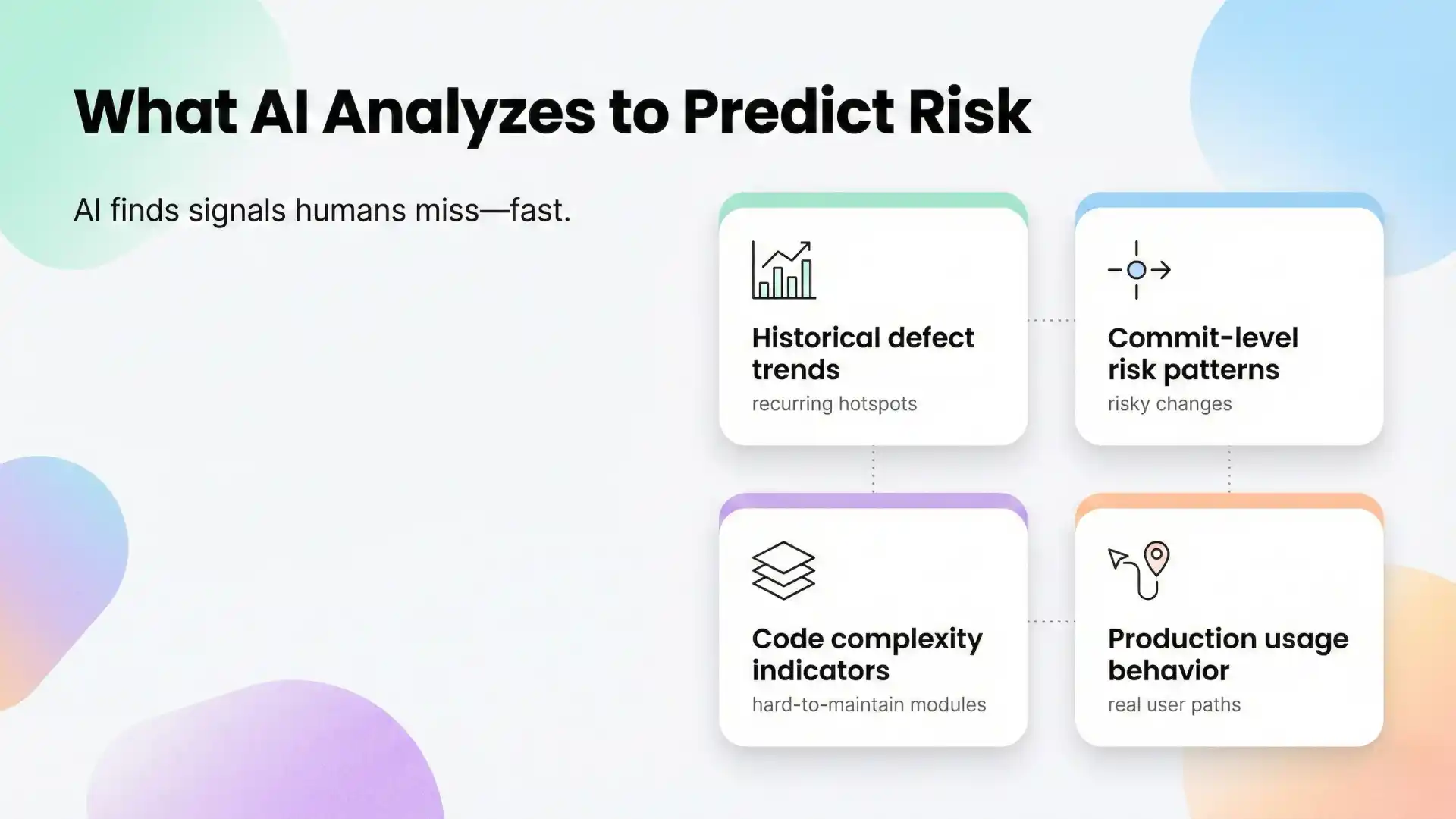
AI allows systems to analyze:
- Historical defect trends
- Commit-level risk patterns
- Code complexity indicators
- Production usage behavior
Instead of asking, “Did the tests pass?”, teams will increasingly ask:
“What is the probability this release will fail in production?”
That’s a paradigm shift.
Traditional Testing vs AI-Driven Testing
| Aspect | Traditional QA | AI-Driven QA |
|---|---|---|
| Execution | Script-based | Predictive & adaptive |
| Test Creation | Manual scripting | AI-generated tests |
| Maintenance | High (frequent updates) | Reduced with self-healing |
| Speed | Slower cycles | Faster CI/CD pipelines |
| Decision Making | Human-driven | AI-assisted insights |
| Risk Detection | Reactive | Proactive & predictive |
2️⃣ Predictive Quality Engineering Will Define the Next Decade
The next evolution is predictive testing.
Research in software reliability engineering shows that defect distribution follows a Pareto pattern — roughly 80% of defects originate from 20% of modules. AI models trained on repository metadata and defect history can identify these high-risk zones before testing even begins.
Forward-thinking organizations are already:
- Prioritizing test execution dynamically
- Reducing redundant regression cycles
- Detecting flaky test patterns automatically
- Optimizing CI runtime costs
This is not theoretical. AI-driven test selection has shown measurable improvements in reducing pipeline execution time while maintaining coverage quality.
The future tester will interpret these signals — not manually run every test.
3️⃣ Generative AI Will Transform Test Design — But With Guardrails
Large Language Models (LLMs) have introduced powerful capabilities:
- Generating test cases from requirements
- Creating API tests from specifications
- Converting natural language scenarios into automation scripts
- Auto-generating edge cases
However, generative AI introduces risk.
Studies from Stanford and MIT on LLM reliability show that hallucination rates can be significant when domain grounding is weak. In testing, that means:
- Incorrect test logic
- Misinterpreted requirements
- False confidence in coverage
The future belongs to teams who treat AI as a copilot, not an autopilot.
The QA professional of tomorrow must master:
- Prompt engineering
- Output validation
- Domain-driven verification
- Context-aware review
AI generates possibilities.
Humans validate impact.

4️⃣ Self-Healing Automation Is Not a Silver Bullet
Self-healing frameworks claim to reduce maintenance by adapting to UI changes automatically.
While AI-based locator recovery improves stability, it cannot correct:
- Poor test architecture
- Weak locator strategy
- Fragile design patterns
Engineering discipline remains foundational.
The organizations that succeed will combine:
- Strong automation fundamentals
- Clean framework design
- AI-based optimization layers
AI amplifies good systems. It exposes weak ones.
5️⃣ AI Will Expand Testing Into AI Systems Themselves
One overlooked reality: software increasingly includes AI components.
Testing AI-driven systems requires entirely new validation strategies:
- Model accuracy validation
- Bias detection
- Explainability checks
- Data drift monitoring
- Ethical risk assessment
According to McKinsey’s 2023 AI adoption report, organizations using AI at scale struggle most with governance and trust issues — not implementation.
That means QA teams will increasingly test:
- Fairness in recommendation engines
- Reliability in predictive models
- Transparency in decision systems
Testing will no longer focus only on UI, API, and performance.
It will evaluate intelligence itself.
You Might Also Like: Epam interview questions
6️⃣ The Skill Shift: From Executor to Quality Strategist
The most significant transformation is not technological.
It is professional.
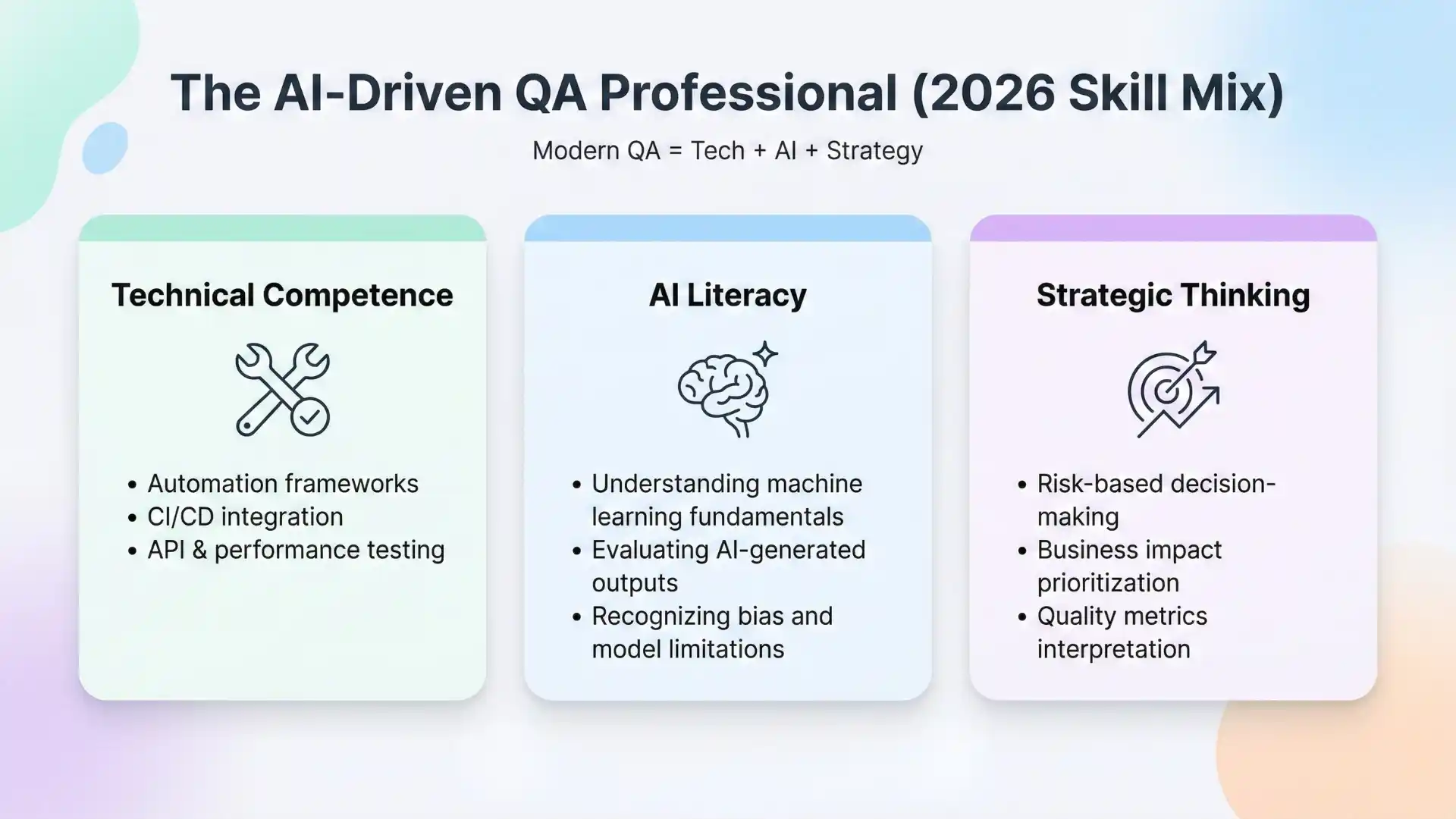
The AI-driven QA professional must combine:
Technical Competence
- Automation frameworks
- CI/CD integration
- API & performance testing
AI Literacy
- Understanding machine learning fundamentals
- Evaluating AI-generated outputs
- Recognizing bias and model limitations
Strategic Thinking
- Risk-based decision-making
- Business impact prioritization
- Quality metrics interpretation
The future role is not “Automation Engineer.”
It is “Quality Intelligence Architect.”
7️⃣ Ethical AI in Testing Will Become Non-Negotiable
As AI influences release decisions, ethical considerations increase.
Risks include:
- Biased datasets affecting test prioritization
- Over-reliance on AI predictions
- Privacy exposure from training data
- Lack of explainability in decision models
The European Union’s AI Act and emerging global AI regulations indicate that accountability and transparency will become mandatory requirements.
Testing teams will play a key role in validating compliance.
Trust in AI systems will depend on how rigorously they are tested.
8️⃣ The Economic Reality: Why AI in Testing Is Inevitable
Software complexity is accelerating:
- Microservices architectures
- Multi-device ecosystems
- Continuous deployment cycles
- Global user variability
Manual scalability is mathematically unsustainable.
AI reduces:
- Regression overhead
- Maintenance cost
- Human bottlenecks
- Pipeline inefficiencies
Organizations adopting AI-enhanced testing strategies are already reporting faster release velocity and improved defect containment.
The economic incentive is too strong to ignore.
Continue Reading: CTS java interview questions
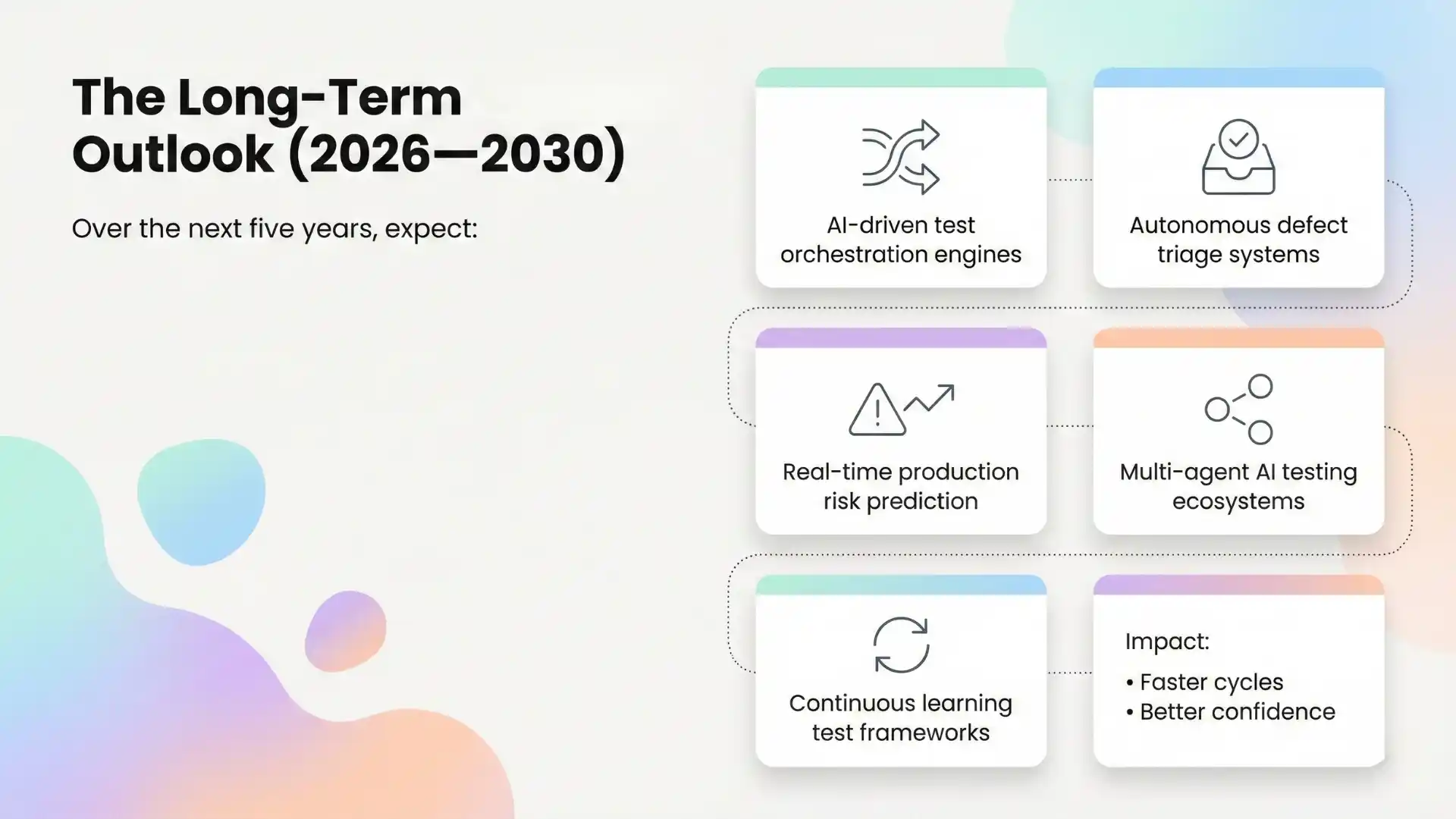
9️⃣ The Long-Term Outlook (2026–2030)
Over the next five years, expect:
- AI-driven test orchestration engines
- Autonomous defect triage systems
- Real-time production risk prediction
- Multi-agent AI testing ecosystems
- Continuous learning test frameworks
But here is the critical truth:
AI will not eliminate testers.
It will eliminate repetitive execution roles.
The future belongs to professionals who:
- Think systemically
- Interpret AI insights
- Design resilient quality ecosystems
- Continuously adapt
Final Perspective: AI Is Not Replacing Testing — It Is Elevating It
The future of AI in software testing is not about automation speed.
It is about intelligent quality governance.
The organizations that thrive will:
- Blend AI with engineering discipline
- Invest in tester upskilling
- Build explainable AI workflows
- Treat quality as a strategic asset
And the professionals who succeed will not fear AI.
They will learn to direct it.
Because in the end, AI does not create quality.
People who understand both software and intelligence do.
If you are a QA professional today, the most important question is not:
“Will AI replace me?”
It is:
“Am I becoming the kind of quality engineer AI needs?”
If you’re serious about staying relevant in this AI-driven testing era, learning these concepts is no longer optional—it’s essential. At Testleaf, we’ve designed a hands-on learning experience to help QA professionals transition into AI-powered roles. Join our GENAI Webinar: “AI Master Class for QA Professionals – Master AI Agents”, where you’ll learn how to apply AI in real testing scenarios, build intelligent workflows, and future-proof your career. Don’t just read about the future—start building it.
FAQs
1. Will AI replace software testers?
No. AI will augment testers by automating repetitive tasks, while humans focus on strategy, validation, and decision-making.
2. What is autonomous quality engineering?
It is an AI-driven approach where testing systems can predict risks, generate tests, and optimize execution with minimal human intervention.
3. How does AI improve test automation?
AI enables predictive testing, self-healing scripts, intelligent test prioritization, and faster CI/CD pipelines.
4. What are the risks of generative AI in testing?
Risks include hallucinated outputs, incorrect test cases, bias, and lack of explainability.
5. What skills are needed for AI-driven QA?
AI literacy, automation expertise, risk analysis, and validation of AI-generated outputs.
We Also Provide Training In:
- Advanced Selenium Training
- Playwright Training
- Gen AI Training
- AWS Training
- REST API Training
- Full Stack Training
- Appium Training
- DevOps Training
- JMeter Performance Training
Author’s Bio:

Content Writer at Testleaf, specializing in SEO-driven content for test automation, software development, and cybersecurity. I turn complex technical topics into clear, engaging stories that educate, inspire, and drive digital transformation.
Ezhirkadhir Raja
Content Writer – Testleaf