
Testleaf

QA Tester

Debugging at the Network Level- A Game-Changer for QA Insights

Debugging at the Network Level: A Game-Changer for QA Insights

  As a QA engineer, I’ve always understood that software testing isn’t just about clicking buttons and verifying outputs—it’s about understanding the entire system. Early in my career, when tests failed, I often relied on screenshots, logs, and manual exploration to figure out the root cause. This worked most of the time, but intermittent failures, …

Debugging at the Network Level: A Game-Changer for QA Insights Read More »

Why Test Evidence Is the Real Game-Changer for QA Teams

Why Test Evidence Is the Real Game-Changer for QA Teams

  As a QA engineer, I’ve spent countless hours running tests, logging defects, and communicating with developers. Over time, one truth became painfully clear: a failed test without evidence is almost useless. Screenshots, logs, HAR files, and execution videos are not just nice-to-haves—they are the backbone of trust, accountability, and efficiency in QA. Early in …

Why Test Evidence Is the Real Game-Changer for QA Teams Read More »

Turning Reported Defects into Automated Tests

Automated Tests: Turning Reported Defects into a QA Best Practice

  As a QA engineer, one of the most valuable lessons I’ve learned is that defects are not just problems—they’re opportunities. Every bug reported in a release represents a gap in coverage, a scenario that wasn’t previously considered. Early in my career, once a defect was fixed, it was often left at that—verified manually and …

Automated Tests: Turning Reported Defects into a QA Best Practice Read More »

From Manual Reports to Automated Dashboards- A QA Transformation

From Manual Reports to Automated Dashboards: A QA Transformation 

  As a QA engineer, I’ve spent countless hours compiling test results, screenshots, logs, and defect lists into endless spreadsheets and emails. In the early days of my career, generating a single manual test report often felt like a project of its own. You run the tests, take screenshots, note failures, add them to a document, summarize …

From Manual Reports to Automated Dashboards: A QA Transformation  Read More »

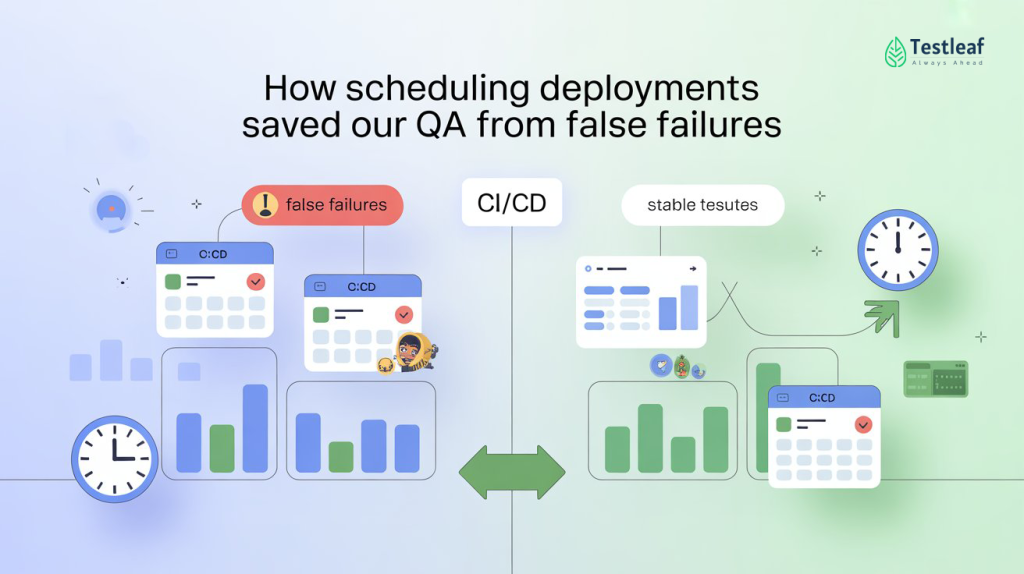
How Scheduling Deployments Saved Our QA from False Failures

How Scheduling Deployments Saved Our QA from False Failures

  Early in my journey as a tester, I quickly realized that not all test failures are created equal. Some were real bugs—valid defects that needed fixing—but many others were false failures, caused not by the application itself, but by chaotic deployment schedules, unstable environments, or overlapping builds. These false failures were draining. I spent …

How Scheduling Deployments Saved Our QA from False Failures Read More »

Parallel Test Execution with Selenium Grid + Azure Kubernetes

Parallel Test Execution with Selenium Grid + Azure Kubernetes: Scaling QA Without Sacrificing Time 

  As a tester, I’ve spent countless hours staring at a screen, waiting for tests to finish on a single machine. Daily sanity checks, regression suites—they all felt like slow, painful marathons. Our QA process was bottlenecked by serial execution, and with tight release cycles, delays were inevitable.  It was clear: we needed speed without compromising quality. That’s when we turned …

Parallel Test Execution with Selenium Grid + Azure Kubernetes: Scaling QA Without Sacrificing Time  Read More »

How Faker + APIs Made Our Test Data Creation 10x Faster

How Faker + APIs Made Our Test Data Creation 10x Faster

  If you’ve worked in QA long enough, you know that test data can make or break your automation efforts. It sounds simple: just feed your tests some input values and check the output. But in reality, creating and maintaining reliable test data is one of the hardest parts of building stable automation.  When I started my journey as a tester, we relied …

How Faker + APIs Made Our Test Data Creation 10x Faster Read More »

Hypothesis Testing in QA: Step-By-Step Guide With Real Examples

Introduction In the world of Quality Assurance (QA), decision-making often relies on evidence rather than assumptions. Whether it’s validating a new feature, analyzing defect trends, or confirming a performance improvement, QA engineers must rely on statistical thinking. That’s where hypothesis testing comes in — a structured approach to validate assumptions with data. This method, widely …

Hypothesis Testing in QA: Step-By-Step Guide With Real Examples Read More »

Accelerate Your Salary with Expert-Level Selenium Training

X