Most test failures are not caused by bugs.
They are caused by uncontrolled dependencies.
A slow backend.
Unstable test data.
Rate-limited APIs.
Unexpected server errors.
And yet, many QA teams still rely heavily on real API responses while testing UI flows.
This approach worked a decade ago.
It doesn’t scale anymore.
What is Playwright network mocking?
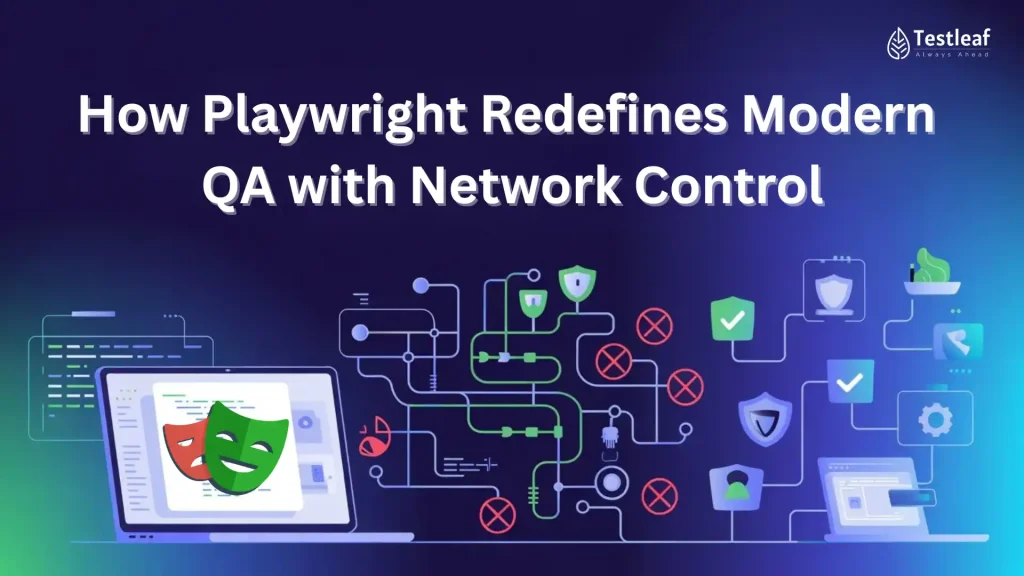
Playwright network mocking is a technique that intercepts API requests using page.route() to simulate responses, enabling faster, stable, and controlled UI testing.
Key Takeaways:
-
Playwright enables real-time API interception
-
Mocking improves test stability and speed
-
Reduces dependency on backend systems
-
Essential for scalable CI/CD pipelines
-
Core skill for AI-driven software testing
You Should Also Read: playwright interview questions
The Shift: From “Testing UI” to “Controlling Systems”
Modern applications are no longer simple.
They are:
- API-driven
- Microservice-based
- Distributed across environments
This introduces a fundamental challenge:
You are no longer testing just a UI — you are testing a system of systems.
Traditional tools like Selenium focused on browser interactions.
But they left a critical gap:
👉 No native control over network behavior
This is where Playwright changes the game.

What Makes Playwright Fundamentally Different
Playwright introduces first-class network interception — something that was never truly seamless in legacy automation frameworks.
With a single API (page.route()), you can:
- Intercept network calls in real time
- Inspect request payloads and headers
- Modify responses before they reach the UI
- Simulate failures, delays, and edge cases
This is not just a feature.
It is a paradigm shift.
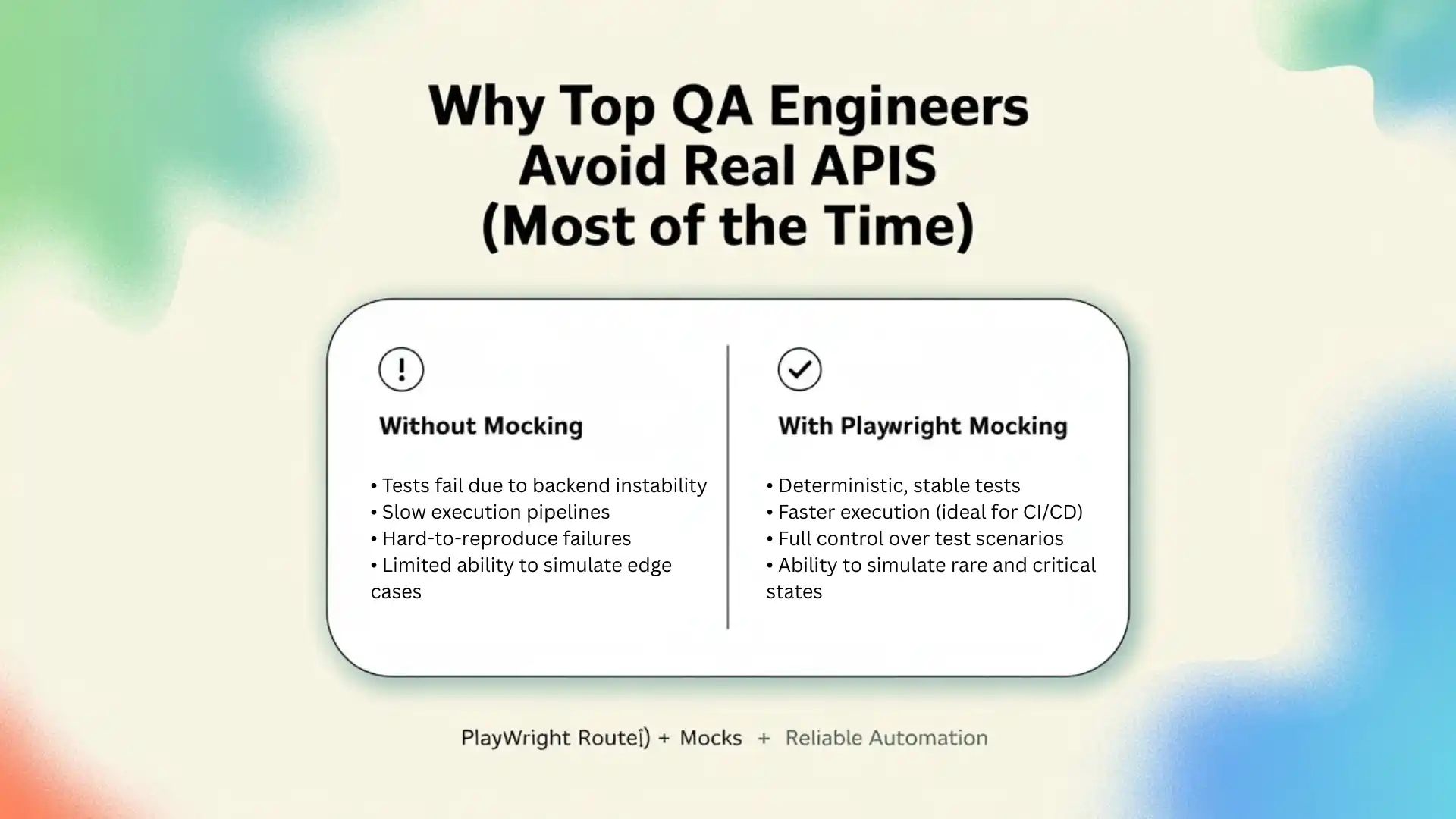
Why Top QA Engineers Avoid Real APIs (Most of the Time)
Let’s be clear — real APIs are important.
But relying on them for every test introduces risk.
Without Mocking:
- ❌ Tests fail due to backend instability
- ❌ Slow execution pipelines
- ❌ Hard-to-reproduce failures
- ❌ Limited ability to simulate edge cases
With Playwright Mocking:
- ✅ Deterministic, stable tests
- ✅ Faster execution (ideal for CI/CD)
- ✅ Full control over test scenarios
- ✅ Ability to simulate rare and critical states
According to multiple industry reports (including Google Testing Blog insights and ThoughtWorks Technology Radar trends),
test reliability and speed are among the top factors influencing DevOps maturity.
Mocking directly contributes to both.
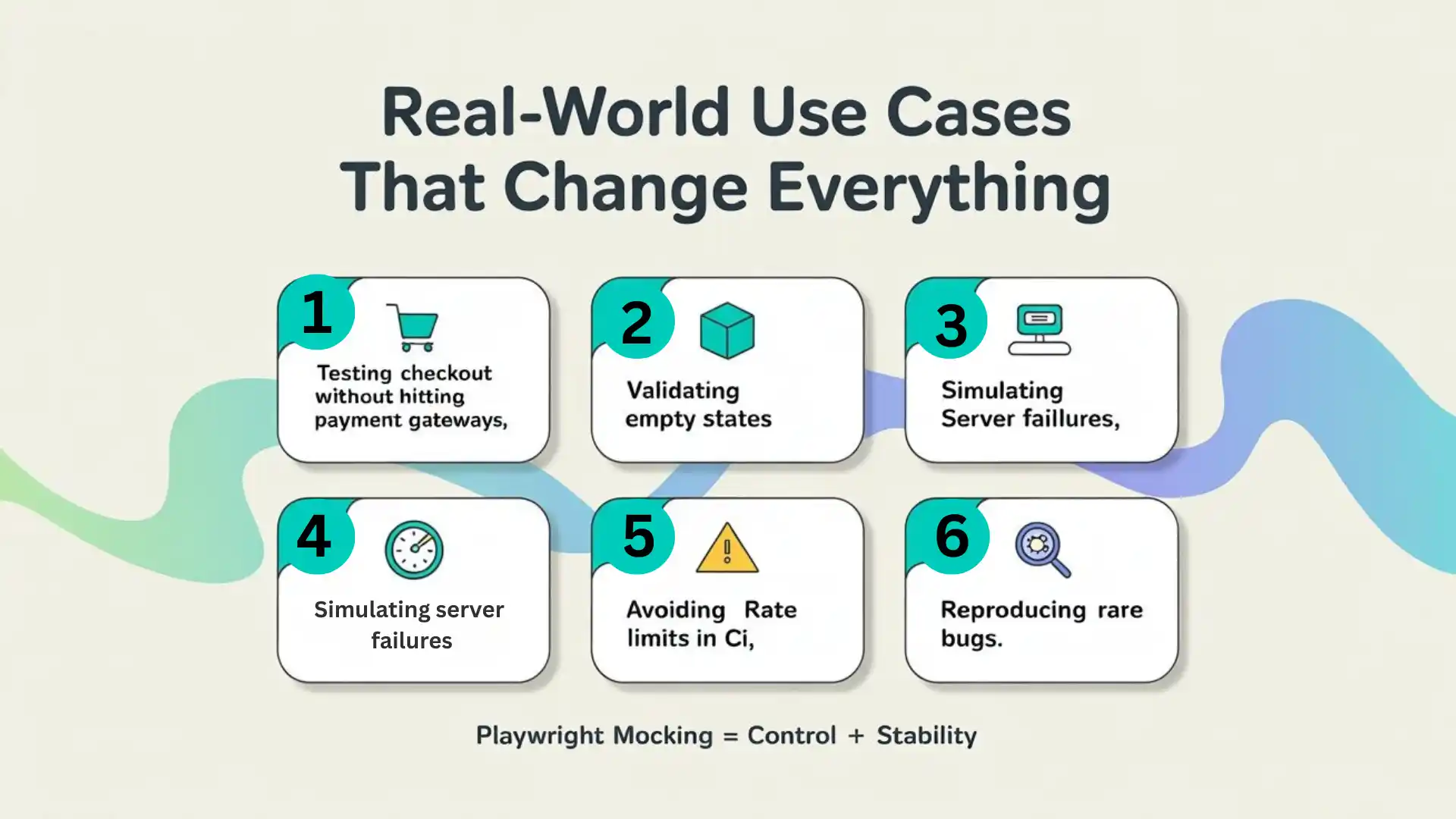
Real-World Use Cases That Change Everything
This is where most tutorials stop — but this is where real engineering begins.
1. Testing Checkout Without Hitting Payment Gateways
Simulate Razorpay/Stripe responses without real transactions.
2. Validating Empty States
Mock an empty API response to test first-time user experience.
3. Simulating Server Failures
Trigger 500 errors to validate UI resilience.
4. Avoiding Rate Limits in CI
Run hundreds of tests without hitting API quotas.
5. Reproducing Rare Bugs
Control edge-case data that’s impossible to generate in real systems.
👉 These are not “nice-to-have” scenarios.
They are production realities.
Other Useful Guides: manual testing interview questions
The Hidden Power: Fixtures as a Testing Architecture
Most engineers understand mocking.
Very few understand test architecture.
Playwright fixtures allow you to:
- Centralize mock logic
- Reuse test setups
- Keep tests clean and readable
- Compose complex scenarios easily
Instead of repeating setup code:
You define reusable behaviors like:
- mockUserLoggedIn
- mockOrdersEmpty
- mockOrdersError
And plug them into tests like building blocks.
This is how high-performing QA teams operate:
👉 Less duplication, more clarity, better scalability
Deep Insight: Why Playwright Doesn’t Need Proxies
In Selenium ecosystems, network mocking often requires:
- External proxies
- Middleware layers
- Complex configurations
Playwright avoids all of this.
It operates at the browser context level, allowing:
- Direct interception before request leaves the browser
- Faster execution
- Reduced infrastructure complexity
This architectural advantage is one of the key reasons why:
Many teams are transitioning from Selenium to Playwright.
Real Backend vs Mocked Testing: The Balanced Approach
This is not about replacing real API testing.
It’s about using the right strategy at the right time.
Use Real Backend When:
- Validating end-to-end business flows
- Testing service integrations
- Running staging/production validations
Use Mocking When:
- Testing UI behavior
- Simulating edge cases
- Running CI pipelines
- Ensuring speed and reliability
The most effective test suites follow this model:
👉 20% real E2E + 80% mocked tests
This balance delivers:
- Speed
- Stability
- Confidence
Why This Skill Matters in 2026 (And Beyond)
The role of QA is evolving rapidly.
We are moving toward:
- AI-assisted testing
- Autonomous test generation
- Intelligent validation systems
But all of these systems rely on one core principle:
Control over inputs and environments
If you cannot control the system,
you cannot test it intelligently.
Playwright’s approach to network control is a foundational skill for this shift.
Don’t Miss Out: Automation testing interview questions
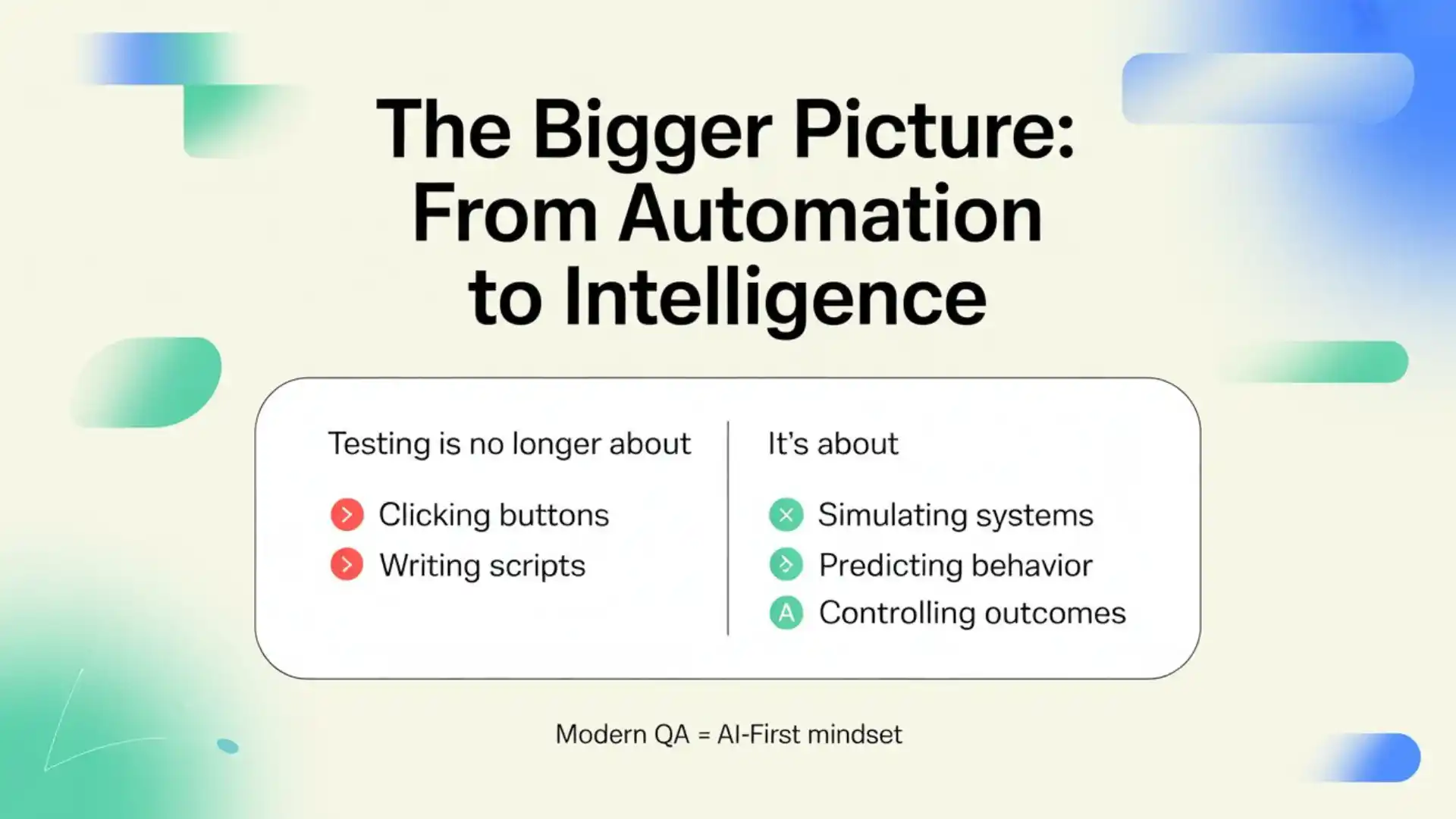
The Bigger Picture: From Automation to Intelligence
Testing is no longer about:
- Clicking buttons
- Writing scripts
It’s about:
- Simulating systems
- Predicting behavior
- Controlling outcomes
This is where modern QA intersects with AI in software testing.
Future testing systems will:
- Generate test scenarios automatically
- Simulate APIs dynamically
- Predict failure points before execution
But to understand that future…
You must first master the fundamentals of control.
Final Thoughts
Playwright’s route interception and fixtures are not just features.
They represent a new way of thinking about testing.
A shift from:
👉 “Testing what exists”
to
👉 “Controlling what should exist”
If you’re still relying entirely on real APIs,
you’re not just slowing your tests —
you’re limiting your growth as a QA engineer.
Because the future of testing belongs to engineers who don’t just validate systems…
They control them.
FAQs
1. Why should you avoid testing with real APIs?
Real APIs introduce instability, slow execution, and unpredictable failures. Mocking ensures faster, reliable, and deterministic test results.
2. What is Playwright network mocking?
Playwright network mocking uses page.route() to intercept and modify API requests and responses for controlled testing.
3. Is Playwright better than Selenium for API control?
Yes, Playwright offers native network interception without proxies, making it faster and easier compared to Selenium.
4. When should you use real APIs in testing?
Use real APIs for end-to-end validation and integration testing, not for UI behavior testing.
5. How does mocking improve CI/CD pipelines?
Mocking reduces test flakiness, speeds up execution, and avoids dependency on external systems.
We Also Provide Training In:
- Advanced Selenium Training
- Playwright Training
- Gen AI Training
- AWS Training
- REST API Training
- Full Stack Training
- Appium Training
- DevOps Training
- JMeter Performance Training
Author’s Bio:

Content Writer at Testleaf, specializing in SEO-driven content for test automation, software development, and cybersecurity. I turn complex technical topics into clear, engaging stories that educate, inspire, and drive digital transformation.
Ezhirkadhir Raja
Content Writer – Testleaf