
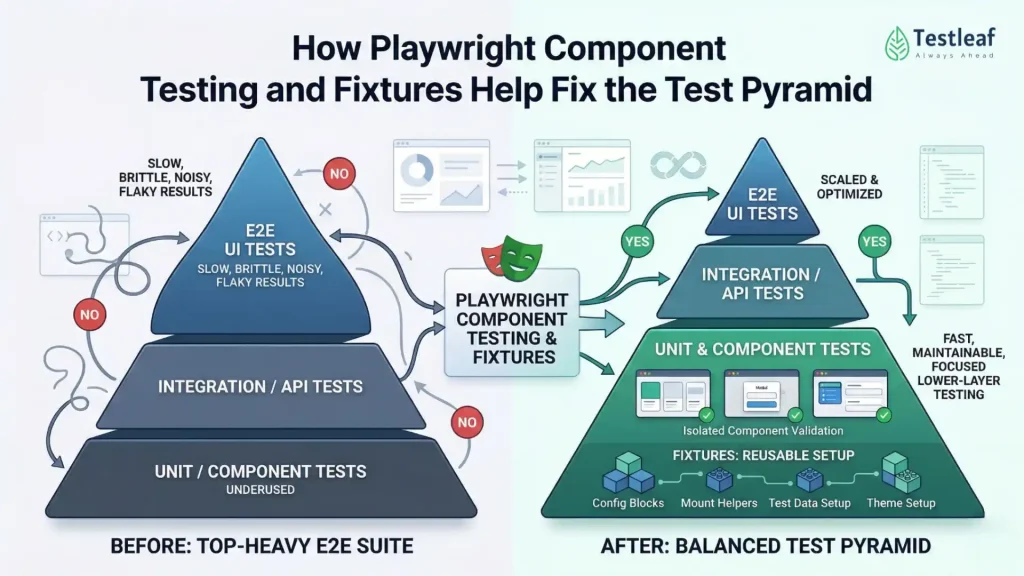
Many QA teams say they want faster feedback, lower flakiness, and more maintainable automation.
But their test strategy often says the opposite.
They are still using full end-to-end journeys to validate UI behavior that should have been caught much earlier, much faster, and at much lower cost. That is not just a tooling issue. It is a test-shape issue. And in mature engineering teams, test shape matters as much as test count.
This is where Playwright becomes more interesting than a typical browser automation tool. It supports component testing in a real browser environment, while still letting teams use Playwright Test capabilities and Node.js-based test code. That makes it possible to validate isolated UI behavior without forcing teams into a completely different testing mindset.
That matters because modern QA is not about writing more tests. It is about placing the right tests at the right layer.
How do Playwright component testing and fixtures help fix the test pyramid?
Playwright component testing and fixtures help fix the test pyramid by moving isolated UI checks out of expensive end-to-end flows and into faster, more focused browser-based component tests with cleaner reusable setup.
Key takeaways
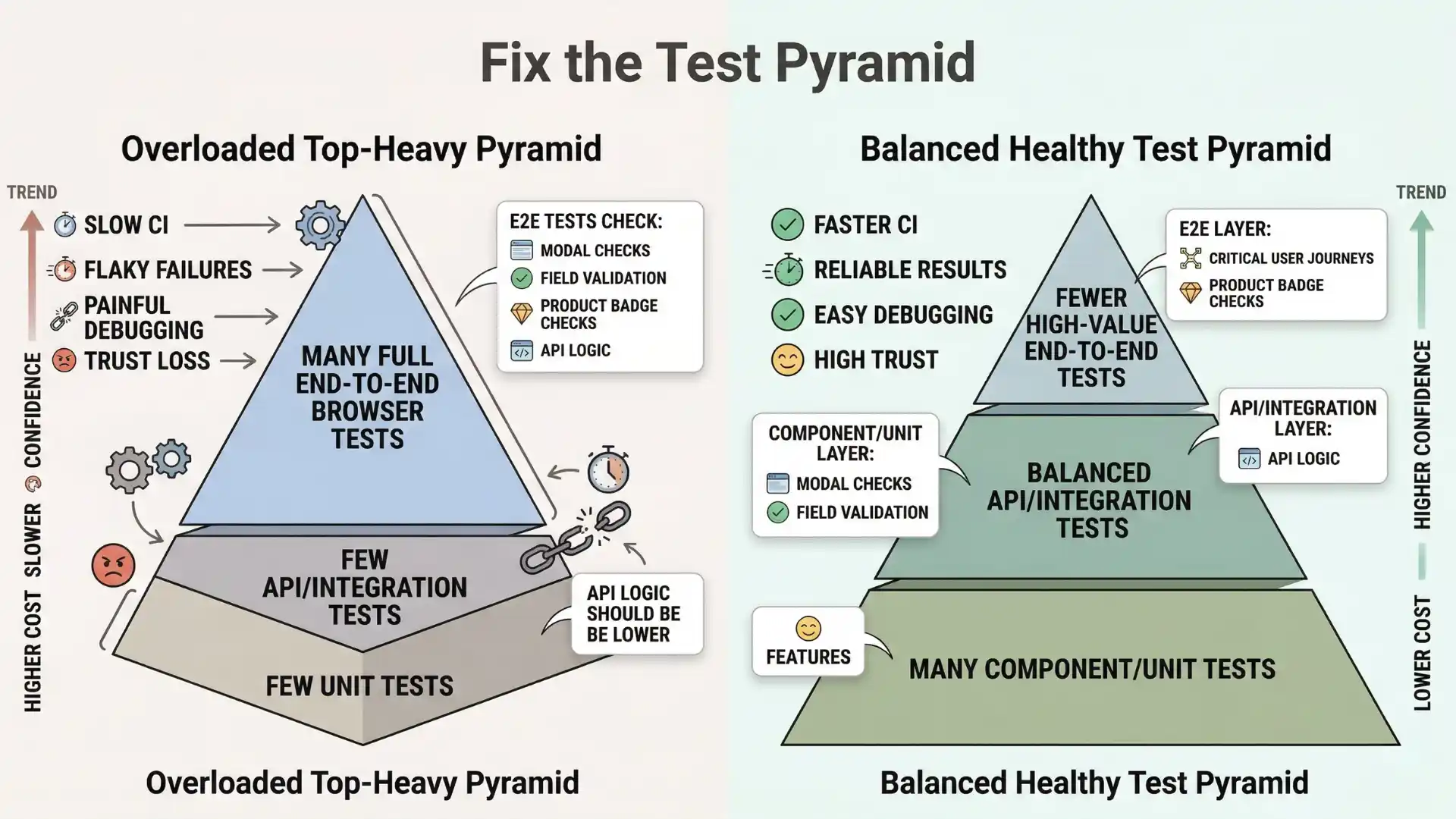
- Many UI suites are slow because small checks are buried inside long end-to-end journeys.
- Playwright component testing helps teams validate isolated UI behavior in a real browser.
- Fixtures reduce repeated setup noise and improve maintainability.
- A healthier pyramid puts each check at the cheapest trustworthy layer.
- Better test placement improves speed, debugging, and confidence.
The real problem is not weak automation. It is an unhealthy pyramid.
A healthy test strategy does not push every UI check into the top layer.
When teams validate a button state, modal behavior, field validation message, discount badge, or loading state through a full login-to-navigation-to-checkout browser flow, they are paying enterprise-level cost for component-level confidence. The result is familiar: slow CI, noisy failures, painful debugging, and teams that start mistrusting their own automation.
This is not a small operational issue. NIST has published that inadequate software testing costs the U.S. economy billions of dollars, and one widely cited NIST publication references an estimate of $59.5 billion per year. That same body of work reinforces a simple truth the industry keeps relearning: software quality problems become more expensive when defects are found later and farther downstream.
So when QA leaders ask how to speed up automation without reducing confidence, the better question is often this:
Which tests are sitting at the wrong layer?
Recommended for You: playwright interview questions
Why Playwright component testing matters
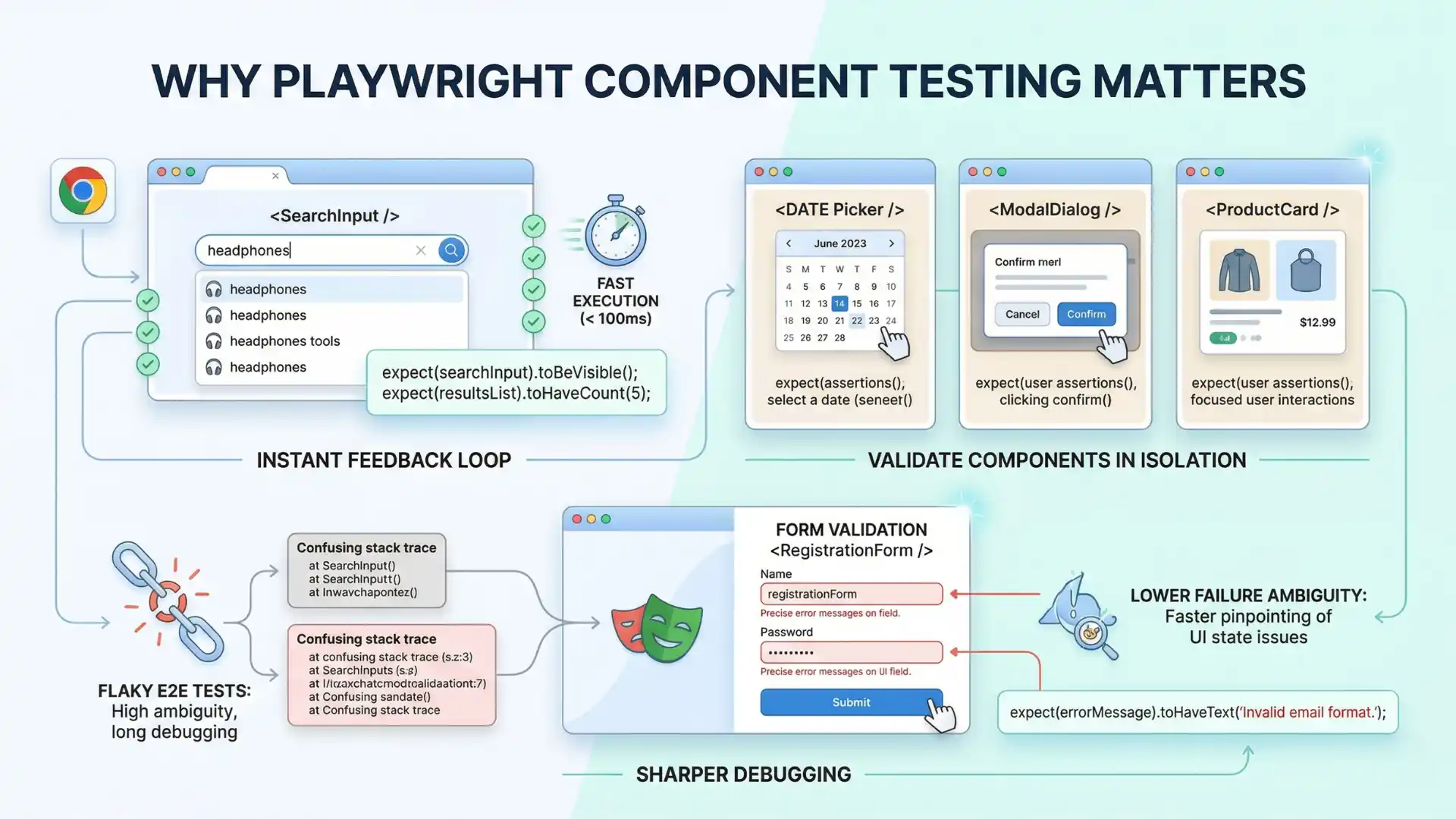
Playwright component testing is powerful because it lets teams mount components directly and test them in a real browser, with real layout and real interactions. The official Playwright docs describe this as bringing together “the best of both worlds”: components run in the real browser environment, while tests still benefit from Node.js and Playwright Test features.
That sounds technical, but the strategic benefit is bigger than the feature itself.
It means a team can test a search bar, date picker, modal, card component, or form state in isolation instead of dragging that check through the full application journey every time. It shortens feedback loops. It reduces unrelated failure noise. It makes debugging sharper. And it helps teams move down the pyramid without abandoning a familiar locator-first testing style.
That consistency matters more than people think.
Playwright teams can keep using the same general way of thinking across layers: user-facing selectors, readable assertions, and test organization that still feels native to the same ecosystem. That lowers adoption friction, which is one reason component testing is more likely to be used well when it is part of a tool teams already trust for broader browser flows.
Not every UI behavior deserves a full browser journey
This is the mindset shift many teams still need.
A modal opening and closing is not a full-system confidence problem.
A product card rendering the right badge is not a full-system confidence problem.
A validation message appearing after invalid input is not a full-system confidence problem.
These are focused UI behavior problems. They should usually be tested where they are cheapest to evaluate and easiest to understand.
That does not reduce quality. It often improves it.
When small checks are buried inside long end-to-end flows, failures become ambiguous. Was the issue caused by the component itself? Authentication? Test data? Navigation? API timing? Environment instability? Cross-page state? Teams lose time just locating the real cause.
Component testing reduces that ambiguity by narrowing scope on purpose.
And that is one of the most underrated ideas in quality engineering: good tests do not just detect failure; they make failure easier to interpret.
Other Helpful Articles: manual testing interview questions
Fixtures are not just setup helpers. They are maintainability infrastructure.
This is where many teams underestimate Playwright.
Playwright’s official docs describe fixtures as a way to give each test “everything it needs and nothing else,” and note that fixtures are isolated between tests. That sounds like a convenience feature. In practice, it is architectural discipline.
Why?
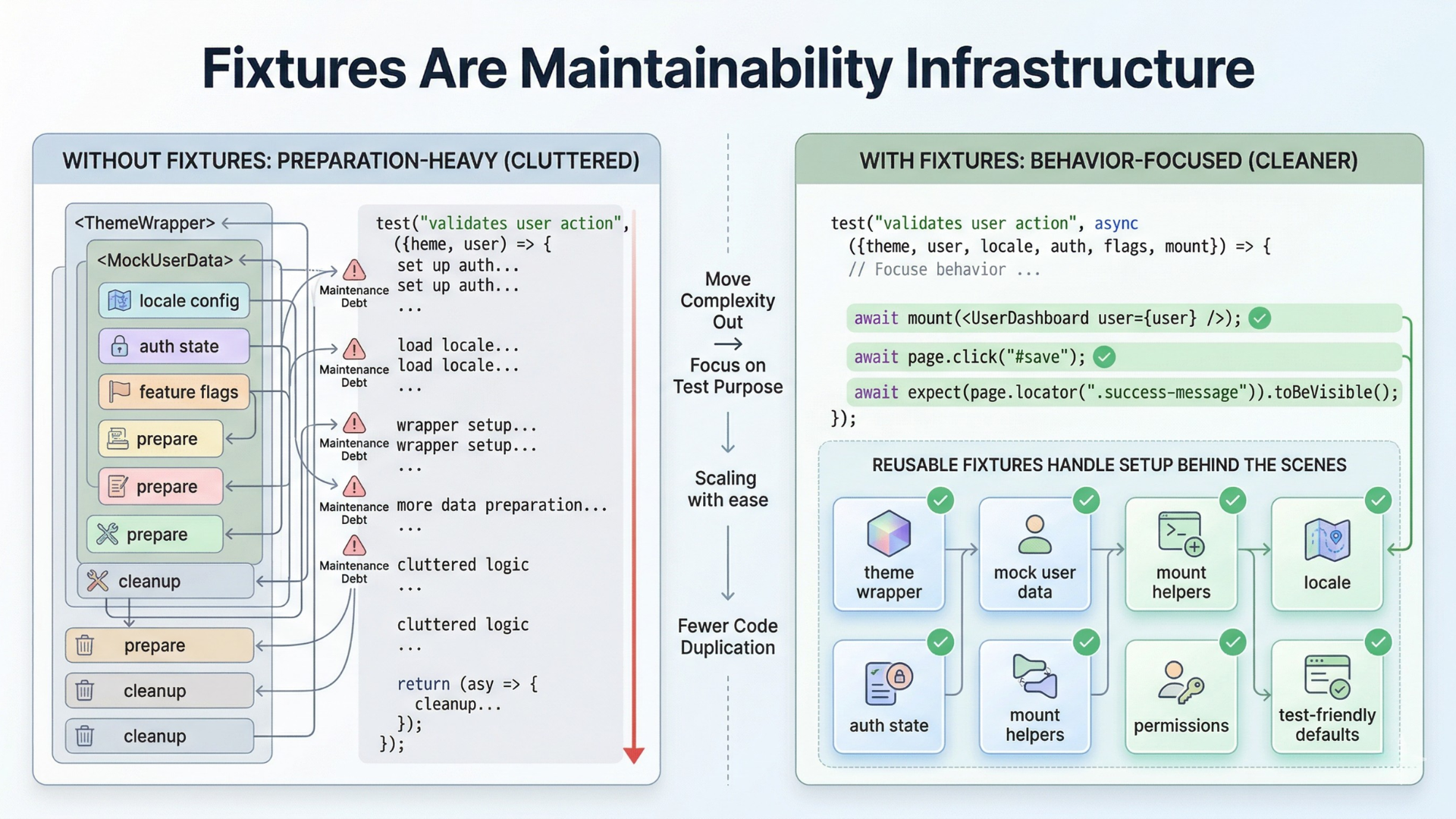
Because repeated setup is one of the quietest reasons test suites become hard to scale. Teams copy the same wrapper logic, mock data, auth state, theme providers, locale setup, and reusable mount preparation across many tests. Over time, the tests become longer, noisier, and harder to reason about. Review quality drops. Maintenance cost rises. Small UI tests begin to look just as cluttered as large flows.
Fixtures solve that by moving setup responsibility into a reusable layer.
For component testing, that can mean:
- standard theme wrappers
- common mock user data
- shared mount helpers
- reusable configuration for locale, feature flags, or permissions
- test-friendly defaults for common UI states
This is not just about reducing lines of code. It is about protecting the purpose of the test itself.
A good test should read like behavior, not preparation.
What should go where?
The strongest automation teams do not ask, “Should we do component testing or E2E?”
They ask, “Where does this behavior belong?”
A useful rule of thumb looks like this:
Component testing
Use it for rendering, props/state variations, local interactions, form validation, disabled/enabled states, empty/loading/error states, and focused UI logic.
API or integration testing
Use it for backend rules, filtering logic, payload correctness, service interaction, contract behavior, and business rules that do not need browser realism.
End-to-end testing
Use it for critical journeys where navigation, session handling, integration between systems, and browser-level realism really matter.
That is the smarter pyramid.
For example, a search feature does not need twenty E2E tests. A mature strategy might use component tests for search input behavior, integration tests for filtering logic, and only a few E2E tests to prove the real user journey still works across the full application. That is how teams reduce cost without reducing confidence.
Don’t Miss Out: api testing interview questions
A simple Playwright example
A component-level check should stay small and behavior-focused:
import { test, expect } from '@playwright/experimental-ct-react';
import { SearchBox } from './SearchBox';

test('shows validation when search is empty', async ({ mount }) => {
  const component = await mount(<SearchBox />);
  await component.getByRole('button', { name: 'Search' }).click();
  await expect(component.getByText('Please enter a keyword')).toBeVisible();
});

And when multiple tests need repeated setup, a fixture can keep that noise out of the test body:

import { test as base } from '@playwright/experimental-ct-react';
import { ThemeWrapper } from './ThemeWrapper';

export const test = base.extend({
  mountWithTheme: async ({ mount }, use) => {
    await use(async (component) => {
      return mount(<ThemeWrapper>{component}</ThemeWrapper>);
    });
  },
});
The point is not the syntax. The point is the discipline.
The test stays focused on what the component should do. The fixture handles what the environment should provide.
The mistake many teams make
A lot of automation strategies become top-heavy because E2E feels more “real.”
That instinct is understandable, but incomplete.
Realism is valuable. But realism is not free. It comes with execution cost, setup complexity, longer feedback cycles, and broader failure surfaces. So the real leadership decision is not whether E2E is useful. Of course it is. The real decision is whether a given behavior deserves that cost.
That is why the future of modern QA will not be defined by who writes the biggest automation suite. It will be defined by who builds the most intentional one.
And that is where Playwright’s combination of component testing and fixtures becomes strategically important. It helps teams create more confidence at lower layers while keeping a consistent tooling model across their stack.
Playwright component testing and fixtures help QA teams reduce top-heavy end-to-end suites by validating focused UI behavior earlier, faster, and with less setup noise.

The bigger takeaway for QA leaders
Playwright component testing is not just a faster way to check UI.
It is a practical way to repair an unhealthy test pyramid.
It helps teams stop overusing full browser journeys for small interface problems. It helps them isolate behavior earlier. It helps them debug faster. And with fixtures, it helps them build a cleaner setup architecture that scales.
That is the thought-leadership takeaway worth remembering:
Healthy automation is not about more tests. It is about better test placement.
And in the years ahead, the QA teams that move faster will not necessarily be the ones with the most tooling. They will be the ones with the clearest judgment about what to test, where to test it, and how to keep that strategy maintainable over time.
For professionals and teams looking to apply these ideas more effectively, a structured Playwright course online can help bridge the gap between basic automation knowledge and smarter test strategy. It is not just about learning syntax. It is about understanding where component testing fits, how fixtures improve maintainability, and how to build a healthier test pyramid with better placement, faster feedback, and stronger long-term confidence.
FAQs
What is Playwright component testing?
Playwright component testing lets teams mount and test isolated UI components in a real browser environment while still using Playwright Test capabilities.
Why does component testing help fix the test pyramid?
Component testing helps because small UI behaviors can be validated earlier and more cheaply instead of being buried inside long end-to-end flows.
What do Playwright fixtures do?
Playwright fixtures provide tests with the setup they need while keeping preparation logic reusable, isolated, and outside the main test body.
What kinds of checks belong in component tests?
Rendering, props and state variations, local interactions, validation messages, disabled states, and loading or error states usually fit well in component tests.
When should teams still use end-to-end testing?
Teams should still use end-to-end testing for critical journeys where navigation, session handling, browser realism, and full-system integration matter.
We Also Provide Training In:
- Advanced Selenium Training
- Playwright Training
- Gen AI Training
- AWS Training
- REST API Training
- Full Stack Training
- Appium Training
- DevOps Training
- JMeter Performance Training
Author’s Bio:

Content Writer at Testleaf, specializing in SEO-driven content for test automation, software development, and cybersecurity. I turn complex technical topics into clear, engaging stories that educate, inspire, and drive digital transformation.
Ezhirkadhir Raja
Content Writer – Testleaf