This blog is a continuation of our previous articles — “AI Won’t Replace Testers — But It Will Replace How They Work,” “How Manual Testers Can Transition to AI-Driven QA in 6 Months,” and “Why AI Testing Needs QA Engineers More Than Ever.”
In the previous posts, we discussed:
- The role of AI in transforming the QA landscape
- How testers can transition into AI-driven QA
- The growing need for testers in the AI era
Now, the focus shifts to a more practical and advanced area:
How can QA engineers start building AI-driven testing agents?
What are AI testing agents?
AI testing agents are systems that use AI models and automation tools to generate test cases, execute workflows, analyze results, and improve testing processes over time.
In This Guide You’ll Learn:
- What AI testing agents are
- How AI in software testing works in real workflows
- Step-by-step approach to build AI agents
- Tools required for AI-driven testing
- Challenges and best practices
What Are AI Testing Agents?
AI testing agents are systems that use AI models to perform testing tasks traditionally handled by testers.
These agents can:
- Generate test cases
- Execute workflows
- Analyze results
- Identify issues
- Improve based on feedback
They reduce repetitive effort and enable testers to focus on decision-making and quality validation.
Recommended for You: playwright interview questions
Why AI Testing Agents Matter
In a conversation with Babu Manickam — CEO & Co-Founder of QEagle and Testleaf, with over 25+ years of experience in software testing and quality engineering — one idea stands out clearly:
AI is not just about automation. It is about building intelligent workflows that can evolve with the system.
AI testing agents make it possible to:
- Reduce time spent on repetitive tasks
- Improve consistency in testing
- Handle larger test coverage
- Adapt workflows as systems change
Why are AI testing agents important for QA engineers?
Because they reduce manual effort and improve testing efficiency.
Core Building Blocks of AI Testing Agents
1. AI-Based Test Case Generation
AI models can generate test cases from:
- Requirements
- User stories
- API specifications
Instead of writing test cases manually, testers can use AI to create initial versions and refine them.
2. Automation Framework Integration
AI alone is not enough. It needs execution capability.
This is achieved through:
- Playwright or Selenium for UI automation
- API testing tools for service validation
AI generates inputs, and automation frameworks execute them.
3. Result Analysis
AI can assist in analyzing:
- Test failures
- Patterns in errors
- Flaky tests
This reduces the manual effort required to interpret results.
4. Feedback Loop
AI systems improve over time through feedback.
By:
- Validating outputs
- Correcting errors
- Refining prompts or workflows
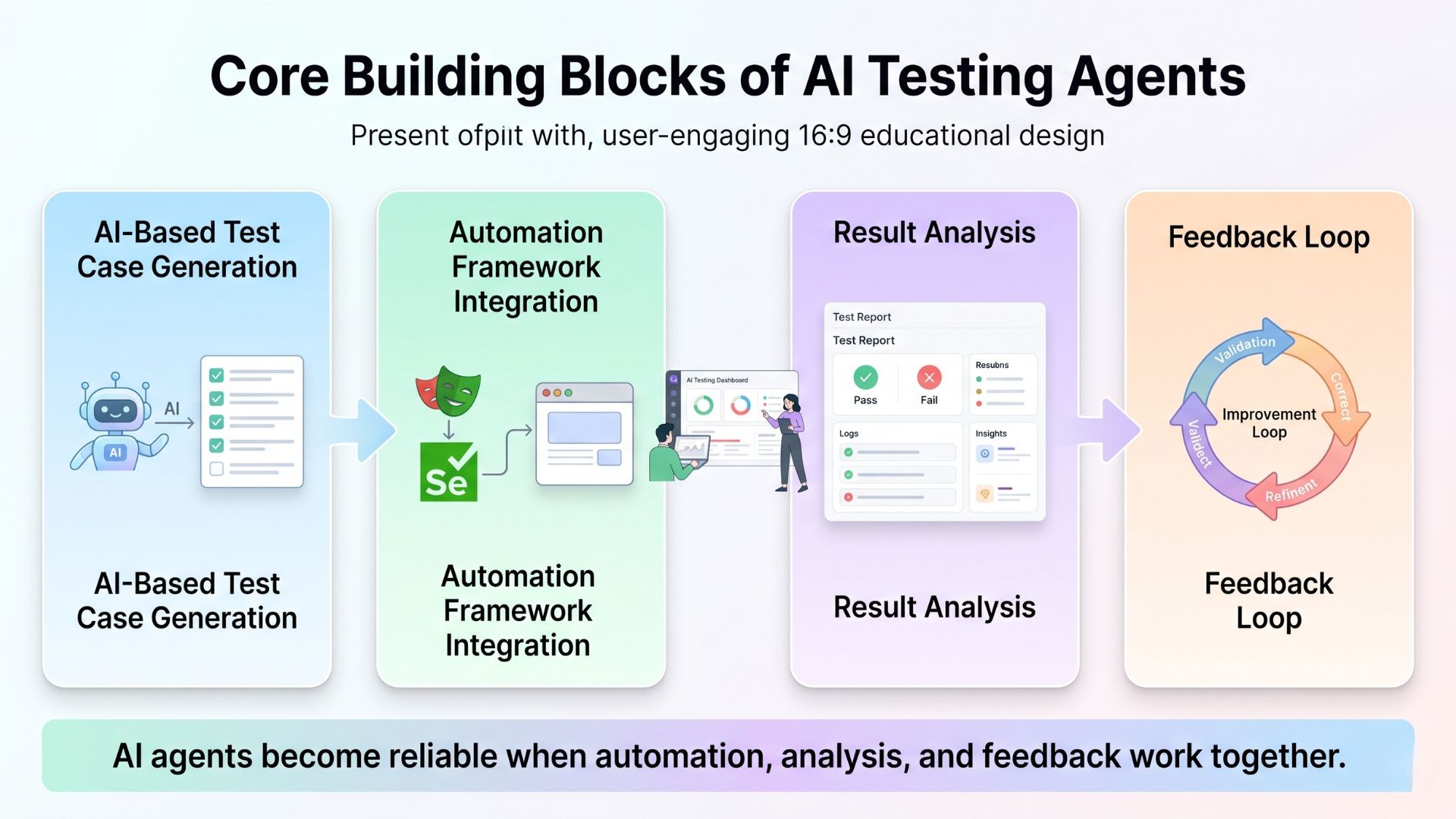
the system becomes more reliable.
You Might Also Like: Manual testing interview questions
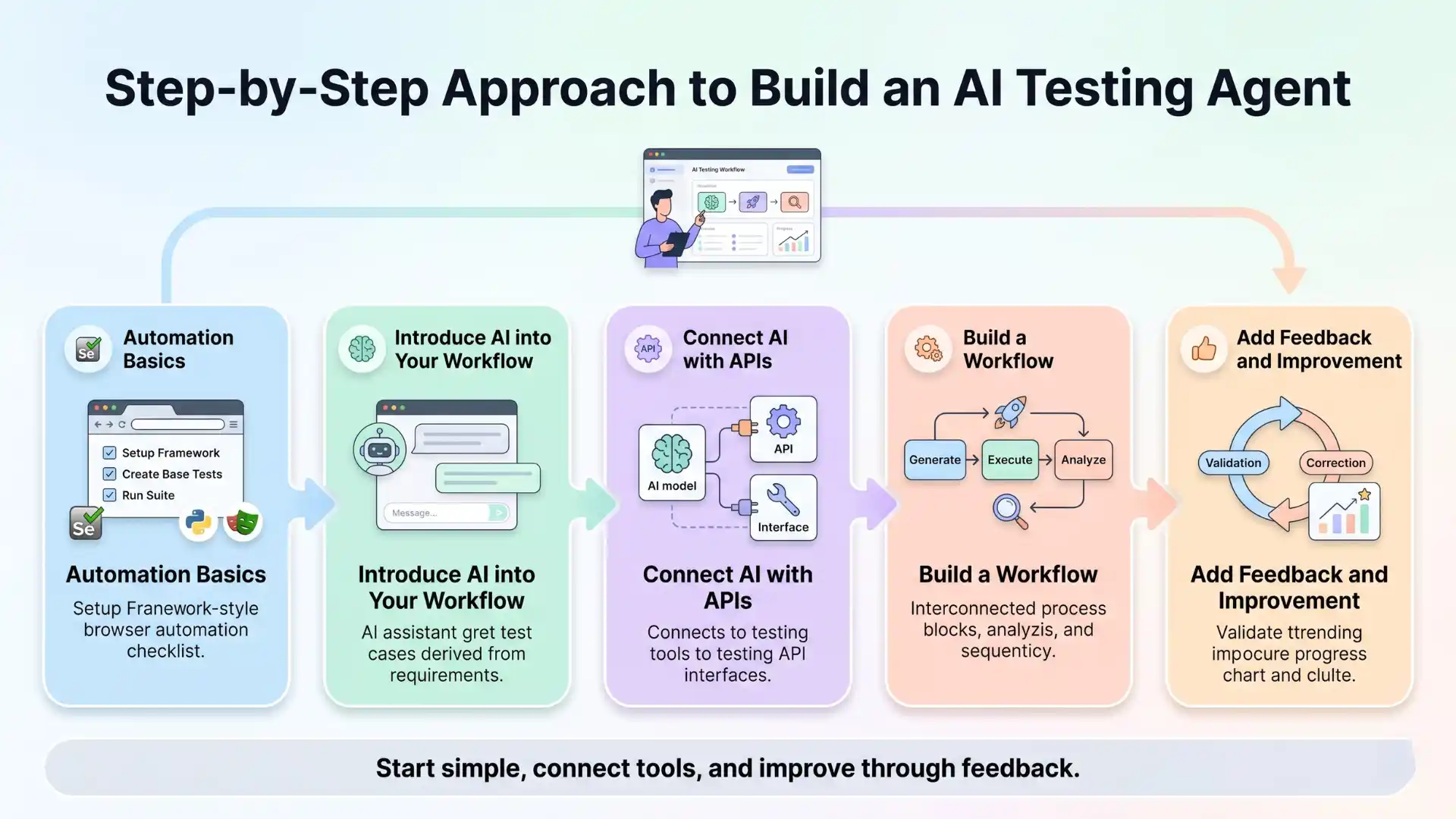
Step-by-Step Approach to Build an AI Testing Agent
Step 1: Start with Automation Basics
Before building AI-driven systems:
- Learn Playwright or Selenium
- Understand test execution and validation
- Build simple automation scripts
This forms the foundation.
Step 2: Introduce AI into Your Workflow
Use AI to:
- Generate test cases
- Convert requirements into scenarios
- Assist in writing automation scripts
At this stage, AI supports your existing workflow.
Step 3: Connect AI with APIs
Instead of using AI manually:
- Learn how to call AI models through APIs
- Integrate responses into your testing flow
This enables automation at scale.
Step 4: Build a Workflow
Combine multiple steps into a single flow.
For example:
- Input: Requirement or API specification
- Step 1: Generate test cases
- Step 2: Convert into automation scripts
- Step 3: Execute tests
- Step 4: Analyze results
This becomes a basic AI-driven testing agent.
Step 5: Add Feedback and Improvement
Refine the system by:
- Validating outputs
- Adjusting prompts
- Improving accuracy over time
This makes the workflow more reliable.
Can beginners build AI testing agents?
Yes. By starting with automation basics and gradually integrating AI.
Continue Reading: Highest paying companies in india
Examples of AI Testing Agents
Common use cases include:
- Test case generation from requirements
- Regression test selection
- Selenium to Playwright conversion
- API test generation from Swagger
These are practical starting points for building agents.
Challenges to Be Aware Of
While building AI testing agents, there are practical challenges:
- AI outputs may not always be correct
- Lack of domain context can lead to gaps
- Integration between tools can be complex
- Continuous validation is required
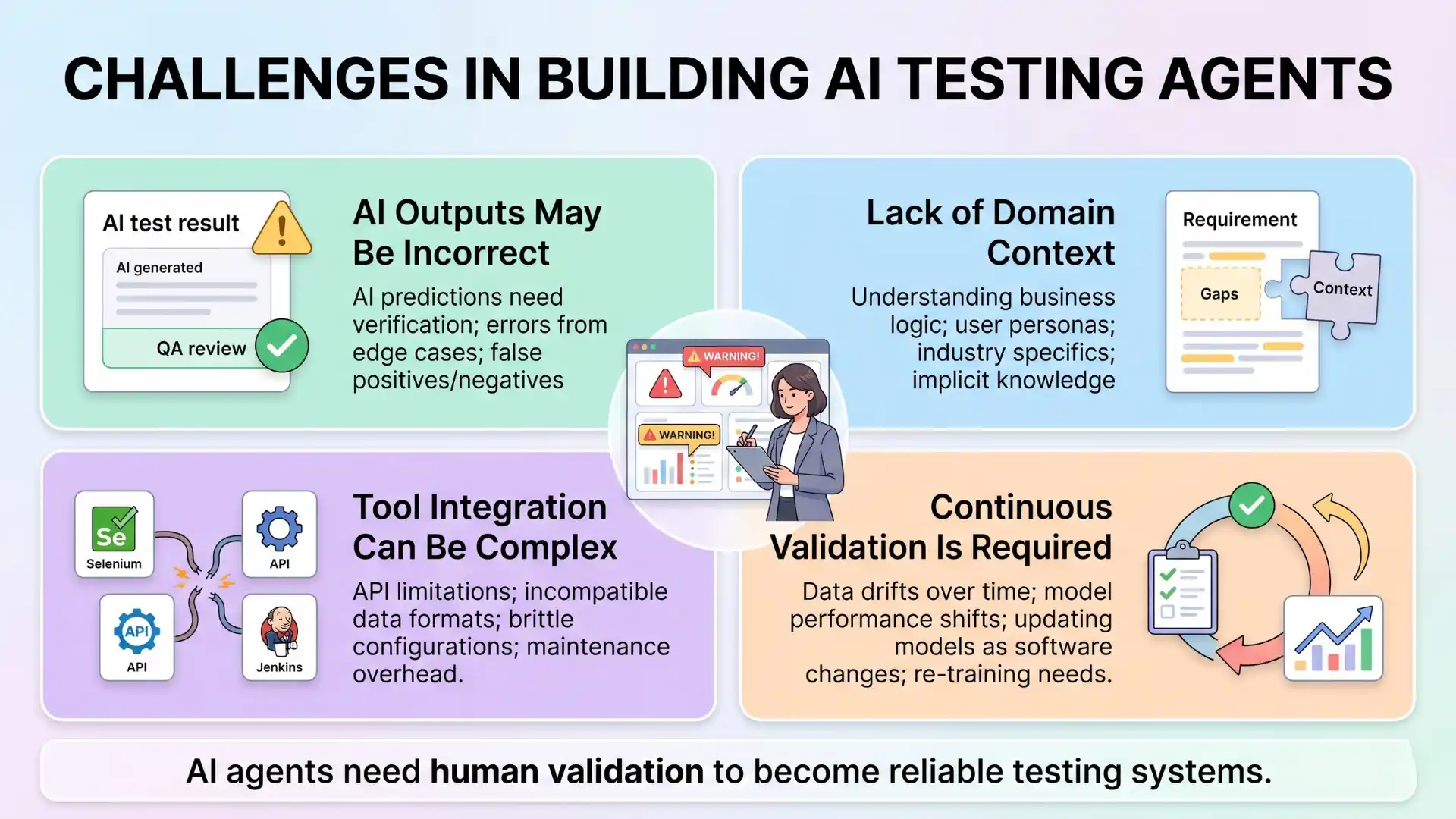
These challenges highlight the need for strong QA involvement.
The Role of QA Engineers in AI-Driven Testing
Even with AI agents:
- Validation is required
- Risk assessment is necessary
- Quality decisions must be made
QA engineers ensure:
- Outputs are accurate
- Systems behave as expected
- Risks are identified early
AI supports testing, but does not replace responsibility.
Do AI testing agents replace QA engineers?
No. QA engineers are essential for validation, risk analysis, and quality decisions.
Key Takeaways
- AI testing agents automate repetitive testing tasks
- AI in software testing improves speed and coverage
- QA engineers ensure accuracy and reliability
- Feedback loops make AI systems better over time
Final Thought
AI testing agents are not about replacing testers.
They are about improving how testing is done.
- From manual effort to automated workflows
- From repetitive tasks to intelligent systems
- From execution to decision-making
Because ultimately:
AI-driven testing is not about building tools —
it is about building systems that solve real testing problems.
FAQs
What are AI testing agents?
AI testing agents are systems that use AI models and automation tools to generate test cases, execute workflows, analyze results, and improve testing processes.
How do AI testing agents work?
They combine AI models, automation frameworks, APIs, and feedback loops to create intelligent testing workflows.
What tools are required to build AI testing agents?
Tools like Selenium or Playwright for automation, APIs for AI integration, and testing frameworks are commonly used.
Can beginners build AI testing agents?
Yes, beginners can start by learning automation basics and gradually integrate AI into their workflows.
What are the challenges in building AI testing agents?
Challenges include incorrect AI outputs, lack of domain context, integration complexity, and the need for continuous validation.
How does AI in software testing help QA engineers?
AI helps generate test cases, analyze failures, and improve testing efficiency while QA engineers validate and ensure accuracy.
We Also Provide Training In:
- Advanced Selenium Training
- Playwright Training
- Gen AI Training
- AWS Training
- REST API Training
- Full Stack Training
- Appium Training
- DevOps Training
- JMeter Performance Training
Author’s Bio:

Content Writer at Testleaf, specializing in SEO-driven content for test automation, software development, and cybersecurity. I turn complex technical topics into clear, engaging stories that educate, inspire, and drive digital transformation.
Ezhirkadhir Raja
Content Writer – Testleaf