
Every QA team wants the same thing: better test coverage, faster releases, and fewer defects escaping into production. But traditional test case generation often struggles to keep up. Requirements change mid-sprint. Edge cases get missed. Regression suites grow, but confidence does not always grow with them.
This is where AI has started to make a real difference.
Not because it can think like an experienced tester.
Not because it can understand every business nuance.
And definitely not because it can replace QA judgment.
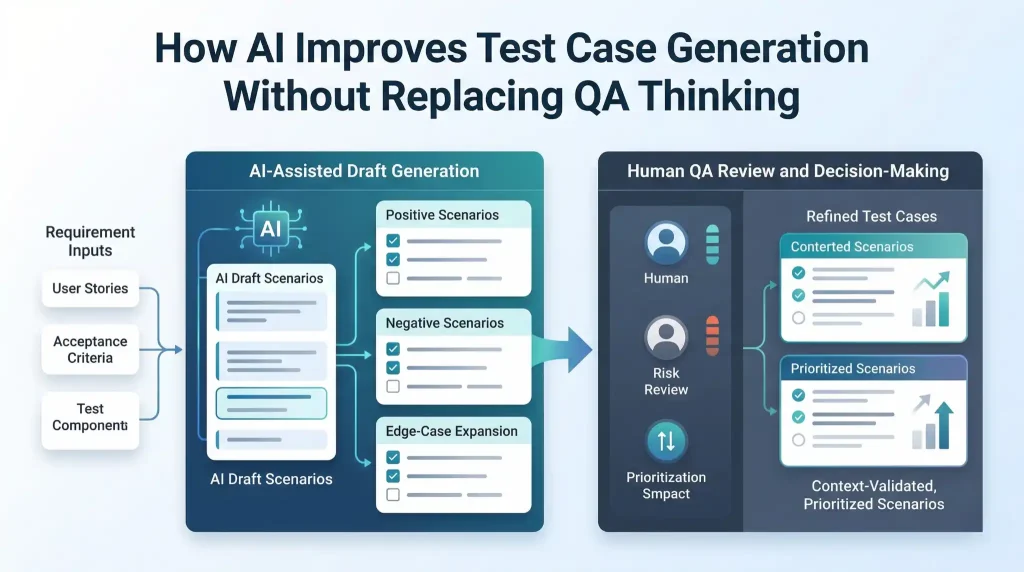
AI improves test case generation because it helps teams move from manual drafting to assisted thinking. It can turn requirements into first-pass scenarios, expand positive and negative paths, suggest missing conditions, and reduce the friction of maintaining large test repositories. But the final quality of a test suite still depends on human reasoning: understanding risk, ambiguity, customer behavior, and business impact. Recent research on automatic test case generation using natural language processing found that most approaches still achieve only a medium level of automation, and only a limited number explicitly incorporate foundational test design techniques such as boundary value analysis, equivalence partitioning, state transitions, and decision tables.
That distinction matters.
The real question is not whether AI can generate test cases. It can.
The better question is: Can AI generate the right test cases, for the right risks, in the right context?
That is still where QA thinking wins.
How does AI improve test case generation?
AI improves test case generation by speeding up first drafts, expanding scenarios, improving consistency, and helping maintain test suites. Human QA still decides risk, priority, and release readiness.
Can AI replace QA thinking in test design?
No. AI can suggest scenarios, but testers still provide domain judgment, edge-case review, business-risk analysis, and exploratory thinking.
These help because Google’s AI features and featured snippets reward clear, direct answers, while strong titles and meta descriptions help Search understand and present the page well.
You Should Also Read: playwright interview questions
What AI actually improves in test case generation
AI is most useful when test case generation is treated as a workflow, not a one-click miracle.
In practice, AI can help in four meaningful ways.
First, it speeds up draft creation. Instead of starting with a blank page, testers can feed user stories, acceptance criteria, API specs, or functional requirements into an AI system and get an initial set of scenarios. That alone removes a large amount of repetitive effort.
Second, AI helps with scenario expansion. Human testers under deadline pressure often focus on the happy path first. AI can quickly suggest negative cases, alternate flows, missing validations, and unusual input conditions. That does not guarantee quality, but it improves the chances that teams begin with broader coverage.
Third, AI improves consistency and structure. Competing content in this space often highlights this well: AI can help standardize test case wording, separate actions from expected results, and reduce duplicate or overlapping cases across growing suites. That is useful, especially for teams working across multiple testers and releases.
Fourth, AI can support maintenance. As features evolve, test cases become stale. AI can flag outdated terminology, highlight likely impact areas, and suggest revisions when workflows change. In large QA environments, that is not a minor benefit. It is one of the biggest reasons AI-assisted testing is gaining traction.
So yes, AI improves test case generation. But mostly by improving the mechanics around it.
That is not the same as improving test judgment.


Where AI still falls short
This is where many articles become too optimistic.
AI is good at pattern generation. QA is about risk interpretation.
A model can read a requirement and produce ten test cases in seconds. But it does not naturally understand which one protects revenue, which one protects trust, and which one protects the customer experience in a real release.
AI also struggles with ambiguity. Requirements in real projects are rarely perfect. A user story may be incomplete, a business rule may be implied rather than stated, and a critical edge case may only exist because of something testers learned from production behavior six months ago. Those are not just documentation issues. They are context issues.
This is why the strongest recent work on AI-assisted software development keeps making the same point: success with AI is a systems problem, not a tools problem. Google Cloud’s 2025 DORA report argues that organizations get better outcomes not simply by adopting AI tools, but by combining them with the right practices, guardrails, and team capabilities.
In testing, that means AI without review creates a familiar danger: faster output, but not necessarily better coverage.
AI can generate more test cases.
It cannot reliably decide which failures matter most.
Other Helpful Articles: Epam interview questions
Why QA thinking still matters
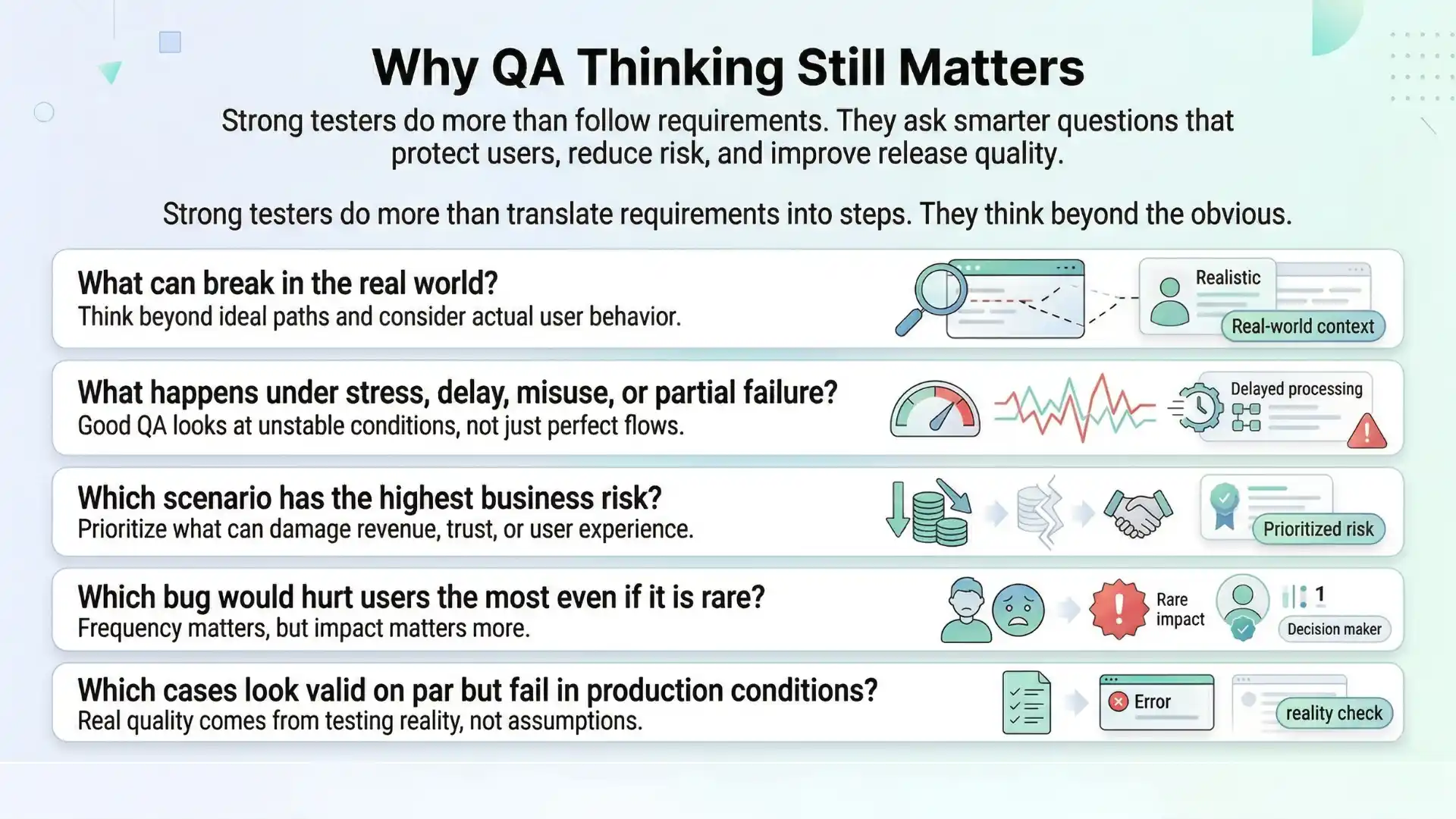
Strong testers do more than translate requirements into steps.
They ask:
- What can break in the real world?
- What happens under stress, delay, misuse, or partial failure?
- Which scenario has the highest business risk?
- Which bug would hurt users the most even if it is rare?
- Which cases look valid on paper but fail in production conditions?

That kind of thinking sits outside simple generation.
Take a login flow with OTP as an example.
An AI system can usually generate obvious cases:
- valid OTP
- invalid OTP
- expired OTP
- blank input
- resend OTP
Useful? Absolutely.
But QA thinking expands the test space in a more valuable way:
- What happens if the user requests multiple OTPs rapidly?
- Can an older OTP still work after a new one is issued?
- What happens if login starts on one device and finishes on another?
- Does session state survive a network interruption?
- Is rate limiting enforced correctly?
- Are error messages secure and user-friendly?
- What happens when SMS delivery is delayed but the timer expires?
- Are there localization or accessibility issues in the OTP flow?
That is the difference between generated cases and tested risk.
AI helps surface possibilities.
QA decides which possibilities deserve trust, priority, and action.
Don’t Miss Out: Automation testing interview questions
The better operating model: AI drafts, humans decide
The healthiest way to think about AI in test case generation is not replacement. It is division of labor.
A practical model looks like this:
AI drafts the initial scenarios from requirements, user stories, or specs.
QA refines them using risk, domain knowledge, and edge-case thinking.
Product and business stakeholders validate whether the cases reflect real user behavior and business rules.
Automation engineers operationalize the final suite in a maintainable way.
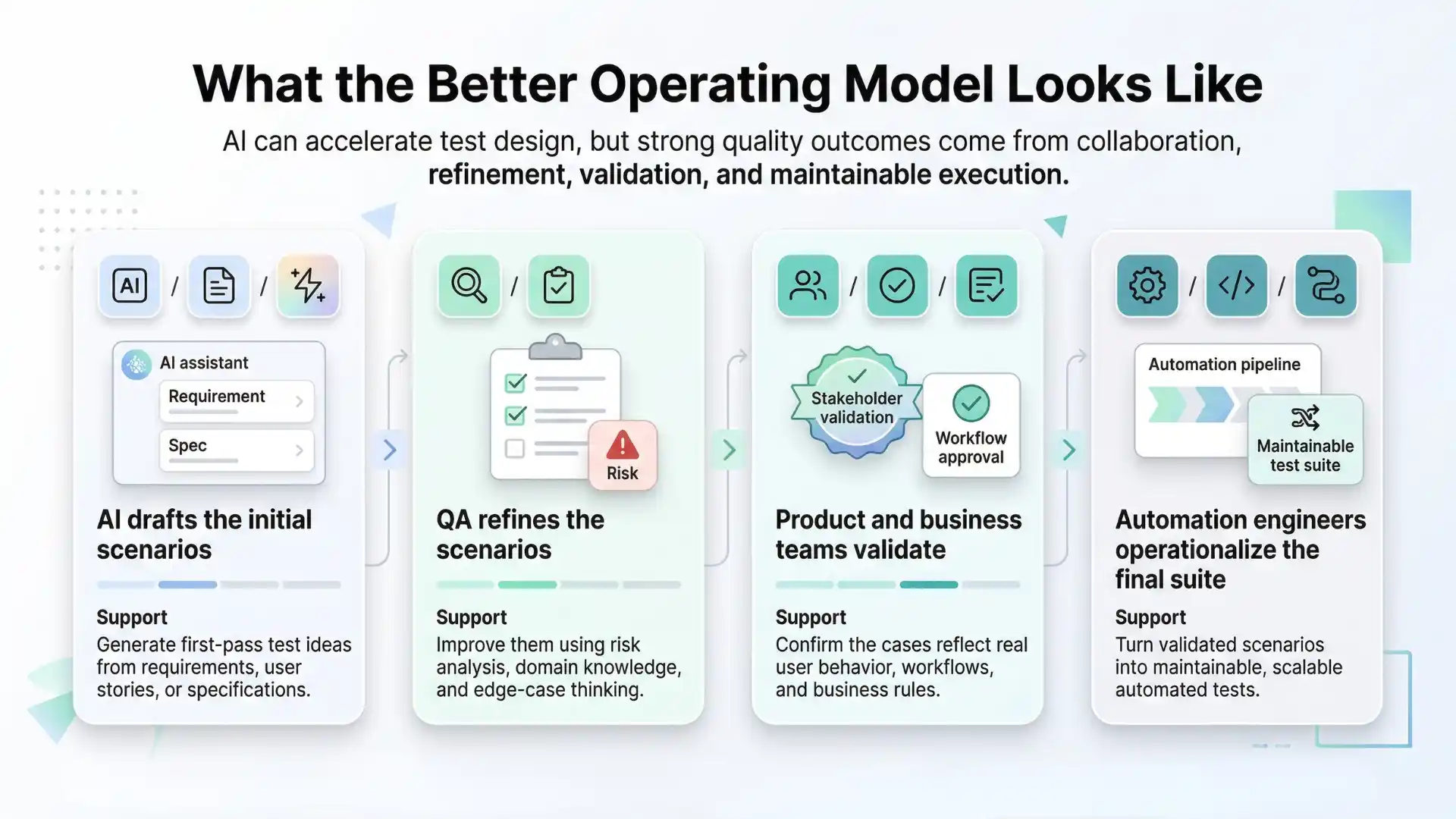
This model is more realistic than “AI writes your tests for you,” and more valuable than fear-based debates about whether testers are being replaced.
In fact, the rise of AI may do the opposite of what many people assume. It may increase the value of testers who think well.
Because once drafting becomes easier, the differentiator is no longer who can write the first version of a test case fastest. The differentiator becomes who can identify the highest-risk gaps, challenge weak assumptions, and turn AI output into trustworthy quality practice.
That is also why governance matters. NIST’s AI Risk Management guidance emphasizes managing AI-related risk across the lifecycle with attention to trustworthiness, oversight, and context. That principle applies directly to QA workflows: AI-generated artifacts should be reviewed, evaluated, and used with clear human accountability.
What modern QA teams should do now
The smartest teams are not asking whether AI should replace test case generation. They are asking how to use AI to improve it without weakening accountability.
That means using AI for:
- first-pass case generation
- scenario expansion
- documentation cleanup
- impact-based maintenance support
And keeping humans in charge of:
- risk prioritization
- domain interpretation
- edge-case review
- release judgment
- exploratory thinking
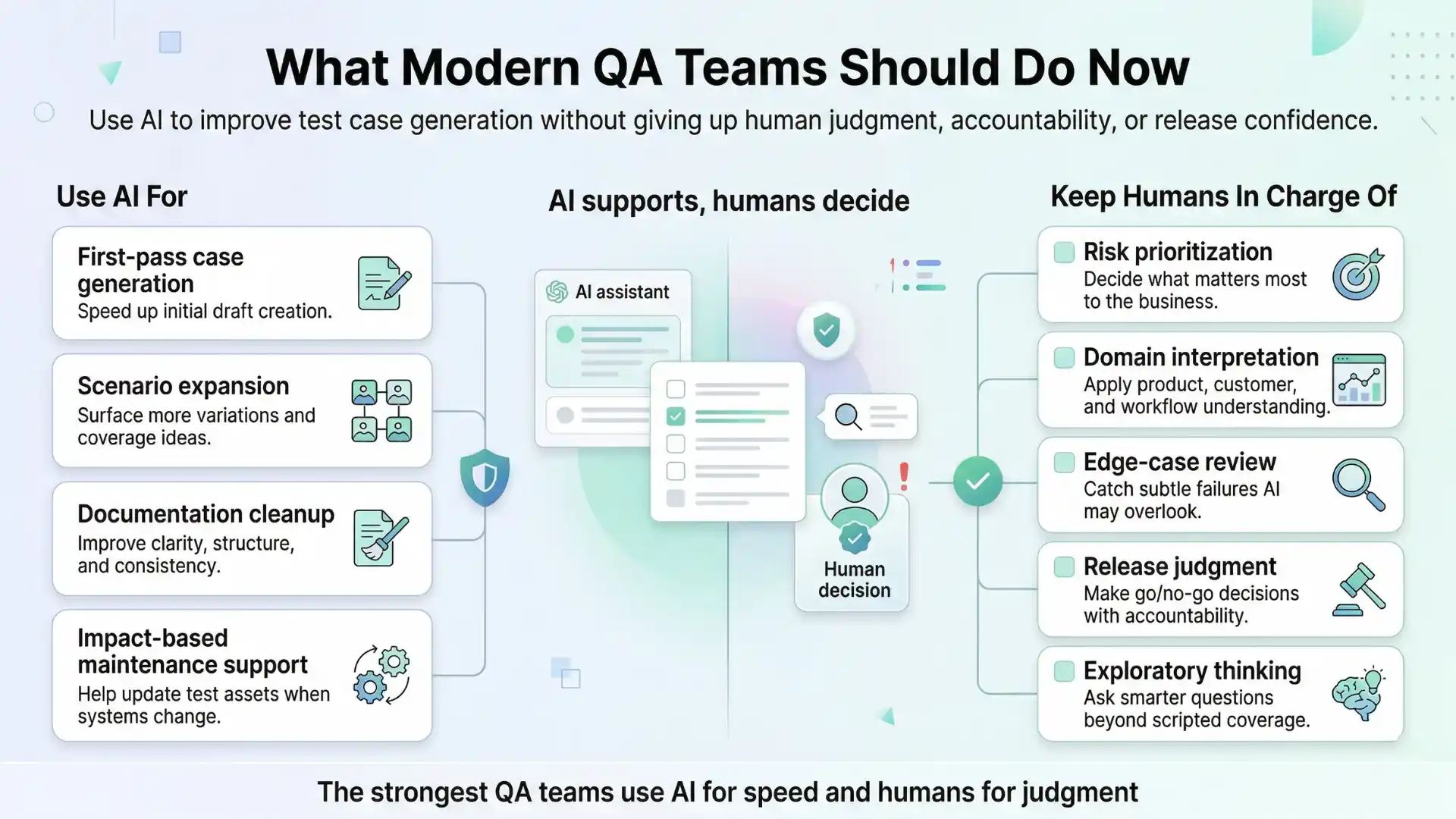
This is the balance that will matter not just in 2026, but for years ahead.
Key Takeaways
- AI improves speed and efficiency in test case creation
- QA improves judgment, risk analysis, and real-world coverage
- The best teams combine AI assistance with human thinking
Modern research shows that AI can support test case generation but still operates at a medium level of automation, especially when it comes to applying advanced test design techniques like boundary value analysis and state transitions.
Final thought
AI is changing test case generation. That part is real.
It reduces blank-page effort. It expands scenario suggestions. It helps teams structure and maintain test assets more efficiently. But it does not replace the hardest part of testing: deciding what truly matters.
That is still a human skill.
The future of QA is not AI versus testers.
It is testers who know how to use AI without outsourcing judgment.
And in that future, the best testers will not be the ones who reject AI.
They will be the ones who make it useful, reliable, and accountable.
FAQs
How does AI improve test case generation?
AI improves test case generation by creating first-pass drafts, expanding scenarios, improving consistency, and helping maintain large test suites more efficiently.
Can AI replace QA testers in software testing?
No, AI cannot replace QA testers. It assists in generating test cases, but human testers are essential for risk analysis, domain understanding, and release decisions.
What are the limitations of AI in test case generation?
AI struggles with business context, risk prioritization, ambiguous requirements, and real-world edge cases, which require human QA judgment.
What is the role of QA in AI-assisted testing?
QA professionals refine AI-generated scenarios, validate risks, review edge cases, and ensure that test coverage aligns with real user behavior and business needs.
Why is QA thinking still important in modern testing?
QA thinking is important because it focuses on real-world risks, user impact, and production scenarios that AI alone cannot fully understand or prioritize.
What is the best approach to using AI in software testing?
The best approach is to use AI for test case drafting, scenario expansion, and maintenance, while humans handle risk prioritization, validation, and decision-making.
What skills are needed for AI-assisted software testing?
Key skills include risk-based testing, exploratory testing, domain knowledge, automation frameworks, and the ability to effectively use AI tools in QA workflows.
We Also Provide Training In:
- Advanced Selenium Training
- Playwright Training
- Gen AI Training
- AWS Training
- REST API Training
- Full Stack Training
- Appium Training
- DevOps Training
- JMeter Performance Training
Author’s Bio:


Content Writer at Testleaf, specializing in SEO-driven content for test automation, software development, and cybersecurity. I turn complex technical topics into clear, engaging stories that educate, inspire, and drive digital transformation.
Ezhirkadhir Raja
Content Writer – Testleaf