People search “data analyst job description” for two reasons.
They want a copy-ready job description. And they want to know what the role looks like in real life.
This guide gives you both. It also shows how to grow into data science, because that is where many careers are heading in 2026.
What does a Data Analyst do in 2026?
A Data Analyst turns raw data into clear answers. Those answers help teams make better decisions.
Most analysts follow the same workflow:
- Understand the business question
- Pull data (usually SQL)
- Clean and shape it
- Analyze patterns and trends
- Share insights with charts and a short story
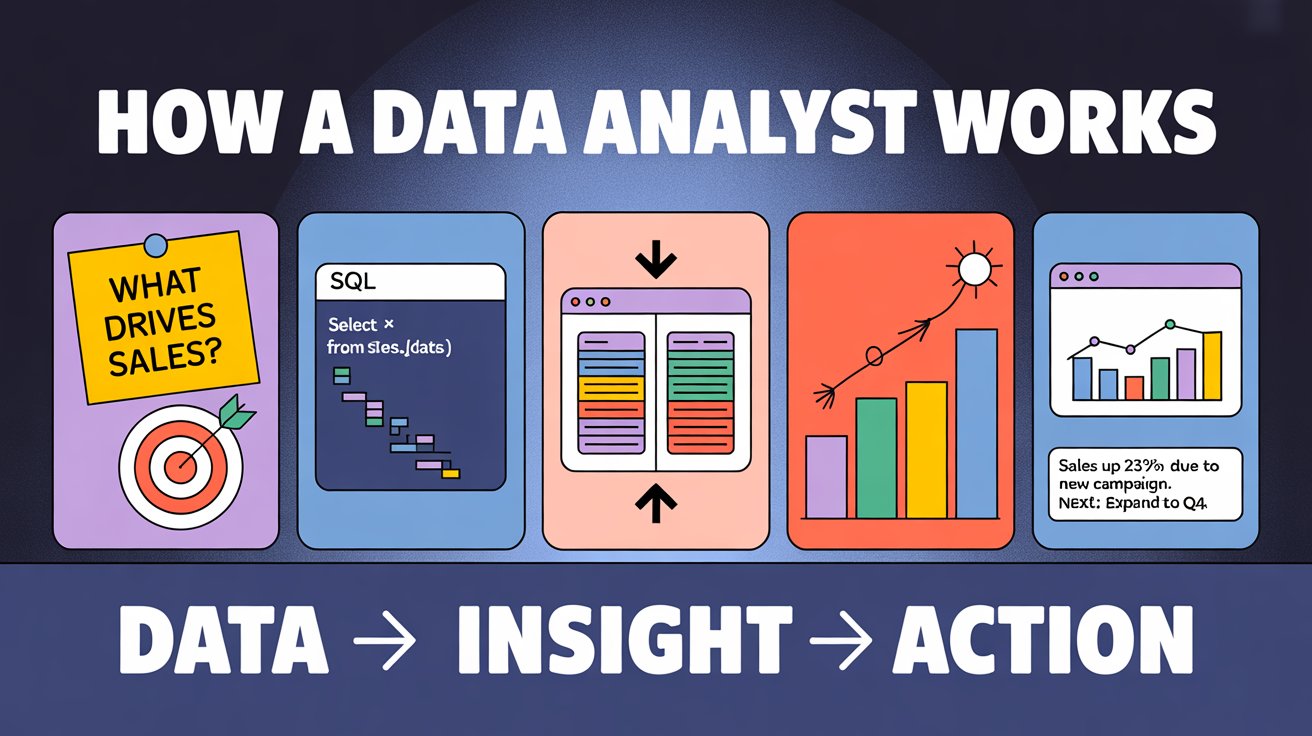
The best analysts don’t just report numbers. They explain what changed, why it changed, and what to do next.
Day-to-day work (what you’ll actually do)
A realistic week often includes:
- Checking dashboards and alerts
- Answering stakeholder questions using SQL
- Updating reports or creating new dashboards
- Finding root causes when metrics drop
- Sharing a short insight update (simple, not long)
Key responsibilities (written like real work)
A strong Data Analyst job description should focus on outcomes, not buzzwords.
Common responsibilities:
- Define and track KPIs (revenue, retention, churn, cost, quality)
- Build dashboards in Power BI or Tableau
- Write SQL queries and validate results
- Clean datasets (duplicates, missing values, wrong formats)
- Document metric definitions and data sources
- Present insights clearly to non-technical teams
- Partner with engineering/BI teams to improve data quality
Continue Reading: playwright interview questions
KPIs analysts work on (by team)
Add these to your JD to make it more specific and realistic:
- Product: activation rate, DAU/MAU, retention, feature adoption
- Marketing: leads, conversion rate, CAC, ROAS
- Sales: pipeline, win rate, revenue, deal cycle time
- Support: ticket volume, resolution time, CSAT, churn signals
- Operations: SLA, defects, turnaround time, cost per unit
Skills recruiters filter on (simple skill matrix)
Entry-level (0–2 years)
- Excel/Sheets: pivots, charts, basic formulas
- SQL: joins, group by, filtering
- Basic stats: average, spread, correlation (and meaning)
- Communication: clean charts + simple explanations
Mid-level (2–5 years)
- Strong SQL (including window functions)
- Business thinking (turn vague requests into measurable questions)
- Python for analysis (Pandas)
- Deeper analysis: funnel, cohort, segmentation
- Better validation: sanity checks and data quality thinking
Senior-level (5+ years)
- Own KPIs and metric definitions end-to-end
- Influence decisions and prioritization
- Mentor analysts and improve reporting systems
- Partner closely with data engineering and product leadership
Tools and stack (2026-ready)
Many articles stop at Excel + SQL + BI. In real teams, this is the practical stack:
- SQL (must-have)
- Excel/Sheets (quick checks)
- Power BI / Tableau (dashboards)
- Python (Pandas) for repeatable analysis
- Basic ML metrics (accuracy, precision, recall)
- GenAI for productivity (drafting queries, summarizing findings, faster documentation — used safely)
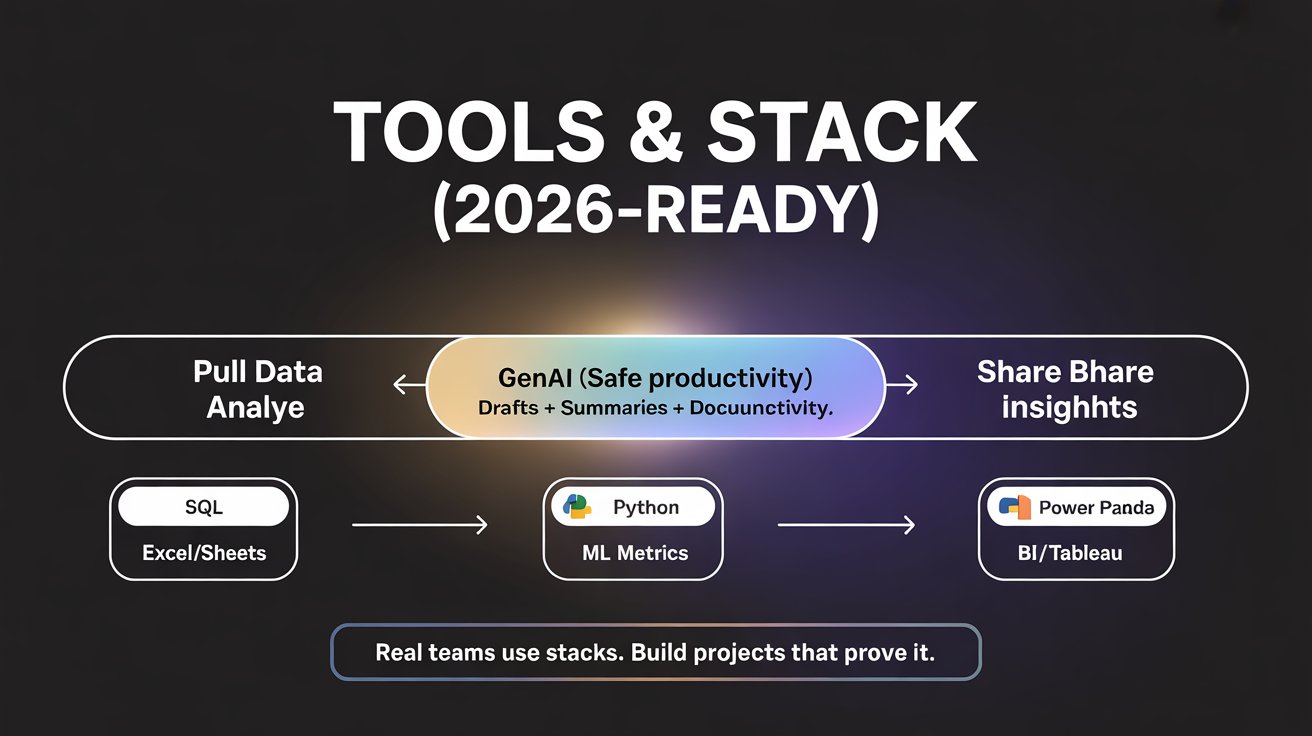
Tip: In interviews, showing one project where you used SQL + BI + a bit of Python is often stronger than listing 10 tools.
Copy-paste job description templates (3 versions)
1) Data Analyst (Entry-Level) — Job Description
Summary: Support reporting and analysis using SQL, Excel, and dashboards.
Responsibilities
- Write basic SQL queries and validate results
- Maintain weekly dashboards and recurring reports
- Clean datasets and document metric definitions
- Share findings with clear charts and short notes
Requirements
- Excel + basic SQL
- Strong communication and attention to detail
Nice to have
- Power BI/Tableau exposure
- Python basics (Pandas)
Check Out These Articles: selenium interview questions
2) Data Analyst (Mid-Level) — Job Description
Summary: Own KPIs, drive insights, and support decision-making.
Responsibilities
- Own dashboards and metric definitions for a business area
- Perform funnel, cohort, and root-cause analysis
- Translate stakeholder needs into measurable questions
- Improve data quality with BI/engineering teams
Requirements
- Strong SQL + dashboarding experience
- Proven ability to present insights clearly
Nice to have
- Python for analysis
- A/B testing basics
3) Senior Data Analyst — Job Description
Summary: Lead analytics for a domain and influence business strategy.
Responsibilities
- Lead KPI design and governance
- Build scalable reporting and insight processes
- Guide junior analysts and review analysis quality
- Partner with leaders to define targets and measure impact
Requirements
- Advanced SQL + strong storytelling skills
- Experience leading cross-team analytics projects
Nice to have
- Data modeling basics, experimentation, forecasting
Other Recommended Reads: automation testing interview questions
Data Analyst → Data Scientist (simple roadmap)
If your goal is data science, don’t jump straight to “deep learning.”
Build in this order:
- SQL + Python + statistics (foundation)
- 2–3 end-to-end projects (clean → analyze → explain)
- ML basics (classification/regression + evaluation metrics)
- Add one GenAI workflow (prompting + safe usage)
- Prepare interviews using your own projects (not copied projects)
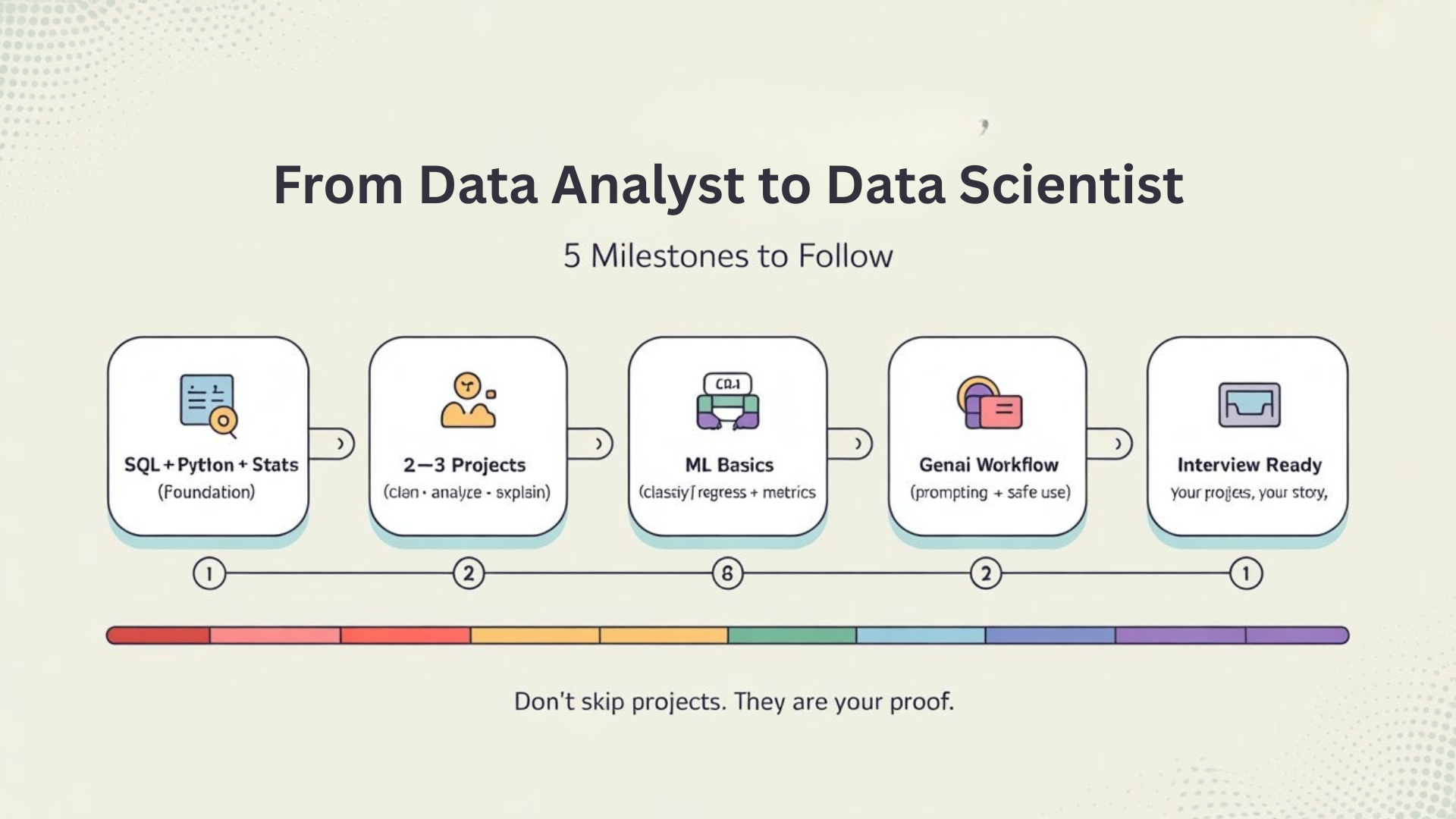
A simple rule: Projects + clarity = faster interviews.
Ready to Become a Data Scientist Faster? (Free AI-Powered Webinar)
If you’re searching for a Data Science Course, you’re likely aiming for more than dashboards. You want to predict outcomes, build models, and use AI to work faster. That shift is exactly what modern teams value. To help you start quickly, we invite you to our free live webinar: “Become a Data Scientist—faster, with AI-powered skills.” It’s a live online session that includes a mini project, a GenAI demo, a participation certificate, and even a short interview Q&A guide. Check the masterclass page for the next session timing and to reserve your seat.
10 interview questions (use for hiring or preparation)
- What KPI did you build? Define it clearly.
- Which SQL join do you use most, and why?
- How do you handle missing values?
- Which chart fits trends vs comparisons?
- Tell me about a time data was wrong. How did you catch it?
- How do you validate results before sharing?
- Correlation vs causation: explain simply.
- How would you analyze a drop in conversions?
- Explain precision and recall in plain words.
- How would you use GenAI safely in analytics work?
Final note
Companies don’t hire analysts for tools alone. They hire analysts who bring clarity.
Use the templates above. Build a few strong projects. Then take a structured path if you want to become a Data Scientist faster—especially in 2026, where AI-powered skills are becoming the new baseline.
FAQs
1) What does a data analyst do?
A data analyst collects, cleans, analyzes, and visualizes data to answer business questions and support decisions with clear insights.
2) What skills are needed to become a data analyst in 2026?
SQL, Excel/Sheets, dashboarding (Power BI/Tableau), basic statistics, data storytelling, and Python basics for repeatable analysis.
3) Is SQL mandatory for a data analyst role?
Yes. SQL is the most common requirement because analysts use it to pull and validate data from databases.
4) What tools do data analysts use most?
SQL, Excel/Google Sheets, Power BI or Tableau, and Python (Pandas). Many teams also use cloud data platforms and automation tools.
5) What are the key responsibilities in a data analyst job description?
Defining KPIs, building dashboards, writing SQL, cleaning data, validating reports, and communicating insights to stakeholders.
6) How do I move from data analyst to data scientist?
Build SQL + Python + statistics first, complete 2–3 end-to-end projects, learn ML basics and metrics, then practice interviews using your projects.
7) What projects help a data analyst get hired?
A KPI dashboard project, a funnel or cohort analysis project, and one Python analysis project that shows cleaning, insights, and recommendations.
8) Can I become a data analyst without a degree?
Yes, if you can prove skills with projects, a portfolio, and strong SQL + dashboarding ability. Many employers prioritize practical work.