In large software projects, regression testing doesn’t fail because teams don’t care about quality.
It fails because scale wins.
Test suites grow into thousands of cases. Multiple teams push changes daily. Release cycles shrink. And somewhere along the way, regression testing shifts from being a quality safeguard to a bottleneck.
At that point, the real question is no longer:
“Are we testing everything?”
It becomes:
“Are we testing the right things, at the right time, with enough confidence to release?”
This is where AI is starting to reshape regression testing—not by replacing it, but by making smarter decisions possible at scale.
What are the real benefits of AI in regression testing for large projects?
AI helps large QA teams improve impact analysis, prioritize high-risk tests, reduce maintenance overhead, speed failure triage, learn from historical defects, and create more time for real QA thinking.
Can AI replace QA teams in regression testing?
No. AI can support prioritization, maintenance, and analysis, but it cannot fully understand business context, make final release decisions, replace domain expertise, or take ownership of quality.
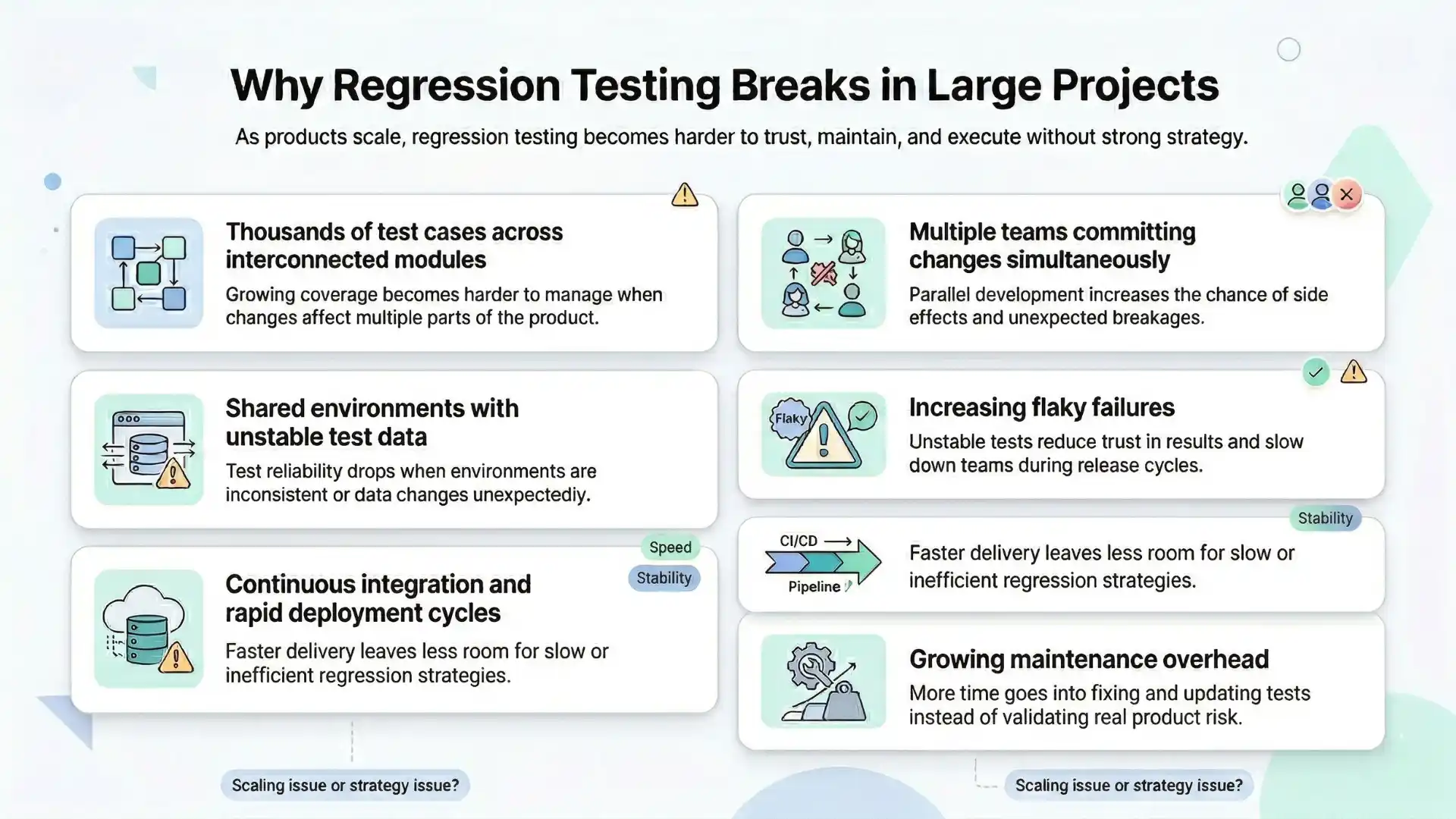
Why Regression Testing Breaks in Large Projects
Traditional regression testing strategies were built for a different era—smaller systems, slower releases, and more predictable change.
Large projects operate differently.
They deal with:
- Thousands of test cases across interconnected modules
- Multiple teams committing changes simultaneously
- Shared environments with unstable test data
- Increasing flaky failures
- Continuous integration and rapid deployment cycles
- Growing maintenance overhead
In theory, teams aim for full regression coverage.
In reality, they compromise.
They skip tests. They prioritize based on intuition. They delay releases—or move forward with uncertainty.
This isn’t just a tooling gap.
It’s a decision-making problem under pressure.
Other Helpful Articles: playwright interview questions
What AI Actually Changes in Regression Testing
There’s a common assumption that AI’s main role is to make testing faster.
Speed is a benefit—but not the most important one.
The real shift AI introduces is this:
From executing everything… to deciding intelligently.
Instead of treating every test equally, AI helps teams:
- Understand risk
- Prioritize effectively
- Detect patterns
- Reduce unnecessary effort
This transforms regression testing from a repetitive process into a strategic function.
Traditional vs AI-Assisted Regression Testing
| Area | Traditional approach | AI-assisted approach |
|---|---|---|
| Test selection | Run large suites or rely on intuition | Prioritize by risk and change impact |
| Failure triage | Manual review of many failures | Group patterns and surface root causes |
| Maintenance | Reactive updates | Detect instability and redundancy earlier |
| Learning | Limited reuse of history | Use historical failures and defect trends |
| QA focus | Repetitive execution effort | More time for business risk and edge cases |
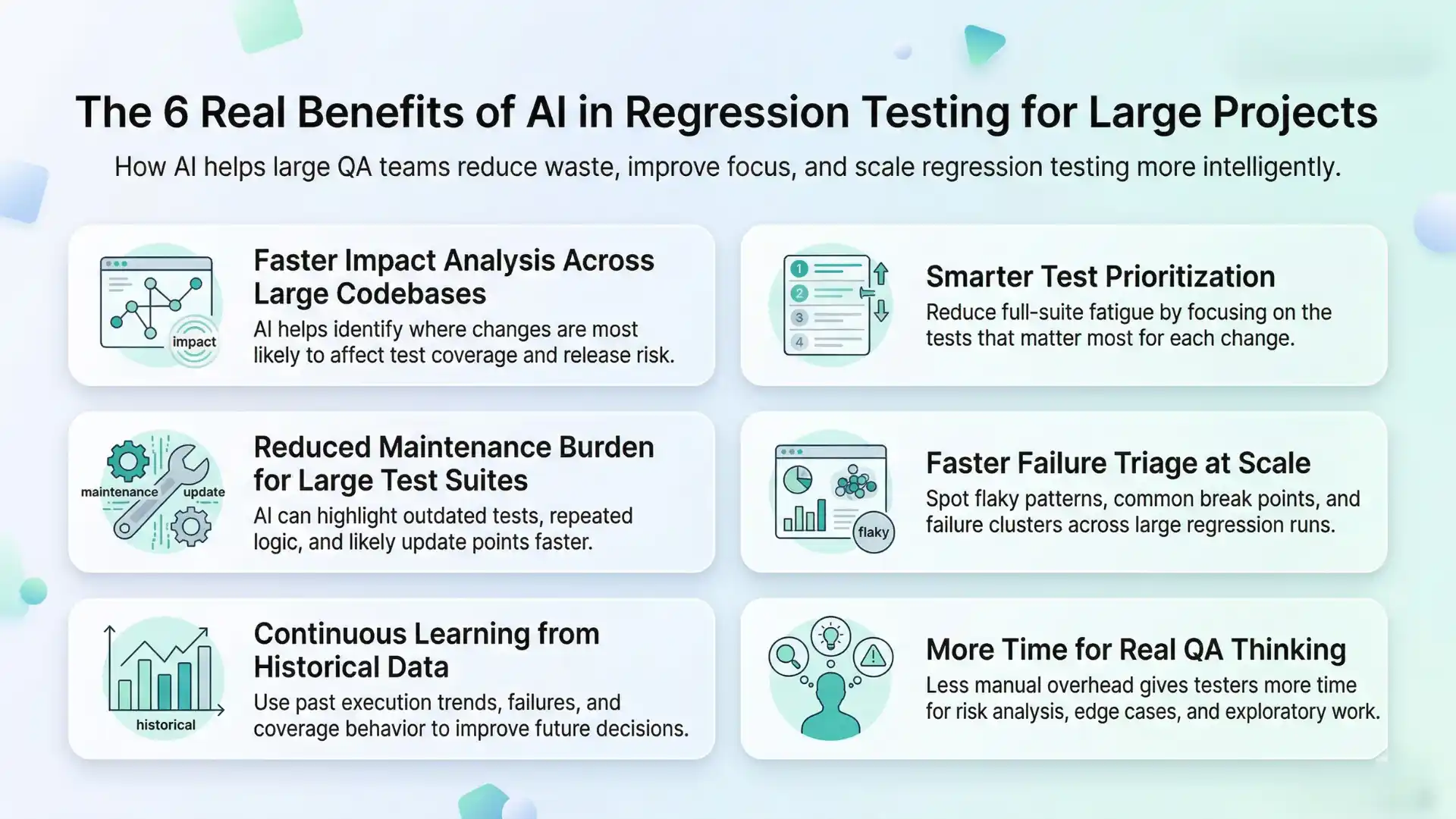
The 6 Real Benefits of AI in Regression Testing for Large Projects
1. Faster Impact Analysis Across Large Codebases
In complex systems, a small change can have wide-reaching effects.
AI can analyze code changes, historical defects, and test coverage to identify which areas are most likely to break.
Instead of running everything, teams can focus on what actually matters.
2. Smarter Test Prioritization (Instead of Full-Suite Fatigue)
Running full regression suites for every build is not sustainable.
AI enables:
- Risk-based test selection
- Dynamic prioritization
- Intelligent sequencing
This ensures high-risk scenarios are tested first—without slowing down delivery pipelines.
3. Reduced Maintenance Burden for Large Test Suites
As automation grows, so does maintenance effort.
Common issues include:
- Broken locators
- Outdated test flows
- Duplicate scenarios
- Flaky tests
AI can assist by detecting instability patterns, suggesting fixes, and identifying redundant tests—reducing long-term maintenance costs.
4. Faster Failure Triage at Scale
When hundreds of tests fail, the challenge isn’t just fixing them—it’s understanding them.
AI helps by:
- Grouping similar failures
- Identifying root causes faster
- Highlighting recurring defect patterns
This significantly reduces debugging time and improves overall efficiency.
5. Continuous Learning from Historical Data
Large projects generate valuable data across releases—but most of it goes unused.
AI can:
- Identify high-risk modules
- Detect recurring defect trends
- Learn from past failures
This shifts regression testing from reactive to predictive.
6. More Time for Real QA Thinking
This is the most important benefit—and often overlooked.
By reducing repetitive tasks like test selection, maintenance, and failure analysis, AI allows testers to focus on:
- Business logic
- Edge cases
- User experience
- Release confidence
AI doesn’t replace testers—it elevates their role.
What AI Still Cannot Do
Despite its capabilities, AI has limitations—and understanding them is critical.
AI cannot:
- Fully understand business context
- Make final release decisions
- Replace domain expertise
- Take ownership of quality
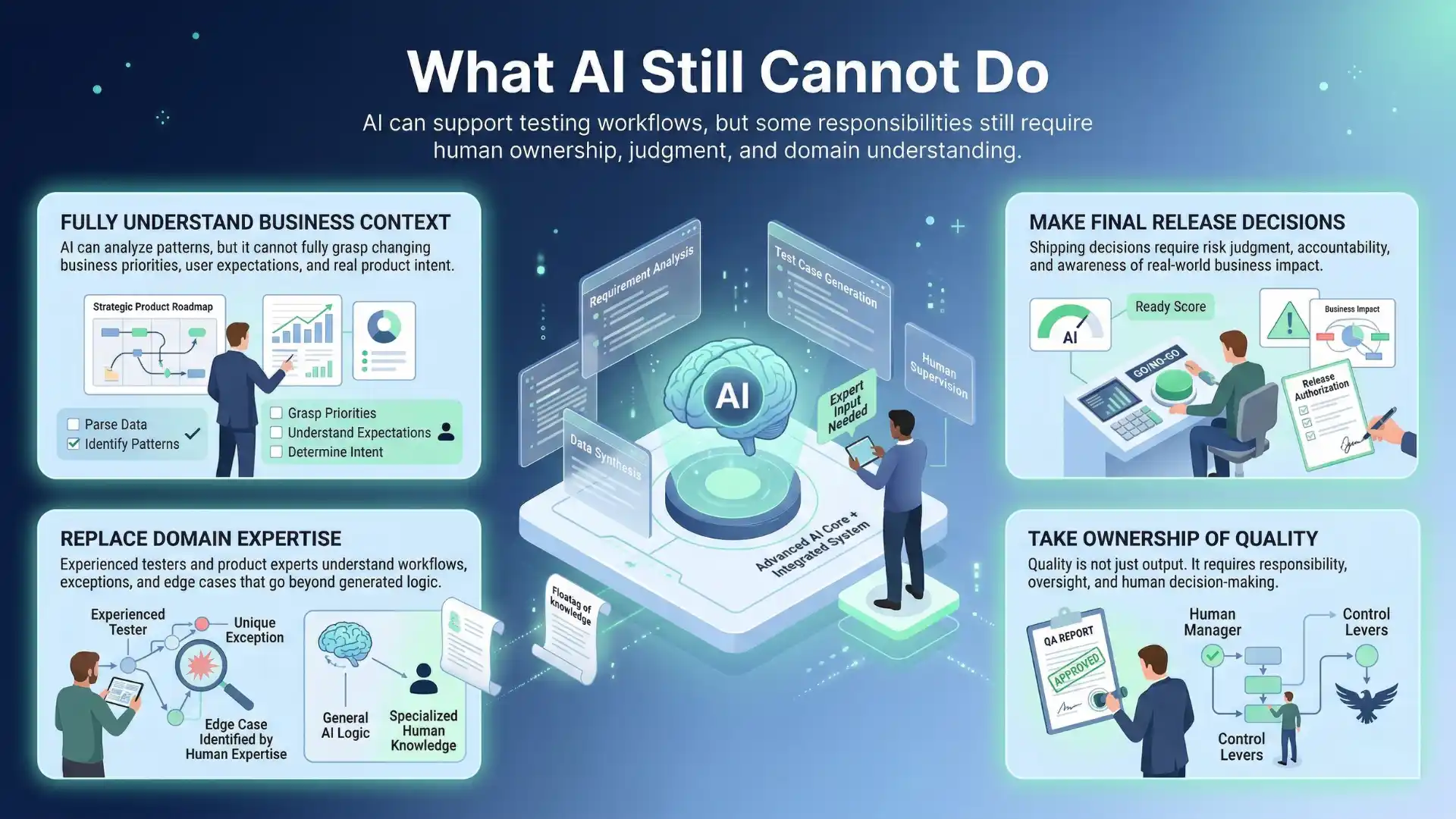
AI is a powerful assistant—but QA responsibility remains human.
The strongest teams are not the ones who rely entirely on AI, but the ones who use it to enhance their judgment.
Check Out These Articles: AI and ML engineers salary in india
Why This Shift Matters Now
AI is already transforming software engineering workflows.
Industry research suggests that generative AI can improve engineering productivity by 20% to 45% in certain activities, while developer studies have shown task completion speeds improving significantly with AI assistance.
While these numbers apply broadly, the implication is clear:
AI reduces repetitive effort and improves decision efficiency.
And regression testing—especially in large projects—is one of the biggest beneficiaries of this shift.
The Real Takeaway for QA Leaders
For small projects, regression testing is an execution problem.
For large projects, it becomes a decision problem.
And that is where AI delivers its greatest value.
Not by running more tests.
But by helping teams:
- Run the right tests
- At the right time
- With the right confidence
Key Takeaways
- AI improves regression testing most in large projects, where scale makes full-suite execution harder to manage.
- The biggest value of AI is not just speed, but smarter decision-making.
- AI helps teams with impact analysis, test prioritization, maintenance reduction, and faster failure triage.
- Historical test and defect data become more useful when AI is used to identify patterns and recurring risks.
- AI gives testers more time to focus on business logic, edge cases, user experience, and release confidence.
- AI still cannot fully understand business context or replace QA judgment.
- The best QA teams use AI as a decision-support system, not as a replacement for human ownership.
- In large-scale regression testing, success comes from running the right tests at the right time with the right confidence.
Final Thought
AI will not eliminate regression testing effort.
But it will fundamentally change how that effort is spent.
The future of testing is not about doing more.
It’s about doing what matters most—better, faster, and smarter.
If you’re a QA professional or team exploring how to adapt to this shift, now is the time to move beyond tools—and start thinking in terms of strategy, scale, and intelligent testing.
At Testleaf, we believe the future belongs to testers who combine strong fundamentals with AI-driven thinking.
FAQs
What are the real benefits of AI in regression testing for large projects?
AI helps large QA teams improve impact analysis, prioritize high-risk tests, reduce maintenance overhead, speed up failure triage, learn from historical data, and create more time for real QA thinking.
How does AI help prioritize regression tests?
AI helps prioritize regression tests by analyzing code changes, historical defects, risk areas, and test coverage so teams can run the most important tests first.
Can AI reduce maintenance in large regression test suites?
Yes. AI can detect outdated tests, repeated scenarios, instability patterns, and likely update areas, helping teams reduce long-term maintenance effort.
Can AI replace QA teams in regression testing?
No. AI can support decision-making, but it cannot fully understand business context, replace domain expertise, make final release decisions, or take ownership of quality.
Why does regression testing break in large projects?
Regression testing breaks in large projects because test suites grow across interconnected modules, multiple teams ship changes at once, environments become unstable, flaky failures increase, and maintenance overhead rises.
How does AI improve failure triage in regression testing?
AI improves failure triage by grouping similar failures, identifying recurring defect patterns, and helping teams reach likely root causes faster.
What can AI still not do in software testing?
AI still cannot fully understand business context, make final release decisions, replace human domain expertise, or take ownership of product quality.
What is the biggest value of AI in regression testing?
The biggest value of AI in regression testing is not just speed. It is helping teams make smarter testing decisions at scale.
We Also Provide Training In:
- Advanced Selenium Training
- Playwright Training
- Gen AI Training
- AWS Training
- REST API Training
- Full Stack Training
- Appium Training
- DevOps Training
- JMeter Performance Training
Author’s Bio:

Content Writer at Testleaf, specializing in SEO-driven content for test automation, software development, and cybersecurity. I turn complex technical topics into clear, engaging stories that educate, inspire, and drive digital transformation.
Ezhirkadhir Raja
Content Writer – Testleaf