AI is no longer the future of testing.
It is already here.
Many QA engineers are still writing test cases manually.
Some are just starting automation.
But a bigger shift is happening.
AI is not just helping testers anymore.
It is starting to act like a tester.
This is where the confusion begins.
What is Generative AI?
What is Agentic AI?
And most importantly…
which one should you learn to stay relevant in 2026?
Let’s break it down in the simplest way.
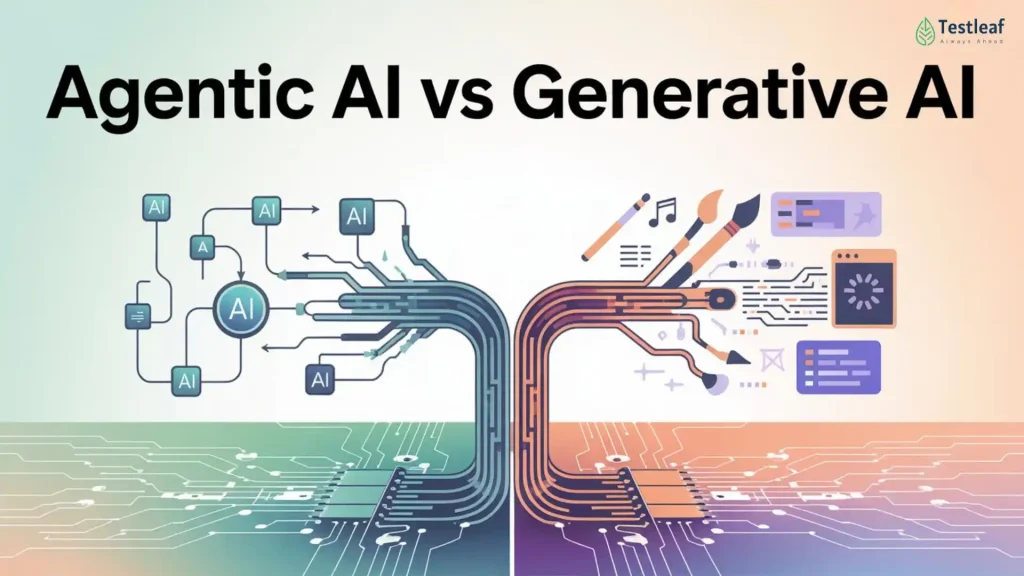
Generative AI creates content based on prompts.
Agentic AI takes actions based on goals.
In software testing, Generative AI helps you write tests, while Agentic AI helps you execute and manage tests automatically.
Understanding Generative AI
Generative AI is like a smart assistant.
You give an instruction.
It gives you an output.
In software testing, it helps you:
- Write test cases quickly
- Generate automation scripts
- Create test data
- Summarize bug reports
Simple Example
You type:
“Create test cases for a login page”
Within seconds, you get structured test cases.
You review them.
You use them.
👉 This is why many testers explore
“Generative AI in Test Automation: How Does It Impact the Industry?”
Understanding Agentic AI (Next Level)
Agentic AI is more powerful.
It does not wait for instructions step by step.
Instead, it works toward a goal.
In software testing, it can:
- Plan test scenarios
- Execute tests automatically
- Detect failures
- Fix broken scripts
- Re-run tests without help
Simple Example
You say:
“Test the checkout flow”
The AI will:
- Create test cases
- Execute them
- Identify issues
- Retry if needed
👉 This is the concept behind
“The Role of AI agents in Software Testing”
Key Difference
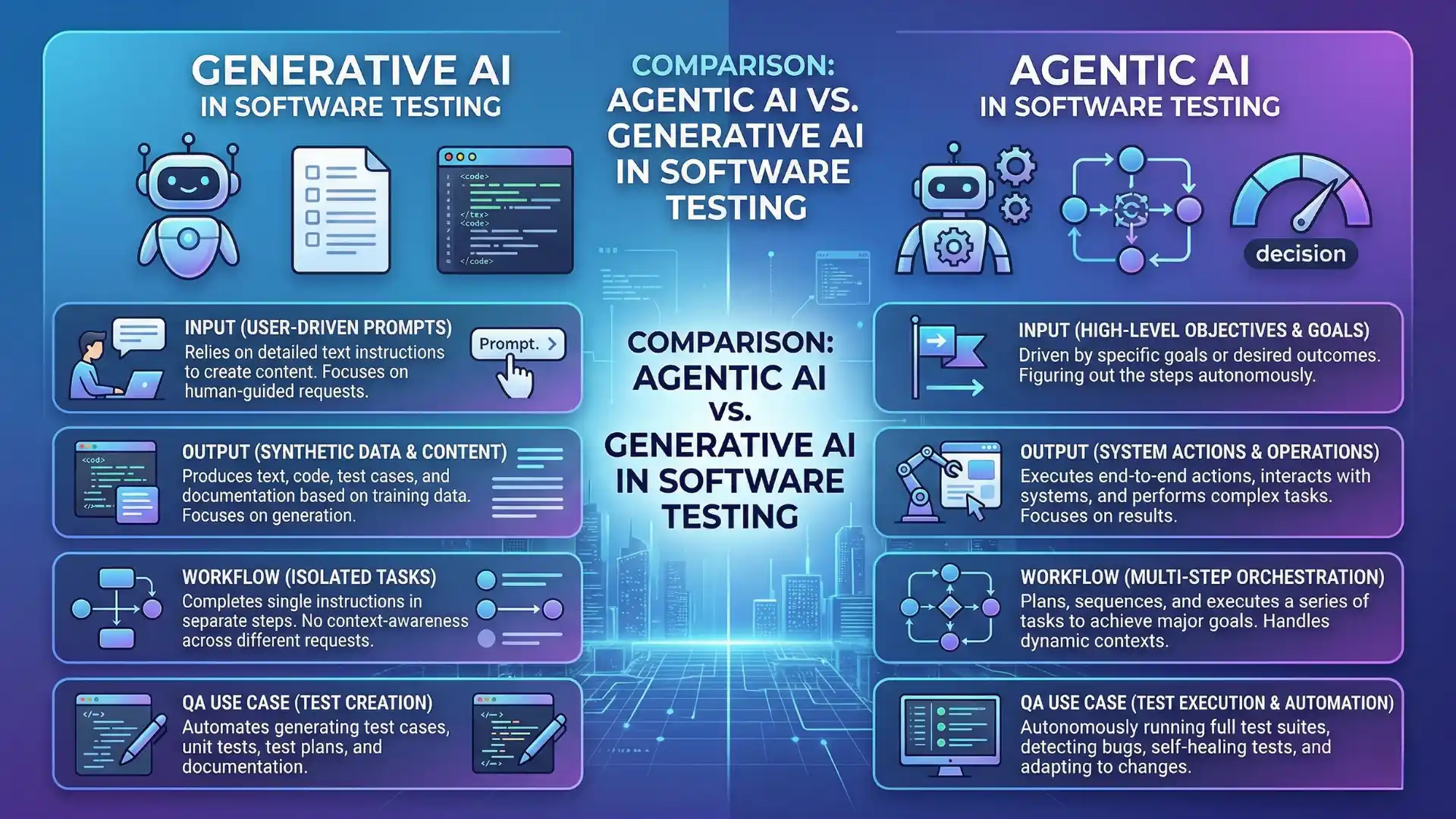
| Aspect | Generative AI | Agentic AI |
|---|---|---|
| What it does | Creates content | Performs actions |
| Input | Prompt | Goal |
| Decision making | Limited | Advanced |
| Workflow | One-step | Multi-step |
| QA role | Supports testers | Acts like a tester |
| Human involvement | High | Reduced |
How They Actually Work
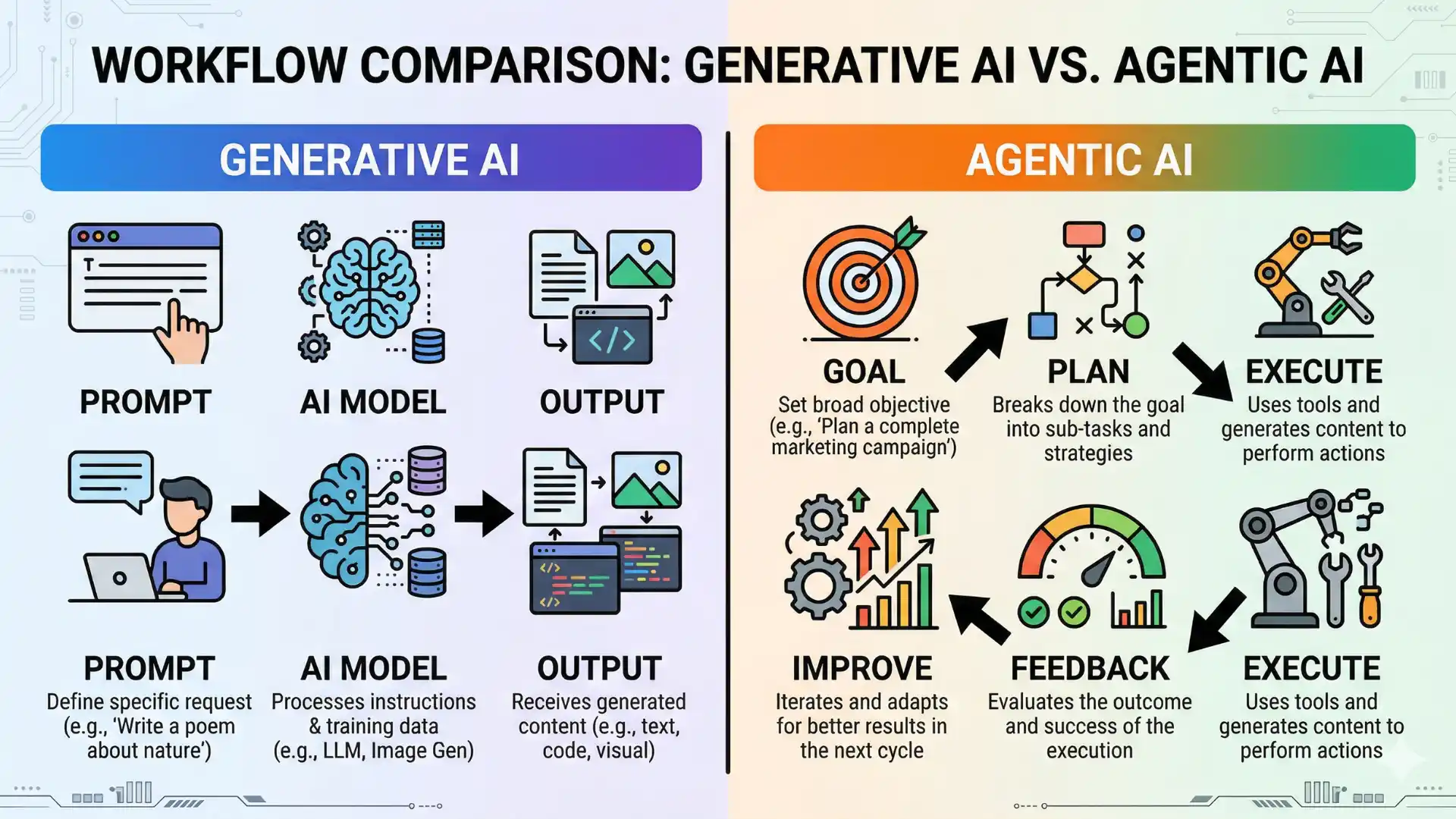
Understanding the workflow makes everything clear.
Generative AI Flow
- You give input
- AI generates output
- You validate and use
👉 Simple
👉 Fast
👉 Human-controlled
Agentic AI Flow
- You define a goal
- AI plans steps
- AI executes tasks
- AI improves results
👉 Autonomous
👉 Continuous
👉 Goal-driven
Real Examples in Software Testing
Let’s move from theory to real usage.
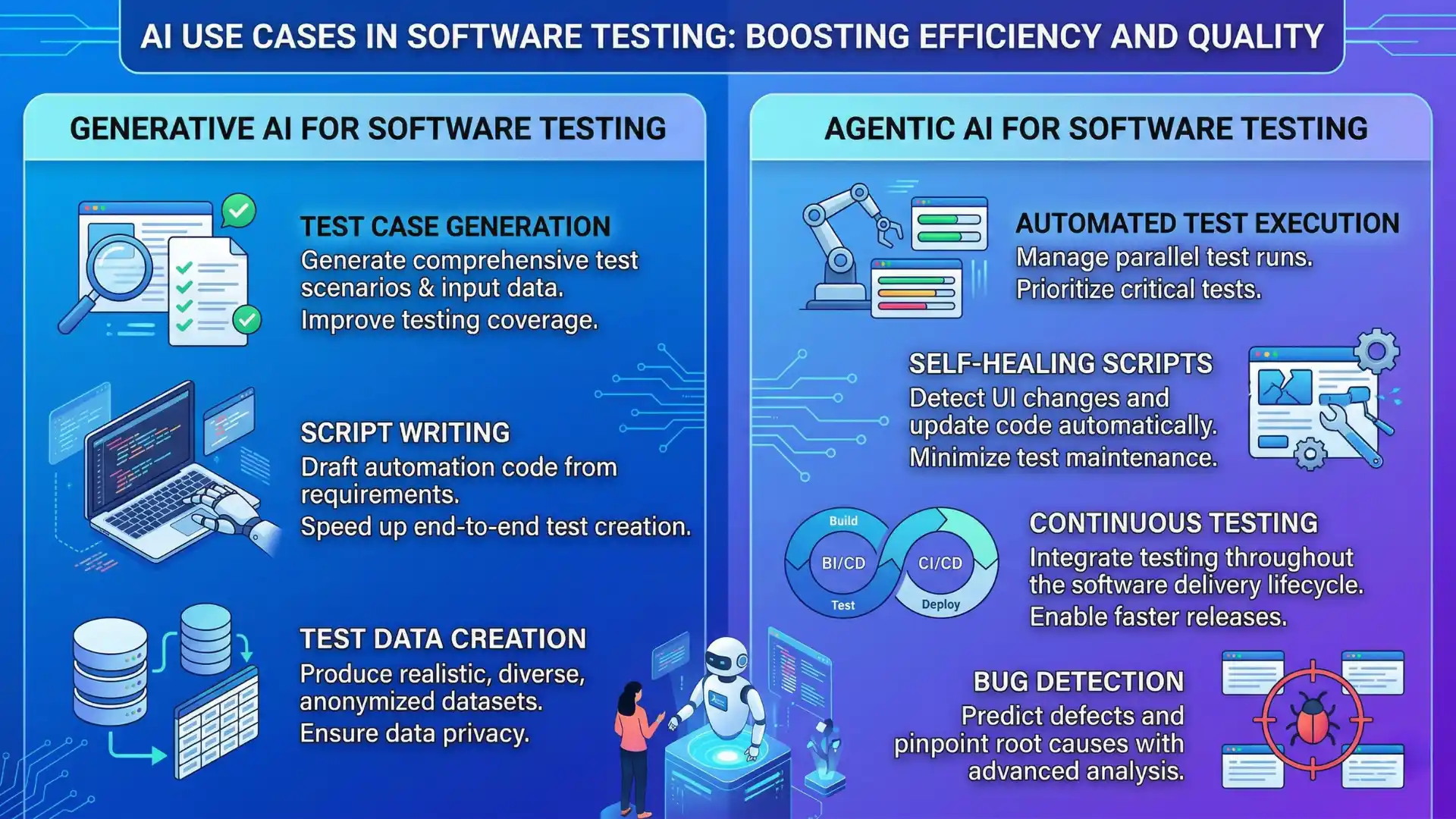
With Generative AI
You can:
- Generate test cases in seconds
- Write Selenium scripts faster
- Create API test scenarios
- Prepare test documentation
With Agentic AI
You can:
- Run full test suites automatically
- Detect and handle failures
- Maintain scripts using self-healing
- Perform continuous regression testing
👉 These capabilities are growing fast in
“Top 10 AI Automation Testing Tools in 2025”
Tools You Should Know
Generative AI Tools:
Agentic AI Tools:
- AutoGPT
- LangChain agents
These tools are shaping the future of selenium automation testing
When Should You Use Each AI?
This is where most people get confused.
Let’s simplify it.
Use Generative AI when:
- You need quick output
- You are writing test cases
- You are creating scripts
- You want to save time
Use Agentic AI when:
- You want automation without manual effort
- You need continuous testing
- You want smart execution
- You aim to reduce human dependency
👉 In real projects, both are used together.

Which One Should QA Engineers Learn First?
Here is the practical roadmap.
Step 1: Start with Generative AI
Why?
- Easy to learn
- Immediate productivity boost
- Useful in daily QA tasks
Step 2: Move to Agentic AI
Why?
- Future-ready skill
- High demand in 2026
- Enables intelligent automation
👉 This approach supports
“How to Accelerate Your Career Growth in QA”
What This Means for Your Career
Software testing is evolving.
Earlier:
- Manual execution
- Script writing
Now:
- AI-assisted testing
- Intelligent automation systems
Future QA Engineers will:
- Use AI to generate tests
- Use agents to execute tests
- Focus on strategy and quality
👉 This shift is already visible in
“Top 10 Software Testing Trends in 2025”
Final Thoughts: The Future of AI in Software Testing
The future of testing is not about choosing one over the other.
It is about combining both.
Generative AI helps you create faster.
Agentic AI helps you execute smarter.
Together, they are transforming AI in software testing.
What Should You Do Next?
- Start using Generative AI in your daily work
- Learn how AI agents operate
- Gradually move toward intelligent automation
QA engineers who adapt to AI will grow faster.
Those who ignore it will fall behind.
FAQs
Is Agentic AI better than Generative AI?
No. Both solve different problems and work best together.
Can Generative AI replace testers?
No. It helps testers but still needs human validation.
Is Agentic AI the future of testing?
Yes. It represents the next evolution of automation.
Which AI should beginners learn first?
Start with Generative AI.
Do QA engineers need AI skills in 2026?
Yes. AI is becoming essential in testing roles.
We Also Provide Training In:
- Advanced Selenium Training
- Playwright Training
- Gen AI Training
- AWS Training
- REST API Training
- Full Stack Training
- Appium Training
- DevOps Training
- JMeter Performance Training
Author’s Bio:

Content Writer at Testleaf, specializing in SEO-driven content for test automation, software development, and cybersecurity. I turn complex technical topics into clear, engaging stories that educate, inspire, and drive digital transformation.
Ezhirkadhir Raja
Content Writer – Testleaf