The conversation around AI in software testing has moved beyond curiosity. In 2026, the real question is no longer whether AI belongs in QA. It does. The more important question is this: which AI tools are truly helping testing teams work faster, think better, and build more reliable automation?
Many articles answer that question with long lists of tools. But that approach often creates more noise than clarity. A smarter perspective is to focus on what genuinely changes testing outcomes. Right now, the most important combination is not an endless stack of AI products. It is the pairing of Generative AI and Playwright.
That is where modern QA teams should pay attention.
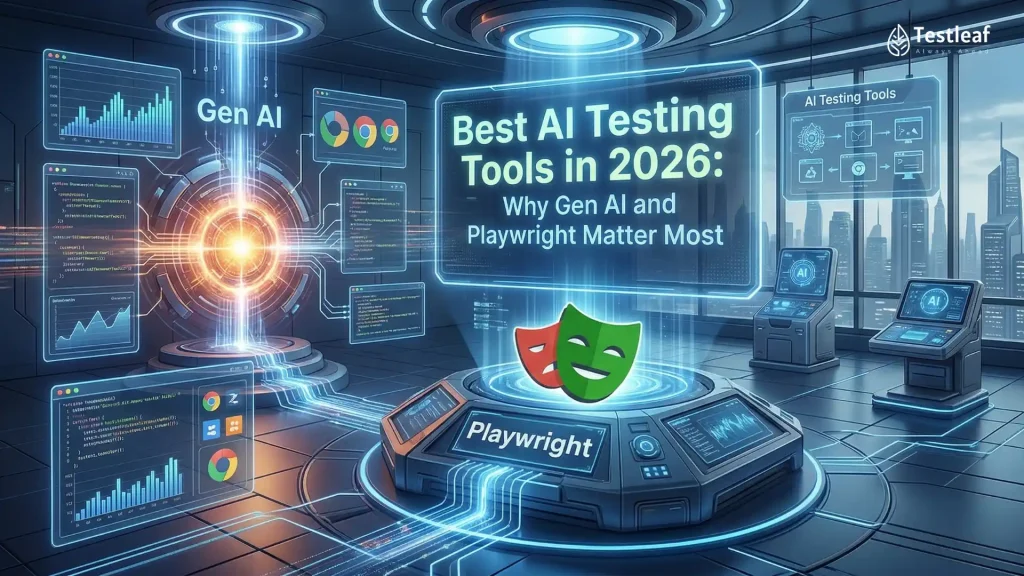
Gen AI is changing how testers generate ideas, design scenarios, analyze failures, summarize bugs, and accelerate repetitive engineering work. Playwright is becoming one of the strongest frameworks for turning those ideas into dependable, modern browser automation. Together, they represent one of the most practical directions in software testing today.
The future of testing will not belong to teams that experiment with every AI-labeled platform. It will belong to teams that know how to use Gen AI for intelligence and speed, and Playwright for reliable execution.
What are the best AI testing tools in 2026?
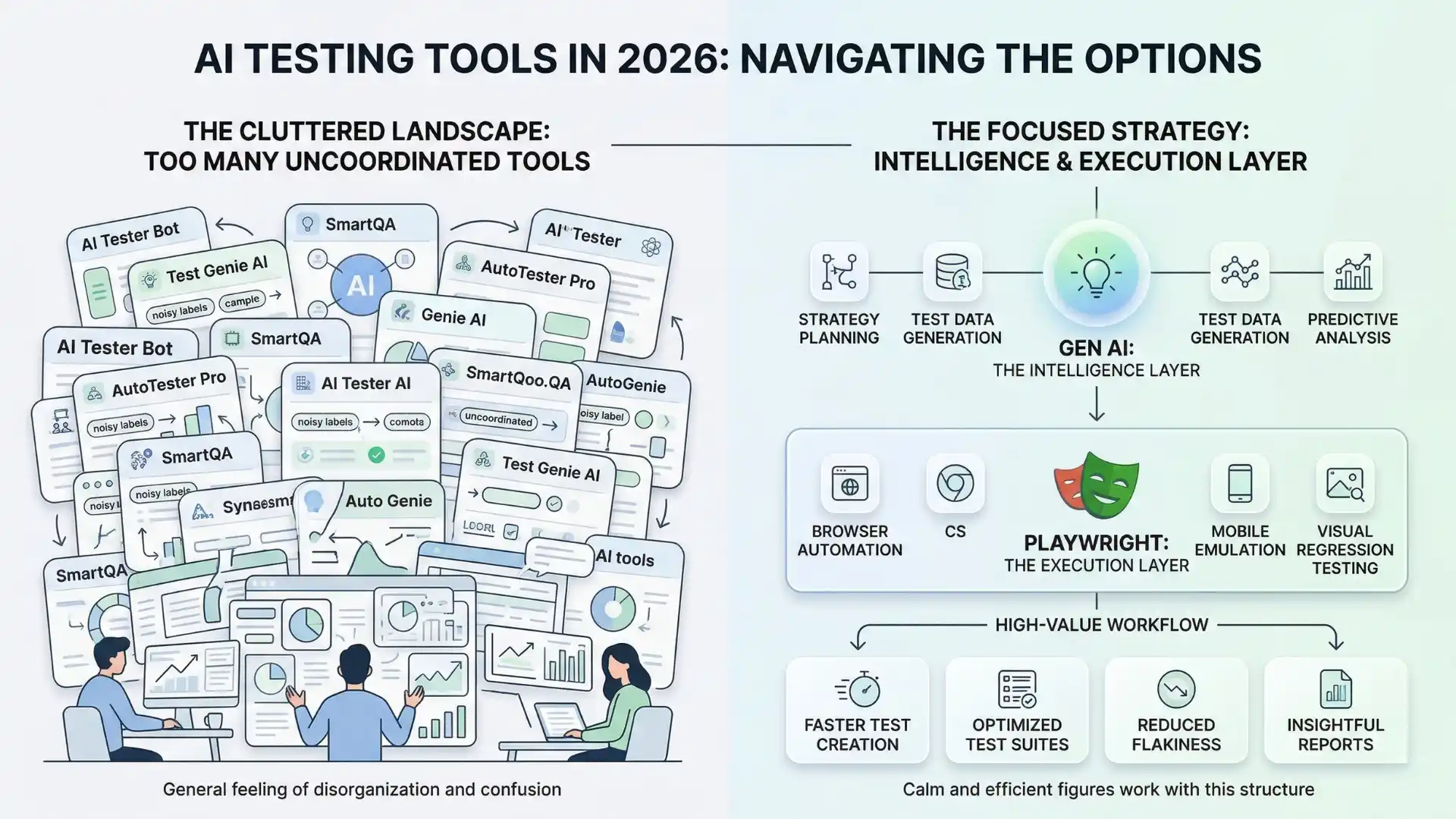
The most practical AI testing strategy in 2026 is not a long list of tools. It is using Generative AI to improve test design, analysis, and debugging, paired with Playwright as a reliable execution framework for modern browser automation.
Key takeaways
-
The best AI testing strategy is not chasing many tools.
-
Gen AI helps testers think faster and reduce repetitive work.
-
Playwright helps teams turn AI-assisted ideas into reliable automation.
-
Dedicated AI platforms can help, but they are usually support layers.
-
Strong QA teams win by combining AI speed, Playwright execution, and human judgment.
What an AI testing tool really means
One reason this topic gets confusing is that the term AI testing tool now covers too many different things. Some tools generate tests from prompts. Some promise self-healing locators. Some focus on visual testing. Some summarize failures. Others claim to create autonomous test workflows.
These are not the same category of solution.
A better way to understand the market is to ask: what job is the tool actually helping the team do?
In practice, most AI testing tools support one or more of these areas:
- test idea generation
- test authoring assistance
- debugging and failure analysis
- synthetic or varied test data creation
- workflow acceleration across the QA lifecycle
Seen this way, the conversation becomes more practical. The real question is not which product has the loudest AI messaging. The real question is whether the tool improves coverage, speed, reliability, and decision-making.
That is why Gen AI and Playwright deserve more attention than a generic “top tools” list.
Other Helpful Articles: playwright interview questions
Why Gen AI matters most in 2026
If one capability is reshaping software testing faster than anything else, it is Generative AI.
Its real value is not just writing code. That is the narrowest way to think about it. Gen AI matters because it changes how testers work with information. It helps convert requirements into test scenarios. It helps identify negative and boundary cases. It helps draft automation code, explain failures, summarize logs, improve bug reports, and expand coverage ideas.
That is a meaningful shift.
In many teams, testing work slows down not only because of scripting effort, but because of analysis effort. Testers move between requirement documents, acceptance criteria, logs, screenshots, traces, browser behavior, and developer conversations before they can build confidence around what to test and how to test it. Gen AI reduces that friction.
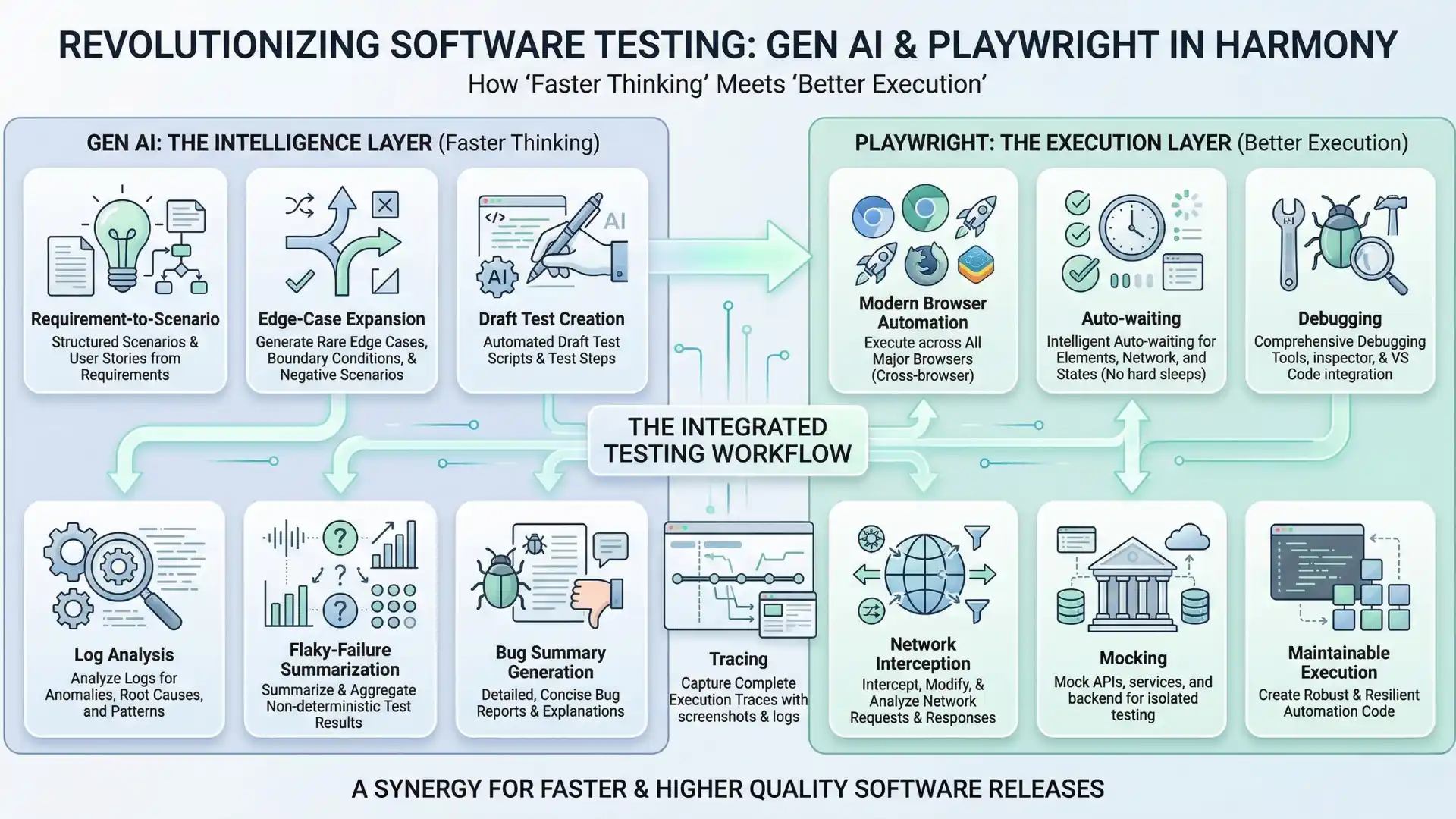
Used well, it can support testers in several high-value ways:
- converting user stories into test scenarios
- expanding positive paths into edge cases
- drafting Playwright test skeletons
- improving readability of tests and assertions
- summarizing flaky failures
- turning raw evidence into clearer bug narratives
- helping learners understand framework patterns faster
That is why Gen AI deserves first priority. It is not just another tool in the stack. It is a productivity layer and a reasoning aid.
At the same time, Gen AI should not be treated like an automatic source of truth. It can generate output that looks polished but misses risk, context, or business meaning. A generated test is not automatically a valuable test. A generated assertion is not automatically the right assertion.
In software testing, fluency is not enough. Evidence matters. Judgment matters. Validation matters.
The strongest teams in 2026 will not use Gen AI to replace testers. They will use it to make strong testers faster and more effective.

Why Playwright is the right execution layer
If Gen AI is the intelligence layer, Playwright is one of the best execution layers for modern automation.
That is why these two fit together so well.
AI can help create faster first drafts of test ideas and automation structures. But those ideas still need to run in a framework that supports reliability, speed, and debugging. This is where Playwright stands out.
Modern web applications are highly dynamic. They depend on asynchronous rendering, API responses, state changes, and browser behavior that can quickly make automation brittle if the framework is weak. Playwright is well aligned to this reality.
Its strengths make it especially valuable for AI-assisted testing:
- modern browser automation
- strong handling of dynamic web behavior
- auto-waiting that reduces many timing-related issues
- traceability for debugging
- network interception and mocking
- support for realistic end-to-end workflows
This matters because AI-generated tests are only useful when they can execute consistently. A prompt may help you create a test quickly, but that speed becomes meaningless if the test turns flaky in CI or becomes difficult to diagnose when it fails.
Playwright helps reduce that gap.
It gives teams a practical foundation for turning AI-assisted test ideas into maintainable automation. A tester can use Gen AI to draft scenarios, improve selector strategy, suggest assertions, or interpret failures. Then Playwright provides the environment to execute and refine those ideas in a way that matches the needs of modern applications.
That combination is powerful because it connects faster thinking with better execution.
Why this combination matters more than chasing many AI tools
The AI testing space is crowded. New tools regularly promise smarter automation, lower maintenance, self-healing capabilities, and faster delivery. Some of those products offer real value. But most teams do not need a strategy built around an ever-growing list of vendors.
They need a foundation.
That foundation should answer three questions:
How do we generate better test ideas and reduce repetitive work?
How do we automate reliably in modern web applications?
How do we increase speed without weakening confidence?
Gen AI answers the first question strongly. Playwright answers the second. Together, they support the third.
This is a more durable strategy than depending entirely on a single platform that claims to do everything. Real QA environments are not that simple. Teams need flexible workflows. They need strong engineering judgment. They need reliable automation. They need AI support that improves quality, not just activity.
That is why Gen AI + Playwright is more important than chasing every new AI tool launch.
Continue Reading: manual testing interview questions
Where dedicated AI testing platforms fit
Commercial AI testing platforms still have a role. Some help with visual validation. Some reduce authoring effort for less technical users. Some focus on maintenance, abstraction, or workflow management.
These tools can be useful. But they should usually be treated as supporting layers, not as the core of modern QA capability.
The real long-term capability comes from knowing how to use Gen AI effectively and how to automate well with a framework like Playwright.
That is the difference between dependency and maturity.
A team that relies entirely on a platform may move quickly at first, but can struggle when debugging depth, customization, or framework control becomes important. A team that understands Gen AI and Playwright builds knowledge that stays valuable even as product trends change.
That is also what makes this perspective evergreen. Specific vendors will change. AI terminology will evolve. New claims will appear. But the need for intelligent workflows and reliable modern automation will remain.
What QA professionals should learn first
For testers, automation engineers, and QA leaders, the key question is not just which tool to buy. It is which skills to build.
The smartest path in 2026 is to first understand how Gen AI can improve daily testing work. Learn how to prompt with context. Learn how to evaluate AI-generated output critically. Learn how to use AI for scenario generation, failure explanation, reporting support, and test design acceleration.
Then build strong Playwright capability.
Learn selectors, assertions, fixtures, tracing, mocking, debugging, and maintainable test design. Learn how to make tests stable, readable, and meaningful.
This combination reflects how real teams work:
- Gen AI helps you think faster
- Playwright helps you automate better
- human judgment keeps quality trustworthy
That is a far more valuable long-term strategy than memorizing a list of AI tool names.
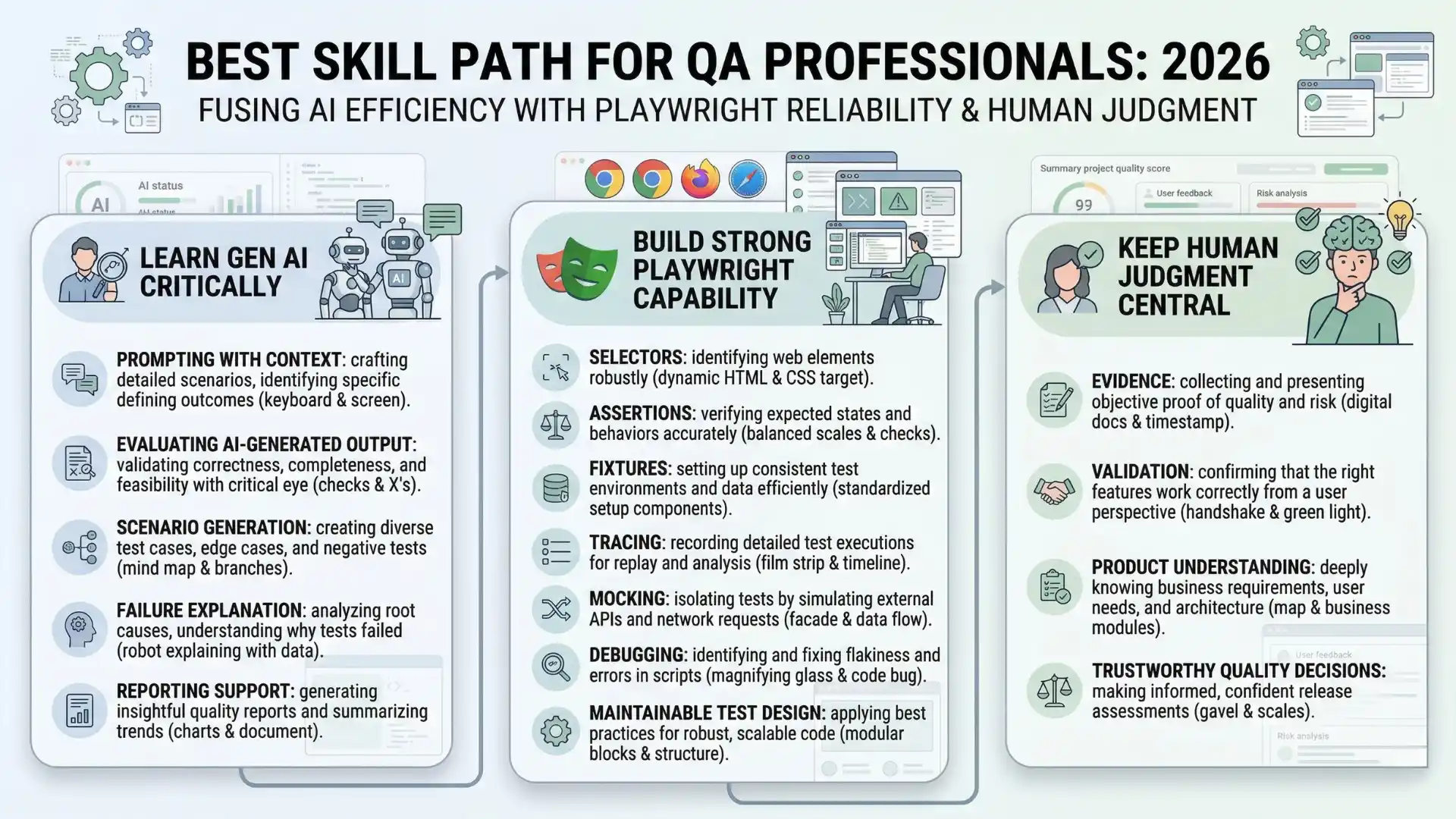
In 2026, the most useful AI testing approach is combining Gen AI for scenario generation, failure analysis, and productivity with Playwright for stable, modern browser automation.
Final takeaway
The future of software testing in 2026 will not be defined by hype alone. It will be shaped by teams that know how to combine intelligence, speed, and reliability in a practical way.
That is why Gen AI and Playwright matter most.
Gen AI matters because it accelerates test design, scenario discovery, debugging support, learning, and communication. Playwright matters because it gives modern teams a dependable framework for turning those AI-assisted ideas into strong automation.
Together, they represent one of the most useful directions in modern QA.
The teams that succeed will not be the ones using AI only for novelty. They will be the ones using Gen AI to think better and Playwright to automate better. That is not just a trend for 2026. It is a practical strategy for building stronger quality engineering teams.
FAQs
What are the best AI testing tools in 2026?
The most practical answer is Generative AI for test intelligence and Playwright for reliable execution. Together, they help teams move faster without weakening quality.
Why does Gen AI matter in software testing?
Gen AI matters because it helps testers generate scenarios, expand edge cases, draft automation, summarize failures, and reduce analysis friction across the QA lifecycle.
Why is Playwright a strong fit for AI-assisted testing?
Playwright is a strong fit because it supports modern browser automation, dynamic web behavior, auto-waiting, debugging, tracing, and realistic end-to-end flows.
Should QA teams depend on one AI testing platform?
Usually not. Dedicated AI platforms can help, but they should be treated as support layers rather than the core of long-term QA capability.
What should testers learn first in 2026?
Testers should first learn how to use Gen AI critically for test design and analysis, then build strong Playwright skills for selectors, assertions, fixtures, tracing, mocking, debugging, and maintainable automation.
We Also Provide Training In:
- Advanced Selenium Training
- Playwright Training
- Gen AI Training
- AWS Training
- REST API Training
- Full Stack Training
- Appium Training
- DevOps Training
- JMeter Performance Training
Author’s Bio:

Content Writer at Testleaf, specializing in SEO-driven content for test automation, software development, and cybersecurity. I turn complex technical topics into clear, engaging stories that educate, inspire, and drive digital transformation.
Ezhirkadhir Raja
Content Writer – Testleaf