

When I started my career in QA, my role was straightforward: execute test cases, log defects, and ensure the application worked as expected. My daily life revolved around manual testing, clicking through screens, and chasing bugs. At the time, I saw QA as reactive—a checkpoint between development and release.
Fast forward several years, and my perspective has completely transformed. Today, as a Senior SDET, my role isn’t just to find bugs; it’s to strategize, architect, and future-proof QA processes. I’ve learned that effective testing is as much about designing robust frameworks, leveraging automation, and enabling fast releases as it is about executing test cases. Here’s a glimpse into my journey from tester to strategist.
The Early Days: Learning the Foundations
In the beginning, QA was all about manual validation. I remember spending hours:
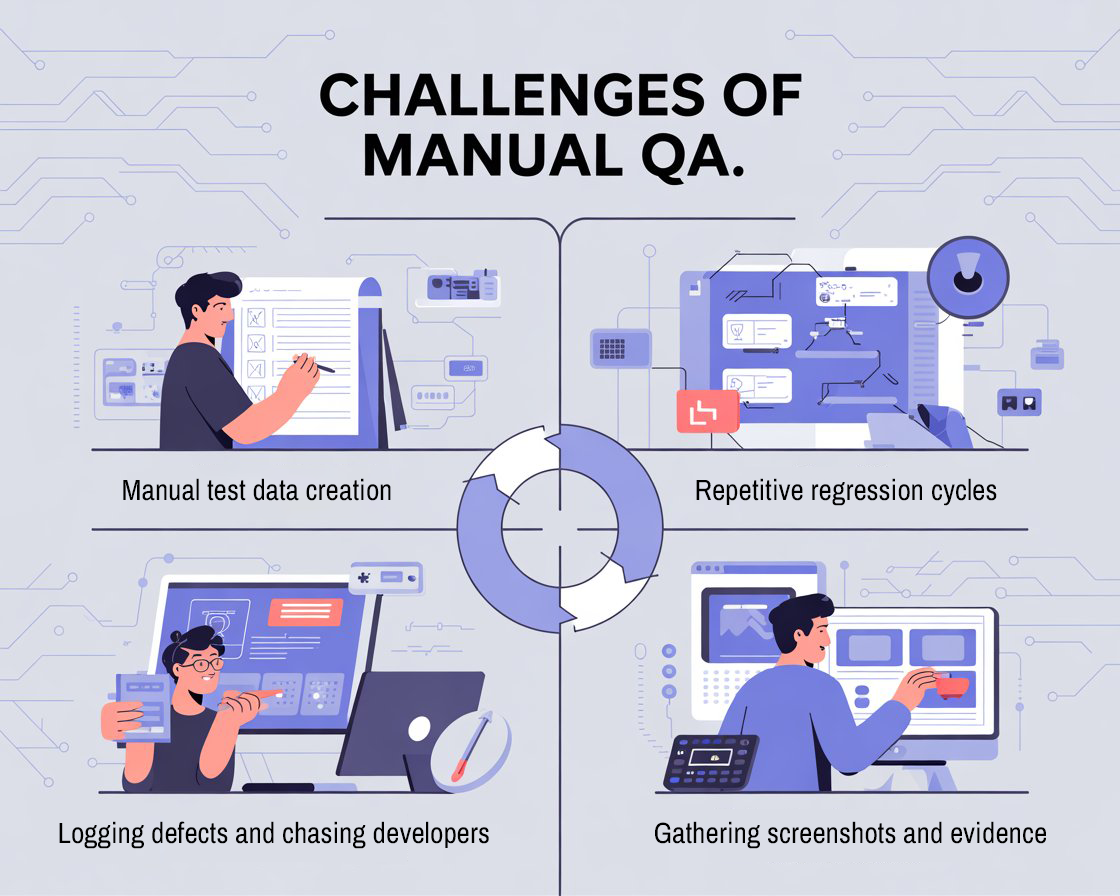
- Creating and managing test data manually
- Running repetitive regression cycles
- Logging defects and chasing developers for clarifications
- Manually gathering screenshots and evidence for release sign-offs
While these tasks taught me the fundamentals of testing, they also highlighted the limitations of a purely manual approach:
- Test coverage was limited
- Regression cycles were slow
- Feedback loops were delayed
- Defect reproduction was time-consuming
These challenges sparked my curiosity: Could we do more with automation? Could QA play a bigger, strategic role in ensuring software quality?
Check Out These Articles: api testing interview questions
Embracing Automation: The First Step Toward Strategy
The first turning point in my journey was embracing test automation. I began by:
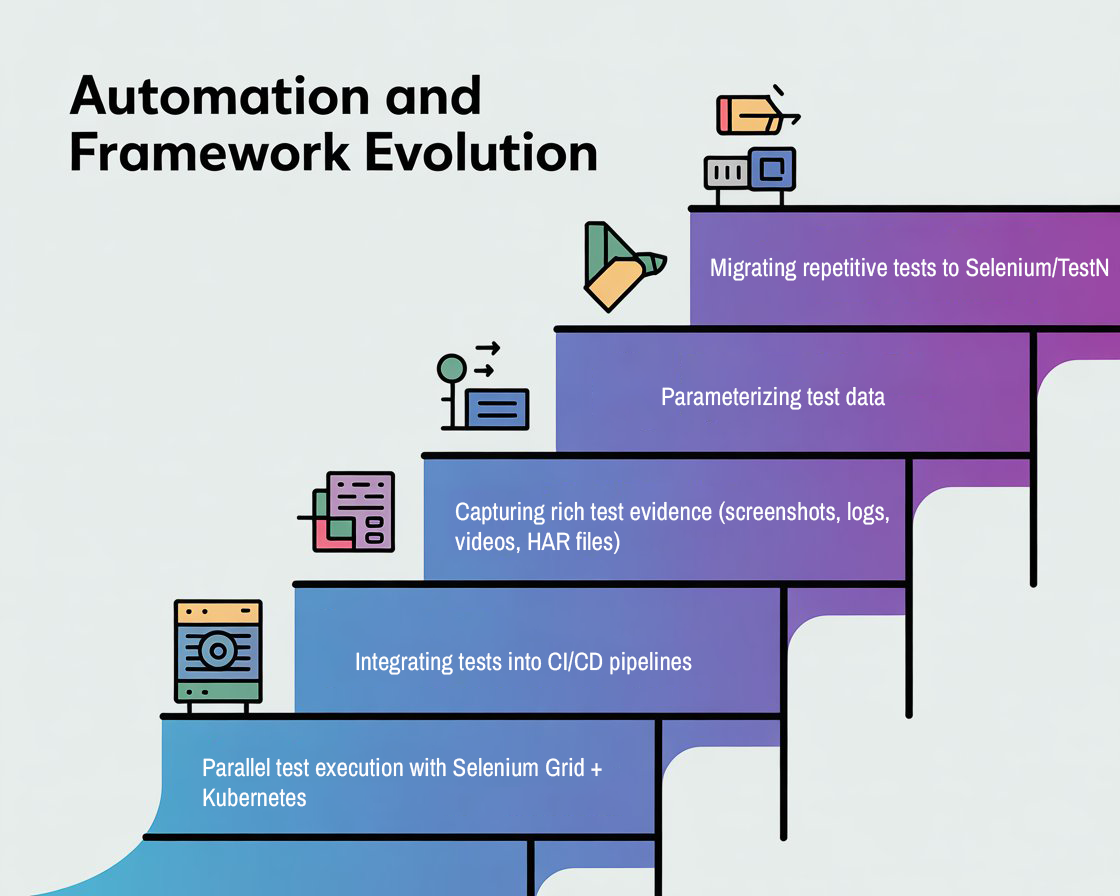
- Migrating repetitive regression tests to Selenium and TestNG
- Parameterizing test data to remove hard-coded values
- Capturing test evidence through screenshots, logs, and eventually video recordings
- Integrating automated tests into a CI/CD pipeline
Automation didn’t just speed up testing—it changed the way QA worked:
- Regression cycles became faster and more reliable
- Defects were detected earlier in the development process
- Evidence was centralized and actionable
- Flaky tests could be identified and fixed systematically
This shift taught me that automation wasn’t just a tool—it was a strategic enabler. QA could now influence release quality, velocity, and risk management.
You Might Also Like: 100 manual testing interview questions
Building Frameworks: From Execution to Engineering
Once I was comfortable with automation, I realized that framework design was critical. It wasn’t enough to automate tests; they had to be:
- Maintainable – easy to update when the application changed
- Scalable – able to run across multiple environments, browsers, and devices
- Reliable – producing consistent results without false positives or flaky failures
To achieve this, I focused on:
1. Page Object Model (POM)
Organizing tests into reusable page objects reduced duplication and made maintenance easier. It also enabled modular and scalable test design.
2. Data Centralization
Hard-coded test data was replaced with centralized data sources, ensuring consistency across all tests and environments.
3. Parallel Test Execution
By leveraging Selenium Grid and Kubernetes, tests could run concurrently across multiple environments, drastically reducing execution time.
4. Rich Test Evidence
We moved from simple screenshots to HAR files, video recordings, and logs, providing actionable evidence for developers and stakeholders.
By building a robust framework, QA moved from execution-focused to engineering-focused, enabling faster, more reliable releases.

Strategic QA: Thinking Beyond Test Cases
As I advanced in my career, I began to see QA not just as a gatekeeper, but as a strategic partner in product development. Here’s how my focus shifted:
1. Risk-Based Testing
Instead of testing everything equally, I learned to prioritize high-risk areas, focusing on critical workflows, edge cases, and integrations with third-party services.
2. Negative and Edge-Case Testing
We expanded coverage beyond happy paths to include negative testing and edge-case scenarios, ensuring the system could handle unexpected inputs and failures gracefully.
3. CI/CD Integration
By integrating automated tests into CI/CD pipelines, QA became continuous, proactive, and real-time, providing developers with instant feedback on every commit.
4. Data Security and NWB Accounts
We introduced Non-Warm Body (NWB) accounts for test execution, eliminating the use of personal credentials and reducing the risk of data breaches in pipelines.
5. Evidence-Driven Decision Making
With centralized dashboards, HAR files, and execution videos, QA could provide actionable insights, enabling leadership and developers to make informed release decisions quickly.

Through these strategic initiatives, QA evolved from being reactive to being proactive, predictive, and influential.
Leadership and Mentoring
Becoming a Senior SDET also meant taking on a mentorship and leadership role. My responsibilities expanded to:
- Guiding junior testers on automation best practices
- Architecting test frameworks to support long-term scalability
- Advocating for QA in product discussions, ensuring quality is considered early in development
- Driving continuous improvement by analyzing pipeline metrics, flaky tests, and defect trends
Leadership isn’t just about managing tasks—it’s about shaping processes, influencing culture, and enabling team success.
Other Useful Guides: Reason for a job change
Lessons Learned Along the Journey
- Automation Is Strategy, Not Just Execution
Automation isn’t about replacing manual testers; it’s about enabling QA to focus on strategy, coverage, and risk mitigation. - Evidence Drives Confidence
Screenshots, videos, logs, and HAR files are not optional. They build trust and enable faster defect resolution. - CI/CD Is a QA Game-Changer
Integrating tests into CI/CD pipelines transforms QA from reactive to continuous and proactive, catching defects before they escalate. - Framework Design Matters
A robust, scalable, and maintainable framework is critical for long-term QA efficiency and effectiveness. - QA Can Be a Strategic Partner
When QA focuses on risk, coverage, and evidence, it evolves into a role that shapes product quality, release confidence, and team success.
Conclusion
Looking back, my journey from a manual tester to a Senior SDET has been transformative. QA is no longer just about executing test cases—it’s about strategy, engineering, and leadership. By embracing automation, building robust frameworks, integrating with CI/CD, and leveraging evidence-driven insights, QA can influence product quality, accelerate releases, and enable confident decision-making.
From my perspective, a Senior SDET isn’t just a tester; they are a strategist, engineer, and leader—someone who ensures that quality is built into the software from day one.
For anyone aspiring to grow in QA, my advice is clear: move beyond execution, embrace automation, and think strategically. That’s how you transition from being a tester to a QA leader who drives real impact.
FAQs
Q1. What is a Senior SDET and how is it different from a tester?
A Senior SDET goes beyond executing test cases. They design automation frameworks, integrate tests into CI/CD, use rich test evidence and influence release strategy, acting as both engineer and quality strategist rather than only a manual executor.
Q2. How did you move from manual testing into automation?
I started by automating repetitive regression tests with Selenium and TestNG, parameterising test data, capturing screenshots and logs, and integrating suites into a CI/CD pipeline. This shift made testing faster, more reliable and more impactful on release decisions.
Q3. Why is framework design so important for an SDET?
A good framework makes tests maintainable, scalable and reliable. Using patterns like Page Object Model, centralized test data, parallel execution and rich evidence helps teams run large suites across environments without constant firefighting.
Q4. How did your mindset change when you became a Senior SDET?
My focus moved from “Did this feature pass?” to “Are we testing the right risks in the right way?” That meant risk-based testing, negative and edge cases, CI/CD integration, secure test accounts and evidence-driven decision making.
Q5. What role does a Senior SDET play in leadership and mentoring?
A Senior SDET mentors junior testers on automation best practices, architects long-term frameworks, represents QA in product discussions and drives continuous improvement by analysing flaky tests, pipeline metrics and defect trends.
Q6. What advice do you have for testers who want to become SDETs?
Don’t stop at execution. Learn automation, understand frameworks, get comfortable with CI/CD and think in terms of risk, coverage and strategy. That’s how you move from tester to true QA leader and strategist.
We Also Provide Training In:
- Advanced Selenium Training
- Playwright Training
- Gen AI Training
- AWS Training
- REST API Training
- Full Stack Training
- Appium Training
- DevOps Training
- JMeter Performance Training
Author’s Bio:

Content Writer at Testleaf, specializing in SEO-driven content for test automation, software development, and cybersecurity. I turn complex technical topics into clear, engaging stories that educate, inspire, and drive digital transformation.
Ezhirkadhir Raja
Content Writer – Testleaf