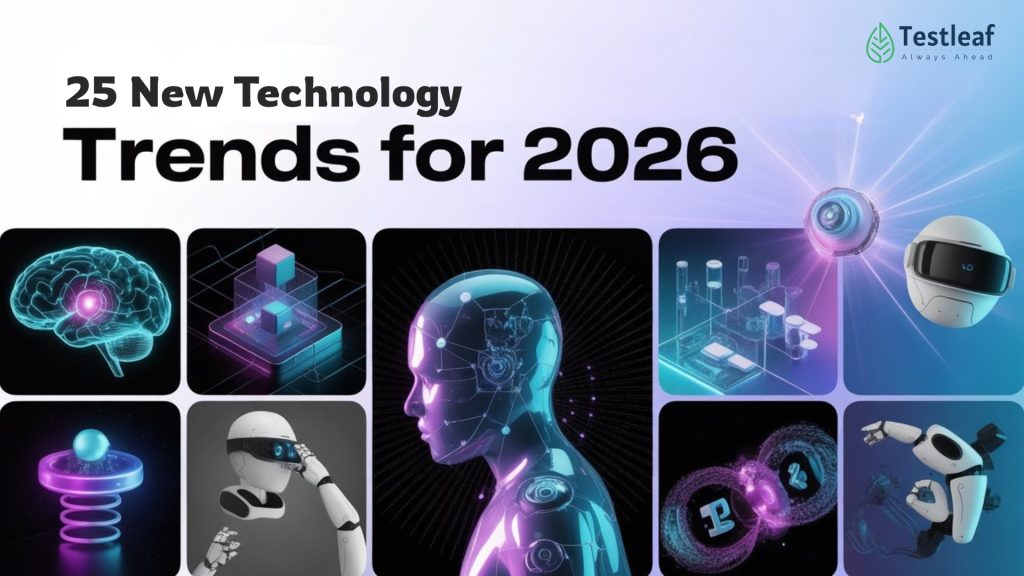
Technology is not just changing tools; it is changing how organizations think, build, test, and deliver software. By 2026, companies will no longer ask whether to adopt advanced technologies. Instead, they will ask how fast they can adapt without losing quality, security, or trust.
This article explores 25 new technology trends for 2026 in a detailed, practical, and career-focused manner. Unlike surface-level trend lists, this guide explains why each trend matters, how it affects businesses, and what it means for professionals, especially in software testing and QA.
If your goal is higher visibility, stronger authority, and long-term relevance, this is the roadmap you need.
1. Agentic AI: Autonomous Systems That Act and Decide
Agentic AI represents a major shift from traditional AI tools. These systems can analyze goals, plan actions, execute tasks, and learn from outcomes without constant human input.
Business impact:
Organizations will use agentic AI to manage workflows, monitor systems, and optimize processes autonomously.
Career impact:
Professionals will focus more on supervising, validating, and governing AI decisions rather than executing repetitive tasks.
2. Enterprise-Grade Generative AI
By 2026, generative AI will be deeply embedded in enterprise systems. It will generate code, test cases, documentation, reports, and even business insights.
Business impact:
Productivity increases dramatically, but only when AI outputs are validated and governed.
Career impact:
Understanding how to review, validate, and integrate AI-generated outputs becomes a critical skill.
3. AI-Driven Software Testing (A Core 2026 Trend)
Testing will no longer rely solely on scripted automation. AI will analyze application behavior, predict defects, generate tests, and adapt to changes automatically.
Business impact:
Faster releases, fewer production failures, and lower testing costs.
Career impact:
QA roles evolve into AI-enabled quality engineers who focus on strategy, risk, and intelligence.
4. Predictive Quality Engineering
Instead of finding defects after they occur, AI models will predict failure points using historical data, usage patterns, and system behavior.
Business impact:
Organizations fix issues earlier, reducing rework and downtime.
Career impact:
Testers move upstream, influencing design and architecture decisions.
5. Low-Code and No-Code Application Development
Business users will create applications using drag-and-drop platforms, while IT teams ensure scalability and quality.
Business impact:
Development speed increases, but testing complexity also rises.
Career impact:
Automation testing, integration testing, and AI validation become essential.
Other Helpful Articles: automation testing interview questions
6. AI-Augmented DevOps Pipelines
DevOps pipelines will use AI to forecast deployment risks, suggest optimal release windows, and prevent failures.
Business impact:
Continuous delivery becomes more stable and predictable.
Career impact:
QA professionals collaborate closely with DevOps teams, contributing quality insights.
7. Intelligent Test Data Management
AI will generate realistic, compliant test data automatically, eliminating dependency on production data.
Business impact:
Improved data privacy and faster testing cycles.
Career impact:
Testers gain more control over data quality and coverage.

8. Cloud-Native First Architecture
Applications will be designed for cloud scalability from the start, using microservices and containers.
Business impact:
Systems become more flexible but also more complex.
Career impact:
Testing distributed systems becomes a core QA responsibility.
9. Edge AI and Edge Computing Expansion
Processing data closer to devices reduces latency and improves performance.
Business impact:
Real-time applications become more reliable.
Career impact:
Testers validate performance across devices, networks, and environments.
10. AI as a Mandatory QA Skill
AI knowledge becomes a baseline expectation.
Business impact:
Quality improves through intelligence.
Career impact:
Traditional testing roles transform into strategic positions.
11. AI in Data Science: LLM-Powered Analytics and AutoML 2.0
AI is shifting Data Science from building every model manually to getting answers faster using LLM copilots + AutoML pipelines. Analysts can explore data in natural language, spot anomalies, and generate dashboards/narratives with less repetitive work.
Business impact:
Faster insights, lower analytics cost, and more consistent governance.
Career impact:
Data roles move toward data quality + monitoring (MLOps/LLMOps) and AI-assisted analytics.
12. Extended Reality (AR, VR, and MR)
XR technologies move beyond entertainment into training, healthcare, and industrial applications.
Business impact:
Better simulations and immersive user experiences.
Career impact:
Testing expands to usability, motion, and multi-sensory validation.
Dive Deeper: playwright interview questions
13. Digital Twins for Safer Testing
Digital twins create virtual replicas of applications, systems, and infrastructure.
Business impact:
Organizations test extreme scenarios safely.
Career impact:
QA teams design advanced test simulations.
14. Data Fabric and Unified Data Architecture
Data will flow seamlessly across platforms in real time.
Business impact:
Faster insights and better decisions.
Career impact:
Data accuracy and integration testing become crucial.

15. Real-Time Analytics as a Standard
Static reports will be replaced by live dashboards.
Business impact:
Businesses respond instantly to issues.
Career impact:
Quality metrics are monitored continuously.
16. AI-Powered Cybersecurity
Security systems will detect and respond to threats automatically.
Business impact:
Reduced breach impact and faster recovery.
Career impact:
Security testing integrates into daily QA workflows.
17. Zero-Trust Security Models
Every request is verified, regardless of location.
Business impact:
Stronger security posture.
Career impact:
Authentication and access testing gain importance.
18. AI Governance and Responsible AI
Governments and enterprises will demand transparency and fairness in AI systems.
Business impact:
Compliance becomes mandatory.
Career impact:
QA validates not just outputs, but ethics and bias.
Also, Know More About: api testing interview questions
19. Sustainable and Green Software Engineering
Energy-efficient applications and carbon-aware infrastructure become priorities.
Business impact:
Sustainability metrics influence software design.
Career impact:
Performance testing includes environmental impact.
20. API-First and Headless Architecture
APIs become the foundation of applications.
Business impact:
Better scalability and integration.
Career impact:
API automation testing becomes essential.
21. Natural Language Interfaces Everywhere
Users interact with systems through voice and text.
Business impact:
Improved accessibility and usability.
Career impact:
Testing conversational accuracy becomes critical.

22. Intelligent Automation (AI + RPA)
Automation systems learn and optimize over time.
Business impact:
Operational efficiency improves continuously.
Career impact:
Manual repetitive work reduces significantly.
23. Industry 4.0 and Smart Manufacturing
Factories adopt AI, robotics, and IoT.
Business impact:
Higher efficiency and lower errors.
Career impact:
Testing crosses software and physical systems.
Continue Reading: manual testing interview questions
24. Continuous Testing in Production
Testing does not stop after release.
Business impact:
Issues are detected early.
Career impact:
QA becomes a lifecycle responsibility.
25. Skill-Based Hiring Models
Employers prioritize hands-on skills over degrees.
Business impact:
Faster hiring and better performance.
Career impact:
Practical experience and certifications matter more.
Conclusion
The future described by these 25 new technology trends for 2026 is not optional—it is already unfolding. Organizations that succeed will be those that combine automation, intelligence, and responsibility. For QA and testing professionals, this transformation is a massive opportunity. Mastering AI in software testing enables faster releases, smarter defect prevention, and long-term career relevance.
To help you lead this transformation, we invite you to our exclusive webinar:
AI Master Class for QA Professionals
Learn how AI is reshaping test automation, quality engineering, and real-world testing strategies. Gain practical insights, live demonstrations, and future-ready skills from industry experts.
Register today and become a future-ready QA professional.
FAQs
Q1. What are the key technology trends for 2026?
This guide covers 25 trends shaping 2026, including agentic AI, enterprise-grade generative AI, AI-driven software testing, predictive quality engineering, low-code/no-code, cloud-native architectures, edge AI, AI-powered cybersecurity and more
Q2. Why do these 2026 technology trends matter for QA and testing teams?
Many of these trends directly impact how software is built and validated. AI-driven testing, predictive quality engineering, digital twins, continuous testing in production and AI as a core QA skill all push testers toward more strategic, data-driven quality engineering roles.
Q3. How will AI change software testing by 2026?
AI will help generate test cases, predict defects, create realistic test data, analyse logs and support continuous testing. Instead of only scripting automation, QA engineers will supervise intelligent systems, validate AI outputs and focus on risk, coverage and ethics in testing.
Q4. Which other areas of tech will be most influenced by these trends?
Beyond testing, the article highlights changes in data (data fabric, real-time analytics), DevOps (AI-augmented pipelines), cybersecurity (AI-powered defence, zero trust), architecture (cloud-native, API-first, headless) and user experience (natural language interfaces, XR, Industry 4.0).
Q5. What do these trends mean for individual careers?
The shift is toward skill-based hiring and AI-literate roles. Professionals who understand these technologies, especially AI in testing and quality engineering, will be better positioned for future-ready careers and leadership opportunities. Hands-on skills and continuous learning matter more than just degrees.
Q6. How can professionals start preparing for 2026 technology trends today?
Start by learning the basics of AI, cloud, APIs and automation; get hands-on with tools in your current role; follow enterprise GenAI and AI governance practices; and invest in courses or webinars focused on AI and quality engineering to stay ahead of the curve.
We Also Provide Training In:
- Advanced Selenium Training
- Playwright Training
- Gen AI Training
- AWS Training
- REST API Training
- Full Stack Training
- Appium Training
- DevOps Training
- JMeter Performance Training
Author’s Bio:

Content Writer at Testleaf, specializing in SEO-driven content for test automation, software development, and cybersecurity. I turn complex technical topics into clear, engaging stories that educate, inspire, and drive digital transformation.
Ezhirkadhir Raja
Content Writer – Testleaf